 Kitful
The 11 Best SaaS Onboarding Tools, Compared
2,140 words · 4 internal links · 2 images · researched from 14 sources
In your voice, on your blog. You approve it first.
Kitful finds what your customers search, writes it in your voice, and publishes on your schedule. Then it watches Search Console and improves the pages that slip.
What to write, what to cover, which sources to trust. So the post waits for a weekend that never comes.
They sound like everyone else’s blog and miss your product, so you rewrite them anyway.
The pages you already rank with decay while you write new ones. Nothing is watching them.
Kitful compares live search results with what your site already covers. Write one topic now, or map the whole area into a plan.
See how Research worksSet a daily limit, a credit cap, and where finished articles go. Keep the topic backlog yourself, or let Autopilot fill it.
See how Campaigns workChoose the format and language first. Voice, internal links, images, and publishing all happen in the same place.
Both are set before Kitful starts writing, never converted afterwards.
Article type
Guide · English
An in-depth article organized around the reader’s problem.
Train it from your published posts, a URL, or a file.
VocabularySuggestion to review
Prefer “sign up” over “register.”
Suggested from your edits to “The SaaS onboarding guide.”
Links point at pages you actually have.
…works best when onboarding emails and product tours support each other…
Pick once, and every article follows it.
You get the last look before anything goes live.
Scheduled publishing
Thursday, 9:00 AM
WordPress · Your local time
Publish to
Four complete articles, one per format, generated by Kitful end to end: research, writing, internal links, and images. Unedited.
Written by Kitful
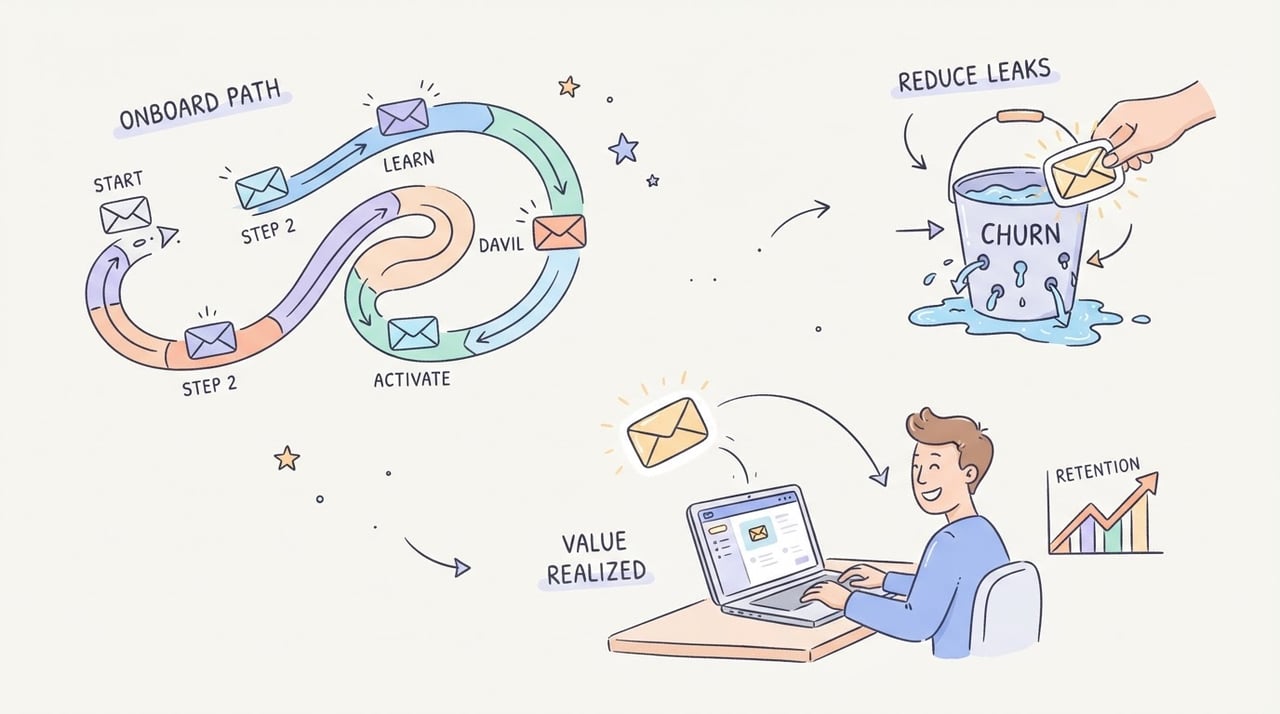
Did you know 90% of new signups who don't engage with your product in the first three days will churn? That's not a typo. Poor onboarding alone is responsible for 40% to 60% of all early B2B SaaS churn. Meanwhile, a structured onboarding process can boost overall retention by 50%. So the real question is not whether you need an onboarding email sequence. It's whether you can afford to keep sending that same generic "Thanks for signing up" message and hoping for the best. If your onboarding is just a welcome mail and a few random tips, you're leaving money on the table. Your onboarding email sequence is your biggest retention lever. Treat it like one.
Shift from signup to activated user by matching each email to a real behavior trigger.
Before you copy a single template, lock in the rules.
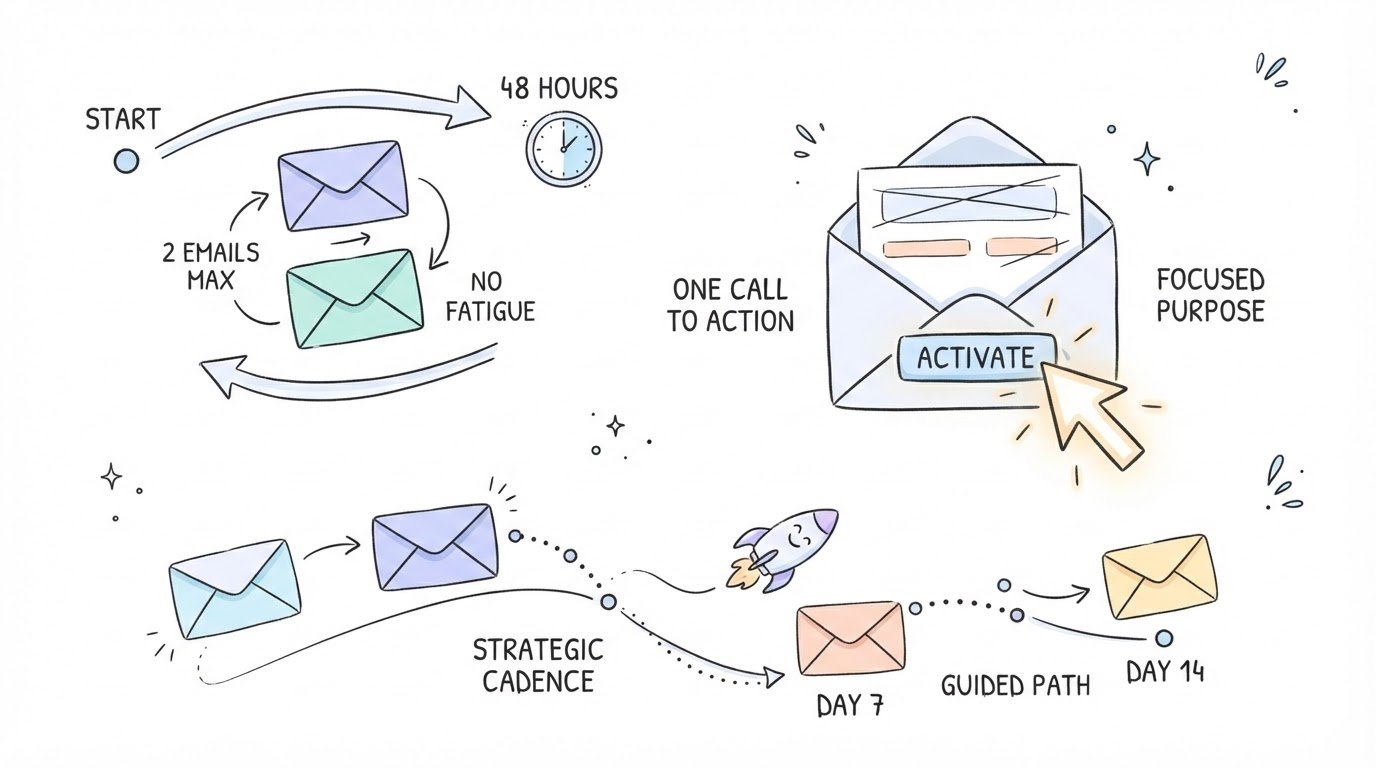
First, never send more than two onboarding emails in the first 48 hours. Inbox fatigue is real, and eager marketers often kill activation by being noisy.
Second, one email gets exactly one CTA. More choices do not mean more clicks. They mean fewer.
Third, prioritize behavior triggers over calendar drips. A Userpilot study found that personalization by behavior drives a 35% lift in 7-day retention compared to flat day-based sequences.
Quick rule: If a user already finished the action, suppress the email entirely. Sending a "complete your setup" nudge to an active user is how you train them to ignore your domain.
The core difference between transactional notifications and strategic onboarding campaigns is intent. The former confirms an action. The latter engineers the next one. Build for the latter. If you are starting from zero, map your emails to a 14-day timeline. Days 1 through 3 are for recovery and setup. Days 4 through 14 are for habit formation and value proof. Anything after day 14 without a payment event is likely noise.
Send this email within five minutes of signup. Not an hour later. Not tomorrow. Five minutes.
The goal is to hijack peak motivation and point it at exactly one action. Grammarly does this perfectly. They don't welcome you with a feature list or a dashboard tour. They ask you to install the browser extension. That is the activation step.
Why it works is simple. New users suffer from choice paralysis. If you give them three buttons, they click none.
The tradeoff is real. If your single action is technically heavy or irrelevant, users will bounce before they ever see value. Choose the smallest step that proves your core promise.
Grammarly focuses its entire welcome experience strictly on getting the browser extension installed. One button. One outcome.
Metric to watch: First-Action Completion Rate.
You can grab raw sequence frameworks from DigiStorms if you need a starting template.
Trigger this 24 hours after signup, but only if the critical setup step is still incomplete. It is a recovery email, not a scheduled broadcast.
This works because it addresses the exact friction point. Dropbox uses direct, permission-based language like "don't ignore this setup step" to recover stalled setups. The email names the specific block and offers a clear path past it.
The risk is your data pipeline. If event tracking lags, you end up nagging users who already finished. That burns trust fast.
A quick tip: keep the subject line specific. "Finish connecting your calendar" beats "Your account needs attention" every time. Segment the recipient by the exact missing step and personalize the body to match. Generic recovery emails feel like spam.
Metric to watch: Setup Completion Rate.
If this email does not recover at least 15% of stalled users, your setup flow is too complex, not just your copy.
Send a plain-text email from the founder's address between day 3 and day 5. No HTML. No logo. Just text.
It works because it shatters the corporate marketing voice. You are asking for raw feedback about product friction, and that honesty builds a relationship that no branded newsletter can match.
The scaling problem is obvious. One founder cannot personally email thousands of trial users. You can automate the send and route replies to customer success, but the personal touch thins out as volume grows.
A good founder check-in reads like this: "Hey, I noticed you signed up for Acme yesterday. What are you hoping to build this week? Hit reply and let me know. I read every response." That's it. No images. No links. Just a question.
Metric to watch: Direct Reply Rate.
If you want to collect that feedback without building a custom form, you can learn how to design frictionless user surveys that fit naturally into early customer success workflows using Minform.
Ship this mid-trial, or as a recurring weekly summary. It highlights the passive value the app already generated for the user.
This is the show-don't-tell principle. Grammarly's weekly writing stats are the classic example. "You wrote 4,200 words this week and caught 37 tone issues." That is value the user created without thinking about the tool.
The downside is integration depth. You need clean analytics and event tracking to calculate these numbers accurately. If your product data is a mess, this email is hard to build.
Bitly uses personalized, dynamic to-do checklists that update based on what the user has already completed. That is value receipt meets progress visualization.
Metric to watch: DAU/MAU Retention and Habit Loops.
If users open this email but do not return to the product, the metrics you are showing are probably vanity, not value.
Fire this only after the user has completed their personal first win. Not before.
The logic is lock-in. Once a user experiences individual value, shifting the account to team utility makes the product sticky. It drives viral loops and increases switching costs.
Push it too early, and you look desperate. No one invites coworkers to a tool they do not personally trust yet.
Pitfall: Never send the teammate invite before the user has completed their personal activation milestone. If they haven't felt the "aha" moment, inviting colleagues reads like spam.
Metric to watch: Referral or Invite Send Rate.
If your invite rate is low, the problem is usually your activation milestone, not your invitation copy. Focus on deepening the personal win before you ask for network expansion.
Send this immediately when the user hits a core benchmark. Not the next morning. Immediately.
Positive reinforcement builds dopamine associations with your tool. The user starts to crave the next milestone. The data says structured onboarding workflows can drive a 50% increase in overall user retention, and behavior-triggered emails that adapt to real-time context outperform rigid time-based drips. When the celebration arrives the instant the accomplishment happens, the brain links the tool directly to the win, and the user starts anticipating the next dopamine hit.
The danger is vanity. Celebrating "You logged in three times" is hollow fluff. Celebrating "You closed your first 5 tasks two days ahead of deadline" is real business value.
A project management tool might trigger this when a user archives their first completed project. The subject line reads "You just shipped your first project. Here is what to tackle next." That is momentum. It reinforces the behavioral loop and tees up the next logical action without choice paralysis.
Metric to watch: Product Feature Adoption Depth.
Superficial milestones signal a product team that does not understand its own value. Choose benchmarks that map to customer outcomes, not internal activity. If your milestone email only tracks surface-level activity, you miss the deeper signal. Product Feature Adoption Depth reveals whether users are embedding advanced capabilities into their workflow or merely scratching the surface. Make the milestone meaningful, celebrate the business outcome in the subject line, and the dopamine will follow.
Send this exactly 3 days before trial expiration. Not a week before. Not the day of.
It works because of loss aversion. Humans fear losing what they already have more than they desire gaining something new. Your job is to remind them exactly what configurations, data, or work they will lose access to. "Your 3 dashboards, 12 connected integrations, and 48 imported leads" is far more effective than "Your trial ends soon." This is the core principle behind the honest trial-end email: warn users of upcoming expiration and list the specific data or configurations they stand to lose if they do not upgrade.
Quick rule: be specific about the data loss. Generic warnings get ignored because they do not trigger the same emotional response.
The tradeoff is a forced binary yes/no decision. If the user is not activated yet, this email can accelerate a churn they might have delayed. That risk is real, but failing to warn users about what they will lose is a common onboarding mistake that leaves money on the table. CopyHackers research shows that trial sequences leading with tangible value before pitching upgrades retain customers at significantly higher rates. Keep this email to one job and one clear upgrade call to action. No feature lists, no secondary links.
Metric to watch: Trial-to-Paid Conversion Rate.
If this email converts under 5%, your trial is probably too long or your activation gap is too wide. Use that signal to shorten the trial or tighten your activation milestones before the next cohort.
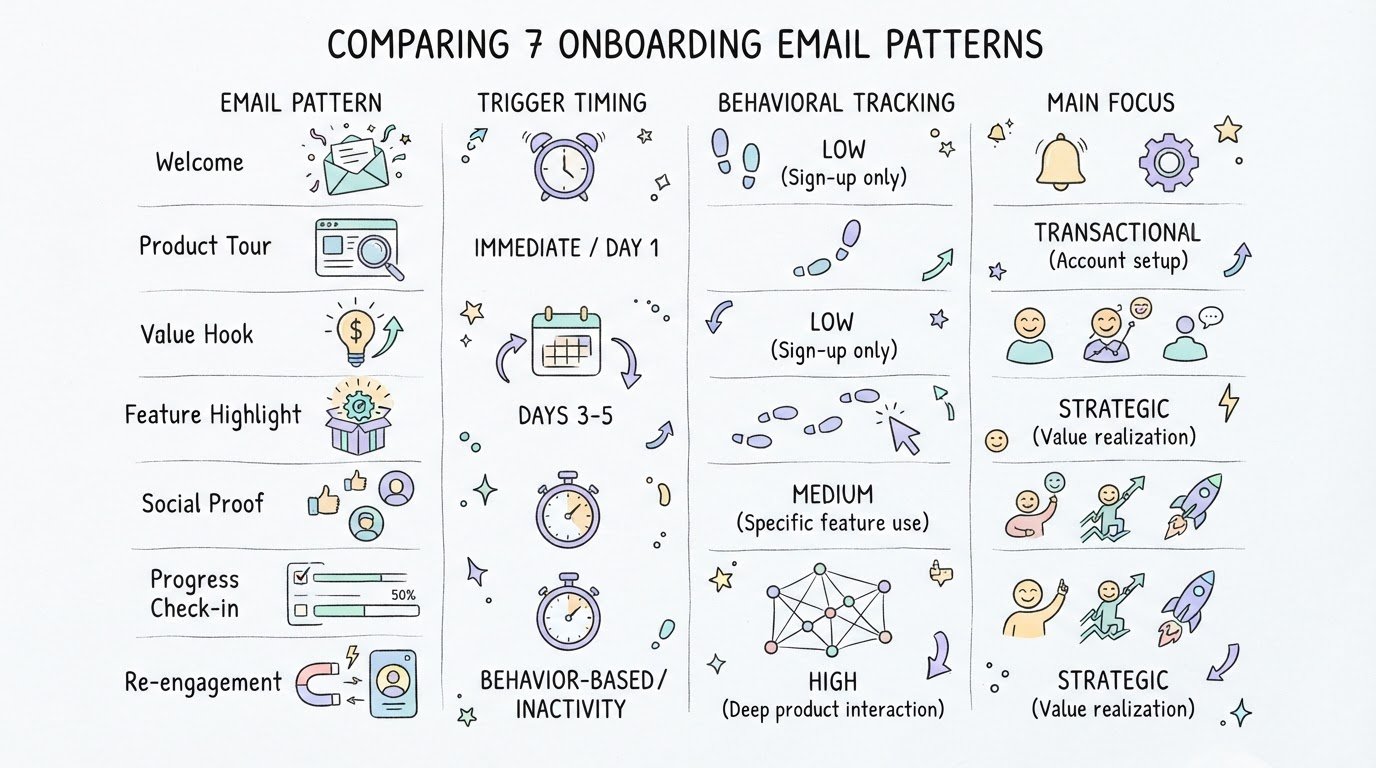
Here is how the seven emails stack up when you are deciding what to build first.
| Email Type | Trigger Timing | Tracking Complexity | Main Focus |
|---|---|---|---|
| Single-action welcome | Immediate post-signup | Low (signup event) | One activation CTA |
| Unfinished-setup nudge | 24h if setup incomplete | Medium (progress flags) | Recover stalled momentum |
| Founder check-in | Day 3 to 5 | Low (time or segment) | Human feedback and trust |
| Value receipt | Mid-trial or weekly | High (usage analytics) | Prove passive ROI |
| Teammate invite | After first personal win | Medium (activation flag) | Account lock-in and virality |
| Usage milestone | Real-time on benchmark | Medium (feature events) | Reinforce habit loops |
| Honest trial-end | 3 days before expiration | Low (trial timestamp) | Loss aversion conversion |
The pattern is clear. Early emails need minimal tracking but high urgency. Later emails require solid event instrumentation and drive real retention. If your analytics are basic, start with the welcome and the setup nudge. Layer the rest as your tracking matures.
This is where most teams stall. They want to personalize the founder check-in or segment the welcome flow by user intent, but they have no clean JTBD data from the signup process.
You can fix that by embedding a lightweight survey directly into your onboarding flow. Not a clunky multi-page form. A single, doc-style question that feels like part of the product.
You can create feedback forms and surveys with AI directly inside your onboarding flow. Minform generates inputs from plain text prompts, supports slash commands, and branches the next question based on the previous answer. It looks like a Notion doc, so users actually fill it out instead of bouncing.
A quick tip: ask one JTBD question during signup, then branch your email sequence based on the answer. Minform's conditional logic handles that without writing code.
Reducing signup-to-activation friction is exactly what a zero-friction interface solves. If you are guessing at user intent, you are already losing the personalization battle.
A welcome email is a single transactional message. A programmatic onboarding campaign is a behavior-triggered sequence engineered to move a new signup from registration to their first activation milestone. One says hello. The other does the job. Campaigns include suppression logic, multiple touchpoints, and dynamic content based on product usage.
Aim for 5 to 8 emails spread across 10 to 21 days. Any shorter and you miss key recovery moments. Any longer and you are training users to ignore your sender name. The exact length depends on your trial length, but 5 to 8 emails is the sweet spot for most B2B SaaS tools.
Because they respond to the user's actual state. A date-based drip congratulates you for importing data you have not imported yet. Behavior triggers suppress irrelevant messages and only nudge when the user genuinely needs help. That relevance is why they drive a 35% retention lift over calendar drips. Customer.io covers this in more detail if you want to dig deeper.
Your onboarding sequence is the only marketing flow that talks to users when they actually care. Stop treating it like a newsletter.
Pick one stalled metric today, wire the nudge, and ship it before lunch. Note that at the time of writing, most entry-level ESPs still treat behavior triggers as advanced features, so plan for a tooling upgrade if your stack is too basic. That's it.
$39per month250 credits
Every feature is on both plans.
Cancel anytime.
Anything we missed? Write to us and a founder answers.
Tell Kitful what your customers search. Read the article it writes, then decide.
Try Kitful before paying. No card required.