BlogEntity Clarity for Gemini: Leveraging Google’s Knowledge Graph for AI Overview Dominance
Entity Clarity for Gemini: Leveraging Google’s Knowledge Graph for AI Overview Dominance
Traditional SEO is dead; long live the Entity. Learn how to transition from keyword-matching to entity-mapping to dominate Google's AI-powered search landscape.
•12 min read
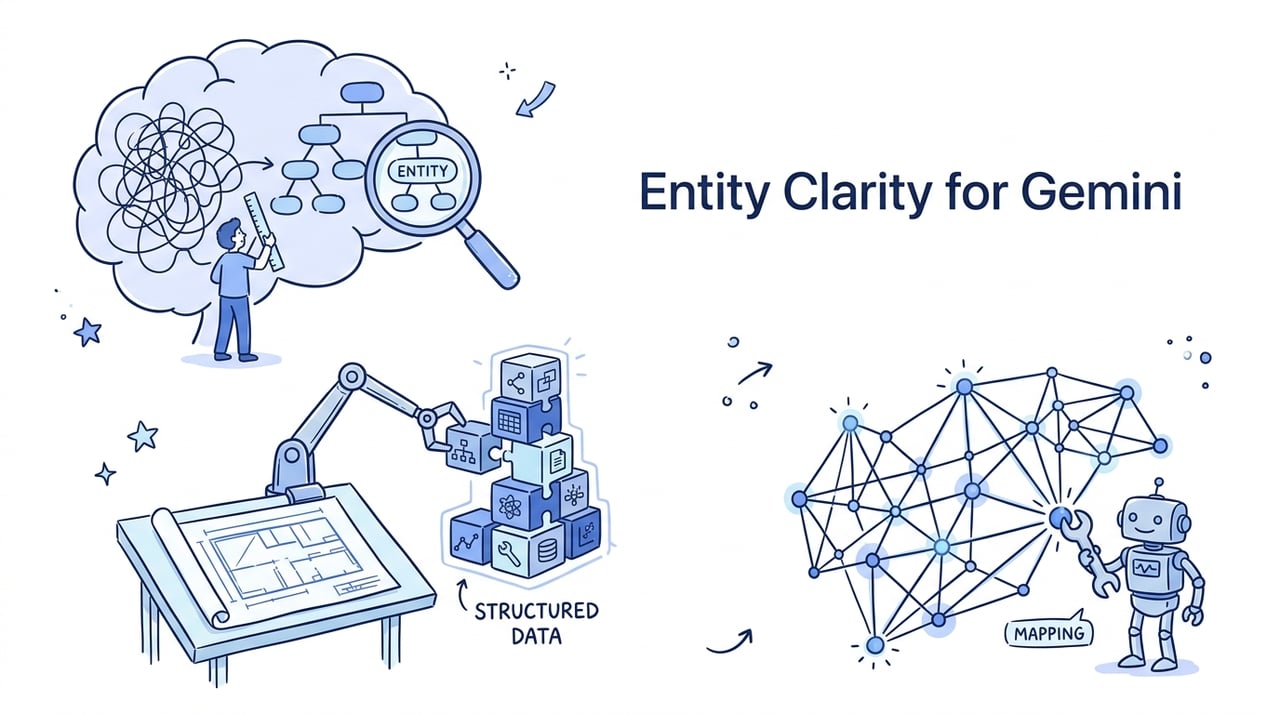
93% of search sessions in AI Mode now end without a single click-through to a website. The era of the blue link is dying as Gemini and other LLMs shift from processing 'strings' (keywords) to 'things' (entities). If your brand remains a collection of keywords rather than a recognized node in the Knowledge Graph, your organic visibility will likely vanish by the end of 2026.
Traditional SEO strategies are seeing an average 61% decline in click-through rates when an AI Overview is present. This is not a temporary dip in traffic but a fundamental shift in how information is retrieved and consumed. The search engine has evolved into a reasoning engine that prioritizes sources it can verify as entities.
You must stop optimizing for ranking positions and start optimizing for citation frequency within AI-generated answers. The goal is no longer just to be on page one, but to be the primary 'source of truth' that the LLM uses to construct its response. This requires a level of structural clarity that traditional content marketing has never had to provide.
Those who fail to adapt will find themselves on the wrong side of the digital divide. If your brand is not in the AI answer, you do not exist for that query on that device. Success in this new landscape depends entirely on your ability to map your content to the Google Knowledge Graph.
The New SEO Reality: Bottom Line Up Front
Traditional search is a volume game, but AI search is a trust game where being a 'citable source' is the only way to win. Even with zero-click sessions rising, the traffic that does come through is far more valuable. Conversion rates for traffic sourced from AI citations are 4.4x higher than traditional search traffic.
Gemini uses the Knowledge Graph as its primary reasoning substrate for every response.
Prioritize canonical IDs like Wikidata to give your brand a permanent identity in the entity web.
Proprietary data moats, such as live APIs or first-party surveys, are your only defense against content demotion.
Programmable content must be treated as a product discipline, not just a writing task.
Being the first-cited source in an AI answer is more valuable than holding positions 2 through 5 combined.
This system ensures your content is self-contained and authoritative enough to pass the 'Island Test' for any given query.
What Is Gemini Knowledge Graph Entity SEO?
Entity SEO is the process of defining your brand, people, and concepts as unique, disambiguated objects within the Google Knowledge Graph. Unlike keywords, which can be ambiguous, entities have stable identities that Gemini can verify across multiple sources. This shift is highlighted in the Ahrefs Study: AI Overview Impact on CTR, which notes how structured information dominates the new interface.
When Gemini generates an answer, it doesn't just look for words; it looks for nodes with high authority and clear relationships. Citations have become the new backlinks in the age of generative search. If the AI uses your data as its reasoning source, you are winning the search war even if the user never leaves the chat interface.
Understanding how Google views your brand as an entity is no longer optional for ranking in the AI era.
This walkthrough explains the shift from keyword density to Knowledge Graph optimization.
Google favors established entity authority that is grounded in its own index. To build this authority, you must provide consistent web mentions that reinforce your identity. Gemini prioritizes 'things' that have canonical IDs and verifiable connections to other trusted entities.
The context of your information matters more than the frequency of your keywords. By mapping your content to the Wikidata: The Entity Web framework, you provide the machine-readable breadcrumbs Gemini needs to trust your site. This is the foundation of becoming a permanent fixture in the Knowledge Graph.
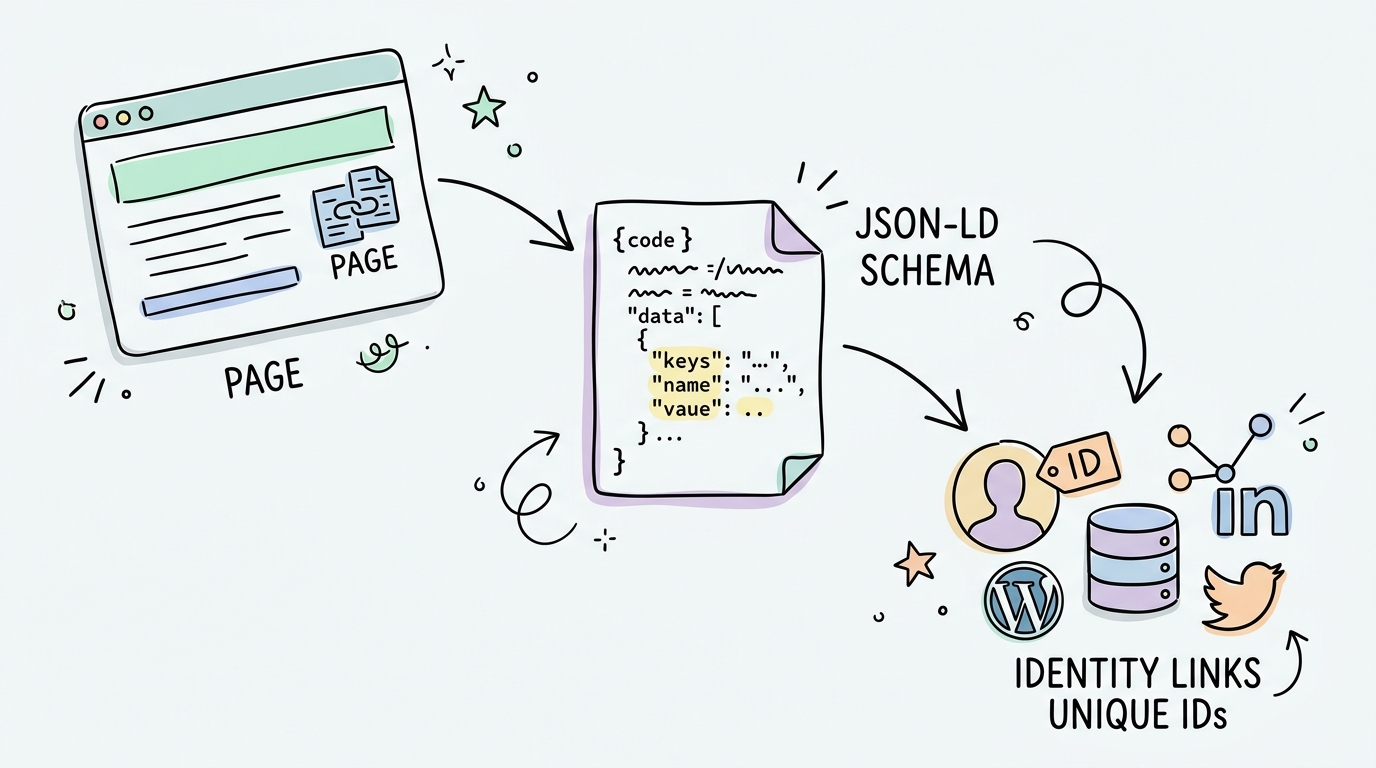
To establish entity clarity, you must start with the code that defines your site for machines. You are not just building a page; you are defining a node in a global database. This requires precise JSON-LD schema that points to stable identity claims across the web.
Linking your entity to Wikidata or Wikipedia profiles removes any ambiguity about who you are. Every page you publish must reinforce this primary identity claim to avoid confusing the AI. You can use tools like Kitful AI to generate schema-ready content that maintains this structural integrity automatically.
Define the primary canonical entity for every page using Organization or Person schema.
Link the entity to a stable identity claim using the sameAs property.
Implement bidirectional internal linking between your pillar pages and clusters.
Embed human-trust signals like author credentials and proprietary data directly into your templates.
Add FAQ and HowTo schema to highlight specific passages for AI extraction.
Ensure your name, address, and phone number (NAP) are consistent across all platforms.
Verify your Google Business Profile (GBP) as it serves as the primary data source for local entities.
Use Wikidata to generate a unique ID for your brand if one does not already exist.
Audit your internal links to ensure they create a readable topical graph for crawlers.
Include hard-coded trust badges and certificates in your footer templates.
Tip: Use the 'Knowledge Panel Test' by searching your brand name. If a panel doesn't appear, your entity isn't strong enough yet. Focus on building Wikidata entries and third-party mentions before scaling your content volume further.
Strategic Components For AI Dominance
Dominating AI search requires a specific set of content components designed for machine extraction. You need to provide 'anchors' that Gemini can grab and display within its overview panels. This is the heart of Answer Engine Optimization (AEO).
Definitional Opening
Every page should begin with a concise, factual sentence that defines the topic. Gemini often lifts these sentences verbatim to provide the summary at the top of an AI response. The goal is to provide the 'perfect answer' in the first 150 characters.
Layered Paraphrasing
To avoid being flagged as thin or repetitive, use layered paraphrasing to break predictable syntactic patterns. This is where Kitful AI excels, humanizing your technical data so it sounds natural while preserving the facts. Machine-detectable patterns can lead to content demotion in the March 2026 update environment.
Pillar-Cluster-Bridge Model
Instead of isolated articles, build a topical graph where every piece of content is a bridge to another entity. This creates a dense network of information that Gemini can navigate easily.
Cluster Pages: Specific sub-entities or features (e.g., 'Gantt Chart Automations').
Bridges: Content that links different topical clusters together to show topical depth.
Proprietary Data: Lists, tables, or charts derived from your own internal research.
Trust Badges: Verified credentials and author bios that prove real-world expertise.
Rule: If a sentence does not provide a factual claim or a semantic signal, delete it. Fluff is a signal of low-quality content to Gemini's reasoning engine.
Traditional SEO vs. AI-Era Strategy
The shift from traditional search to the AI era changes every metric you track. You can no longer rely on ranking positions as the sole indicator of success.
Feature
Traditional SEO
AI-Era Strategy
Primary Goal*******
Ranking positions (1-10)
Citation frequency in AI answers
Core Metric*******
Click-Through Rate (CTR)
Share of Voice (SoV) in Overviews
Success Signal*******
High keyword density
Entity clarity and Knowledge Graph nodes
User Intent*******
Keyword matching
Semantic reasoning and context
Content Style*******
Long-form articles
Self-contained authoritative answers
Traffic Type*******
Direct search clicks
Citation-driven high-intent traffic
Moat Type*******
Backlink profile
Proprietary datasets and E-E-A-T
Performance tracking now focuses on how often your brand is cited as a reasoning source. This requires a move away from 'strings' toward a focus on verifiable 'things'. Traffic from AI citations might be lower in volume, but the quality and conversion potential are significantly higher.
Programmatic Scaling Without Penalties
Programmatic SEO is no longer just a content strategy; it is a product discipline. The March 2026 update by Google makes it clear that mass-producing thin pages will lead to immediate penalties for site reputation abuse. You must follow the Google Search Central: Site Reputation Abuse Policy to ensure your scaled content remains safe.
Zapier provides the ultimate model for this approach. They manage over 25,000 landing pages by treating each software integration as a unique, data-rich entity node. Each page is a structured answer to a specific 'how-to' query involving real-time data.
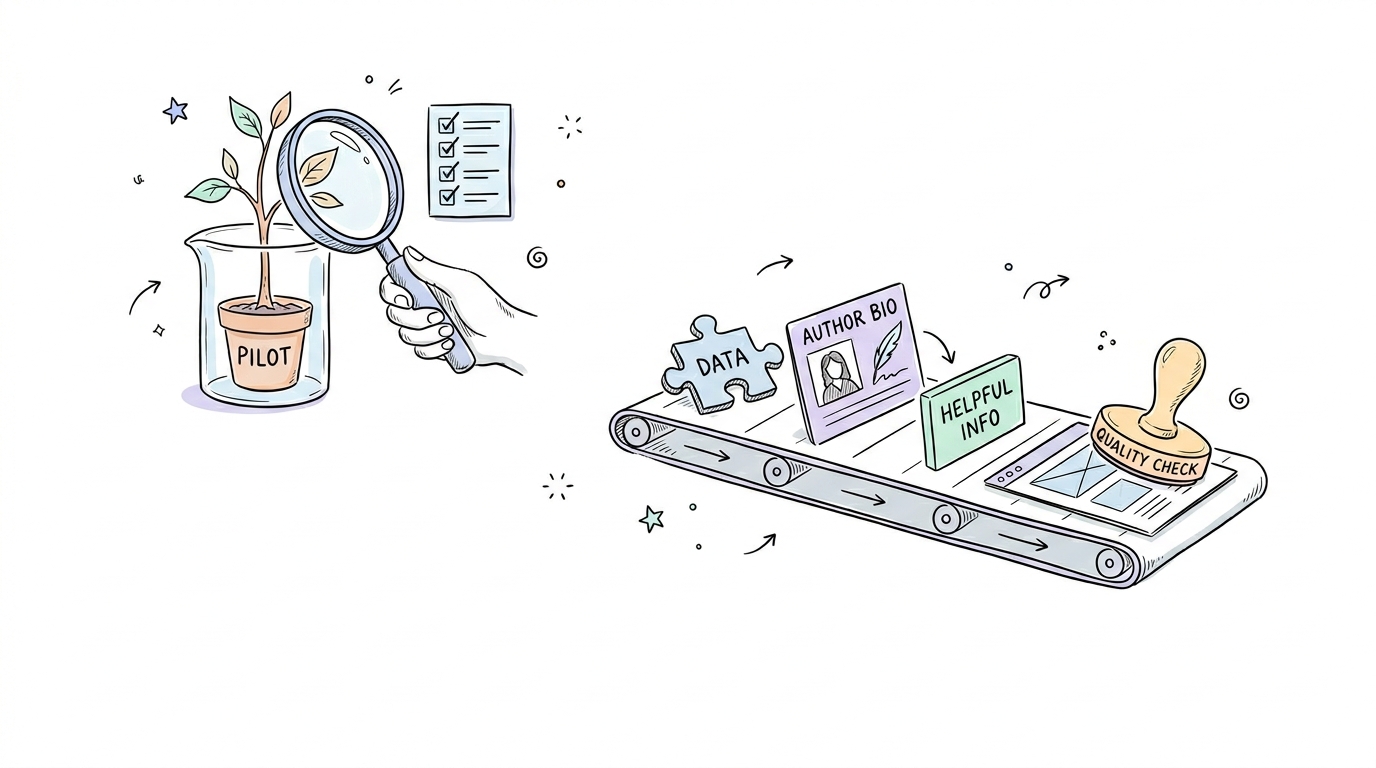
Start with a pilot batch of 50 pages to validate your data and quality gates.
Embed human-trust signals, such as verified author credentials, directly into your page templates.
Use proprietary datasets, like your own internal usage stats or pricing APIs, to create a data moat.
Implement a phased validation approach before scaling to 1,000 or more pages.
Monitor GSC for 'Natural Language' query impressions to see if your programmatic pages are triggering AI Overviews.
Using a tool like Kitful AI allows you to automate the research and drafting process while ensuring each page is humanized and fact-checked. This keeps you on the right side of the quality guidelines while maintaining a high publishing velocity. Scaling without a quality gate is the fastest way to get your entire domain de-indexed.
Avoid the mistake of publishing thousands of pages instantly. Instead, use a batch-launching strategy that proves each set of pages provides unique value. Gemini rewards content that demonstrates real-world expertise and punishes material that looks mass-produced.
Every template you use should include data-driven triggers. If you are a real-estate site like Zillow, your pages should pull live cost-of-living data rather than just generic descriptions. This makes your content 'useful' to the AI reasoning engine, which prefers structured, factual data for its summaries.
The 90-Day Freshness Cycle And Share Of Voice
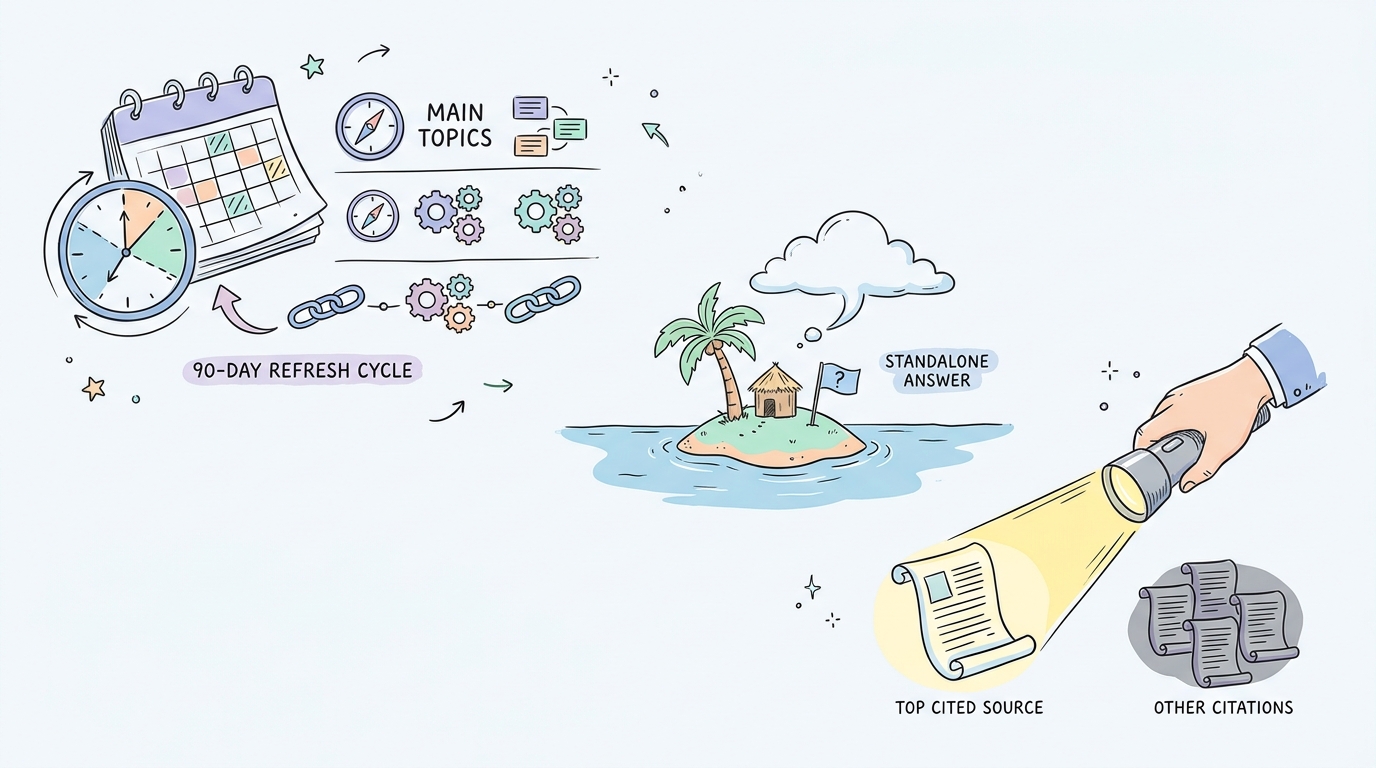
The search landscape in 2026 is highly volatile, with informational topics evolving rapidly. To remain a cited source, your content must adhere to a strict 90-day freshness cycle. Gemini prioritizes information that has been updated recently to ensure its answers reflect the current state of the world.
Being the first-cited source in an AI response is worth more than holding the next four positions combined. This concentration effect means you must constantly refresh your entity signals. Use the 'Island Test' to evaluate your content: it must be self-contained enough to serve as a standalone answer without requiring the user to click anywhere else.
Update Pillars: Refresh your main category pages every 30 days with new data.
Refresh Clusters: Update sub-topic pages every 60 days to reflect new trends.
Monitor SoV: Track your Share of Voice in AI answers to see if you are losing ground to competitors.
Verify Citations: Ensure the AI is still attributing the correct facts to your brand.
Bridge Gaps: Create new content for any semantic gaps where your competitors are being cited instead of you.
If your informational traffic drops by 20% or more, it is time to pivot to Answer Engine Optimization (AEO). This involves restructuring your pages to be more extraction-friendly for LLMs. Freshness is not just about the publish date; it is about the relevance of the underlying data nodes.
Verification: Testing Your Entity Authority
Verifying your authority requires looking beyond traditional rank trackers. You need to confirm that Google's systems recognize your brand as a distinct entity and are using it as a source of truth. This starts with the Schema.org: Organization Vocabulary and ends with analyzing natural language queries in Search Console.
If you search your brand and a Knowledge Panel appears, then your entity is successfully established.
If your impressions for 'Natural Language' queries are rising, then Gemini is likely using your content in AI Overviews.
If you are cited as a source in a zero-click answer, then your 'Island Test' score is high.
If your CTR is falling but your conversion rate is rising, then your AI citation strategy is working.
If your schema fails the Google Rich Results Test, then you must fix your JSON-LD immediately.
If you haven't updated a page in 90 days, then you are at risk of losing your citation status.
Tracking Share of Voice is the only way to measure SEO success in the generative era. Use GSC to filter for long-tail, question-based queries and see where your brand appears in the citation list. This data tells you exactly which entities need more strengthening.
Frequently Asked Questions
How do AI Overviews affect my website traffic?
AI Overviews can lead to a significant decline in traditional clicks, with some reports showing a 61% drop. However, the users who do click through are usually further down the funnel and convert at a much higher rate. The goal is to capture the 'Share of Voice' within the answer to maintain brand authority.
What is a canonical entity in SEO?
A canonical entity is a unique, disambiguated identity for a person, place, or thing that is recognized by the Google Knowledge Graph. It is often linked to a permanent record on Wikidata or Wikipedia. Establishing this identity prevents Google from confusing your brand with others.
Is programmatic SEO still safe in 2026?
Yes, but it must be treated as a product discipline rather than a content-spinning tactic. Following the March 2026 Site Reputation Abuse policy is critical. Pages must be data-rich, humanized, and provide unique value that cannot be found elsewhere to avoid penalties.
How often should I update my SEO content?
For evolving informational topics, you should aim for a 90-day refresh cycle. Gemini and other AI models prioritize fresh data for their reasoning. If your content becomes stagnant, you risk losing your spot as a cited source in AI Overviews.
Do I need a Wikidata entry for my brand?
While not strictly required, a Wikidata entry is the strongest signal you can send to Google to define your entity. It provides a machine-readable ID that helps link all your web mentions together. It is a foundational step for strengthening your position in the Knowledge Graph.
Winning The Zero-Click War
Winning the search war in 2026 requires a total pivot to entity-first thinking. You can no longer hide behind high keyword volume or massive backlink profiles if your brand lacks structural clarity. The reasoning engines of the future only cite what they can verify as a source of truth.
Start by building your data moats today. Whether it is proprietary research, live data feeds, or highly specialized author expertise, these are the only assets that AI cannot easily replicate. Use tools like Kitful AI to maintain the pace of publishing while ensuring every page remains structurally sound and human-centric.
Your success depends on your 'Share of Voice' in the answers that users see on their screens every day. If you aren't the one providing the data, your competitor will be. Stop chasing blue links and start building a brand that the Knowledge Graph cannot ignore.
 Kitful