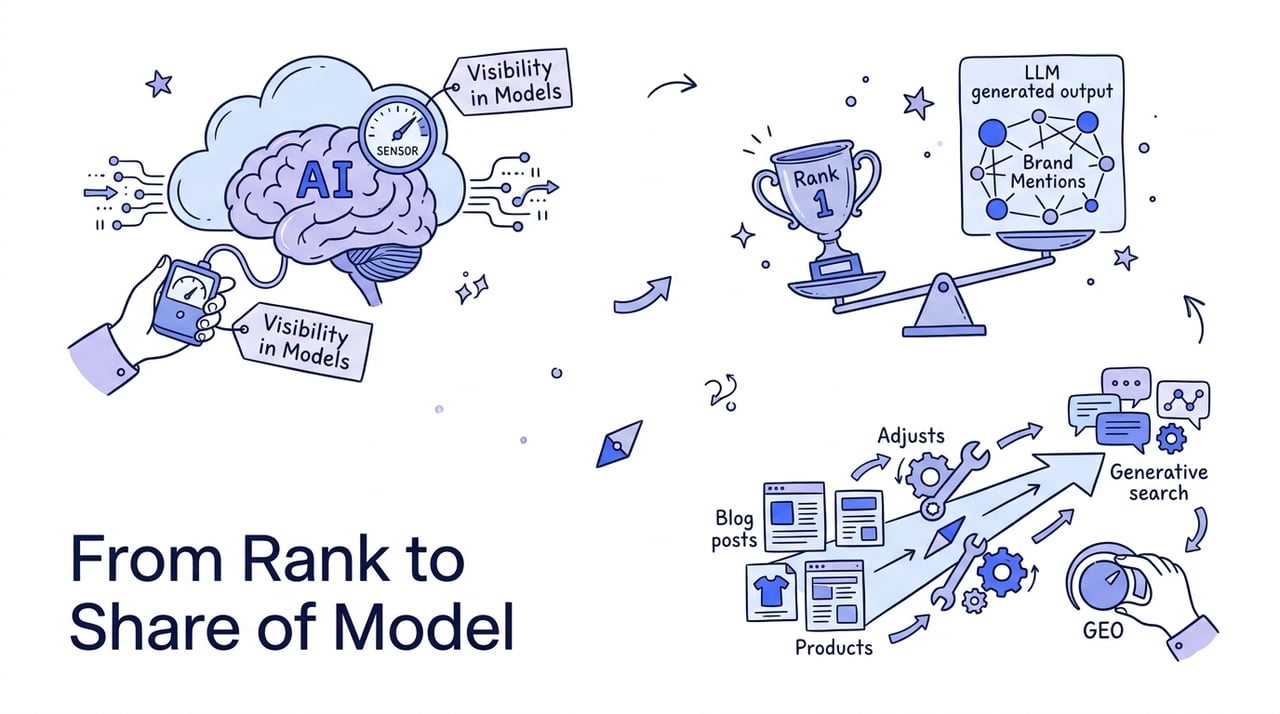
The era of the click is dead. As of 2026, between 60% and 77% of Google searches conclude without a single user clicking a link. AI-generated summaries have effectively hijacked the consumer journey by providing answers directly on the results page. If your brand is not mentioned in that primary LLM response, you simply do not exist in the digital mind of your customer.
Traditional search optimization focused on winning a blue link, but the new landscape rewards synthesis and consensus. We are moving from a world of information retrieval to a world of information generation. If the model doesn't summarize you, you don't enter the funnel.
The SoM Playbook At A Glance
This guide breaks down how to pivot from legacy traffic metrics to Share of Model (SoM) dominance. Use this checklist to audit your current standing:
- Define a Gold Set of 20-50 high-priority categorical prompts.
- Measure the percentage of brand mentions vs total category mentions across major LLMs.
- Prioritize Information Gain by adding unique data and expert quotes to all content.
- Optimize for entity salience and fact-maxing to improve citation rates.
- Implement the Model Context Protocol (MCP) to feed data directly to AI agents.
Share of Model represents the new primary lead indicator for market share.
What Is Share Of Model (SoM) Analytics?
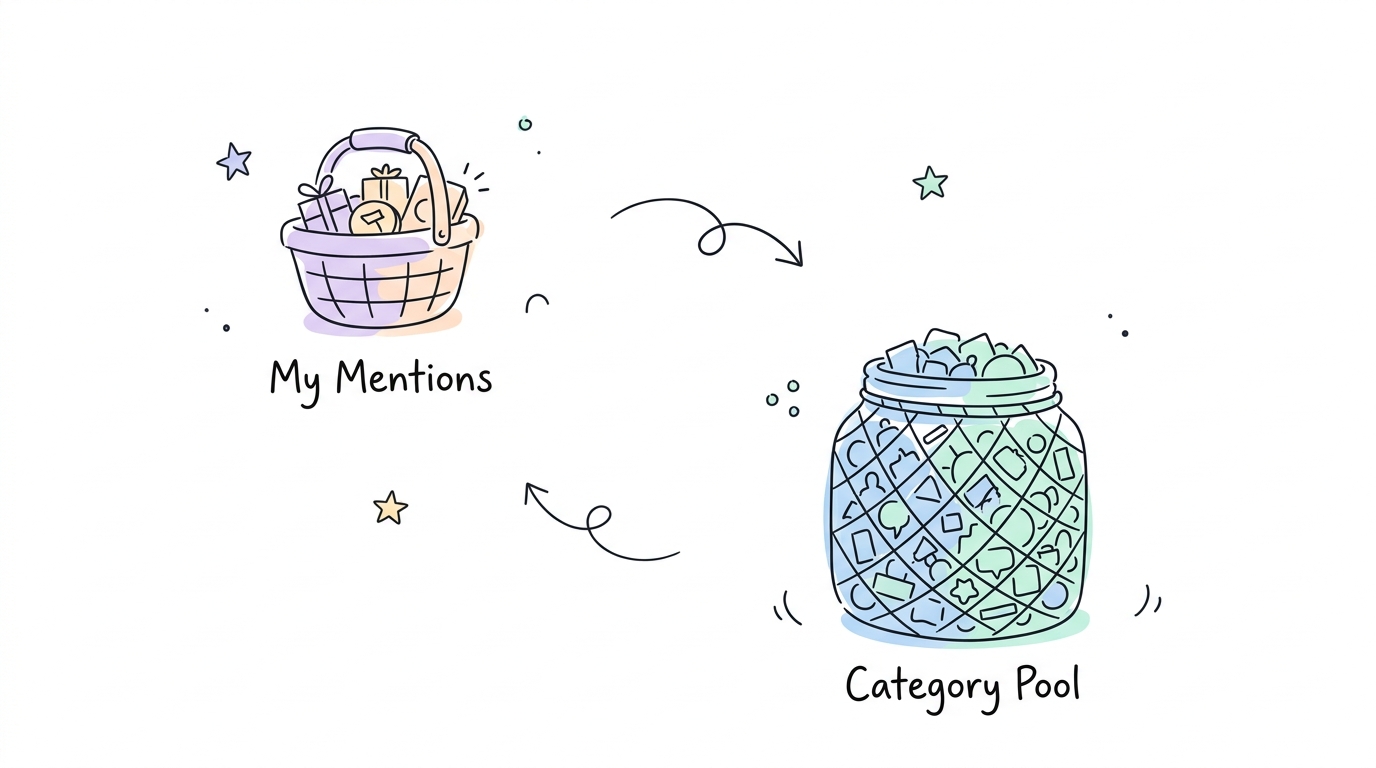
Share of Model (SoM) is a metric that quantifies how often a brand is mentioned and how it is perceived within the answers generated by Large Language Models (LLMs). It measures your brand's presence as a proportion of total mentions within a specific product category.
Share of Voice (Traditional)
- Description: This metric tracks your advertising weight and reach relative to competitors in traditional media.
- Features: Relies on media spend, impression counts, and broadcast frequency.
- Verdict: Effectively dead for digital discovery as it ignores the organic synthesis role of AI.
Share of Search (Search Era)
- Description: This uses query volume as a proxy for brand demand and market interest.
- Features: Analyzes keyword trends, domain traffic, and click-through rates.
- Verdict: Failing in a 77% zero-click environment where users no longer search for specific brand names.
Share of Model (Generative Era)
- Description: The frequency and sentiment of brand mentions in synthesized AI answers.
- Features: Focuses on entity relationships, citation frequency, and consensus across models.
- Verdict: The only metric that accurately predicts future market share in an AI-mediated economy.
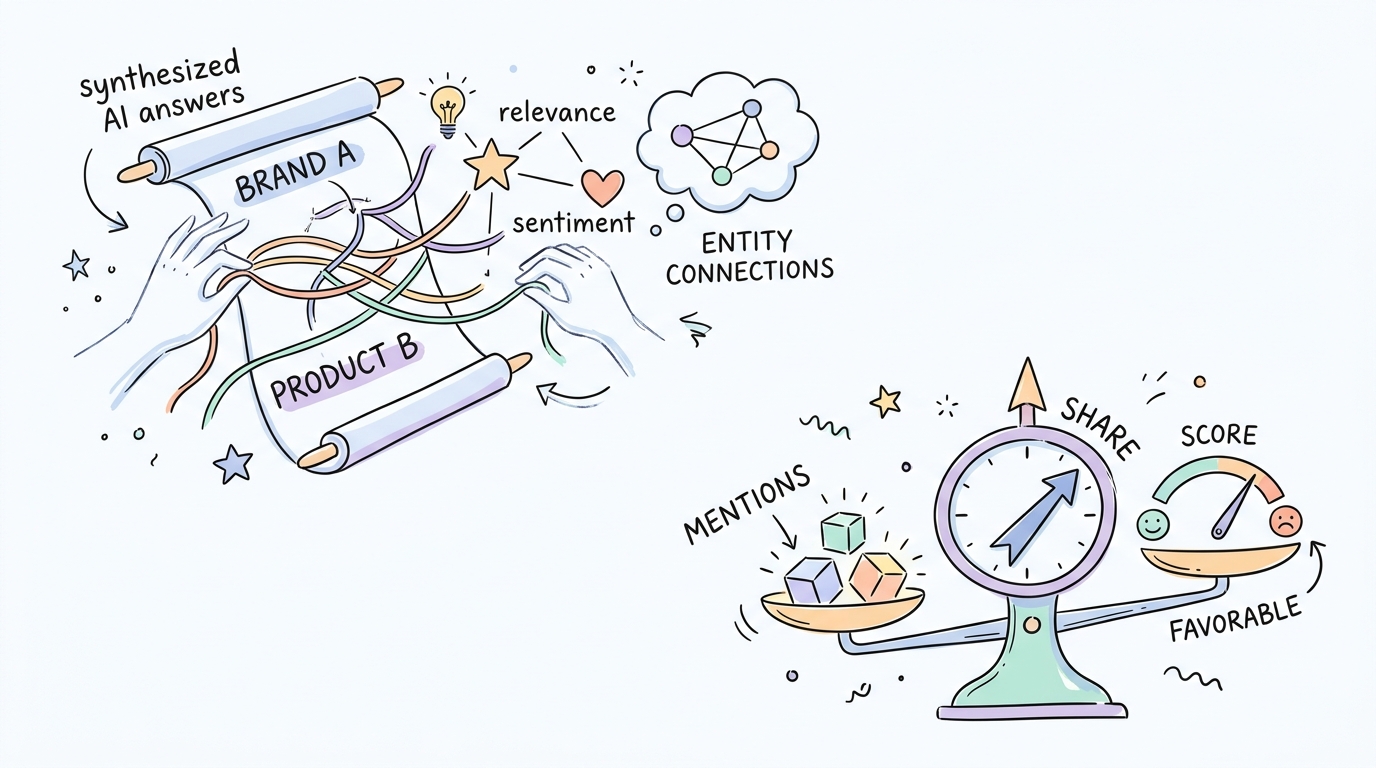
As Jack Smyth from Jellyfish notes, LLMs are no longer just tools; they are a critical audience in their own right. If you aren't visible to the model, you are invisible to the customer.
The Run-And-Regenerate Protocol: Measuring Your Visibility
To accurately measure your standing, you cannot rely on a single prompt. LLMs are non-deterministic, meaning they can give different answers to the same query depending on the session.
- Define a Gold Set of 20-50 non-branded queries that define your category.
- Run these prompts across ChatGPT, Gemini, Claude, and Perplexity.
- Execute 5-10 iterations for every prompt to account for variability.
- Log every instance of brand inclusion, your citation rank, and the sentiment polarity.
- Calculate your final score using the SoM formula.
# Example SoM calculation formula
SOM = (BRAND_MENTIONS / TOTAL_CATEGORY_MENTIONS) * 100
Rule: Always use fresh browser instances or cleared API states to avoid personalization bias.
- If your inclusion rate is below 10%, you have an identity drift problem.
- If sentiment is negative, audit the citation sources feeding the model.
- If Gemini ignores you but Claude doesn't, check your Google-specific indexing.
You can automate this tracking using the Share of Model Platform™ to monitor shifts in real-time.
The Three Pillars Of Generative Engine Optimization
Generative Engine Optimization (GEO) is the process of making your brand the most likely answer for an AI. It requires moving beyond keywords and toward machine-extractable facts.
30-40% improvement in AI visibility achieved by content optimized for GEO.
Citation Pillar
- Description: This measures the percentage of AI responses that link back to your owned assets.
- Features: Focuses on being the 'source of truth' for specific statistics or definitions.
- Verdict: High citation rates prove to the model that you are an authoritative node in the knowledge graph.
Sentiment Pillar
- Description: The tone and recommendation strength the AI applies to your brand.
- Features: Analyzes descriptive adjectives and the rank of your brand in listicles.
- Verdict: Neutral mentions are a start, but positive sentiment triggers higher conversion via the 'concierge' effect.
Association Pillar
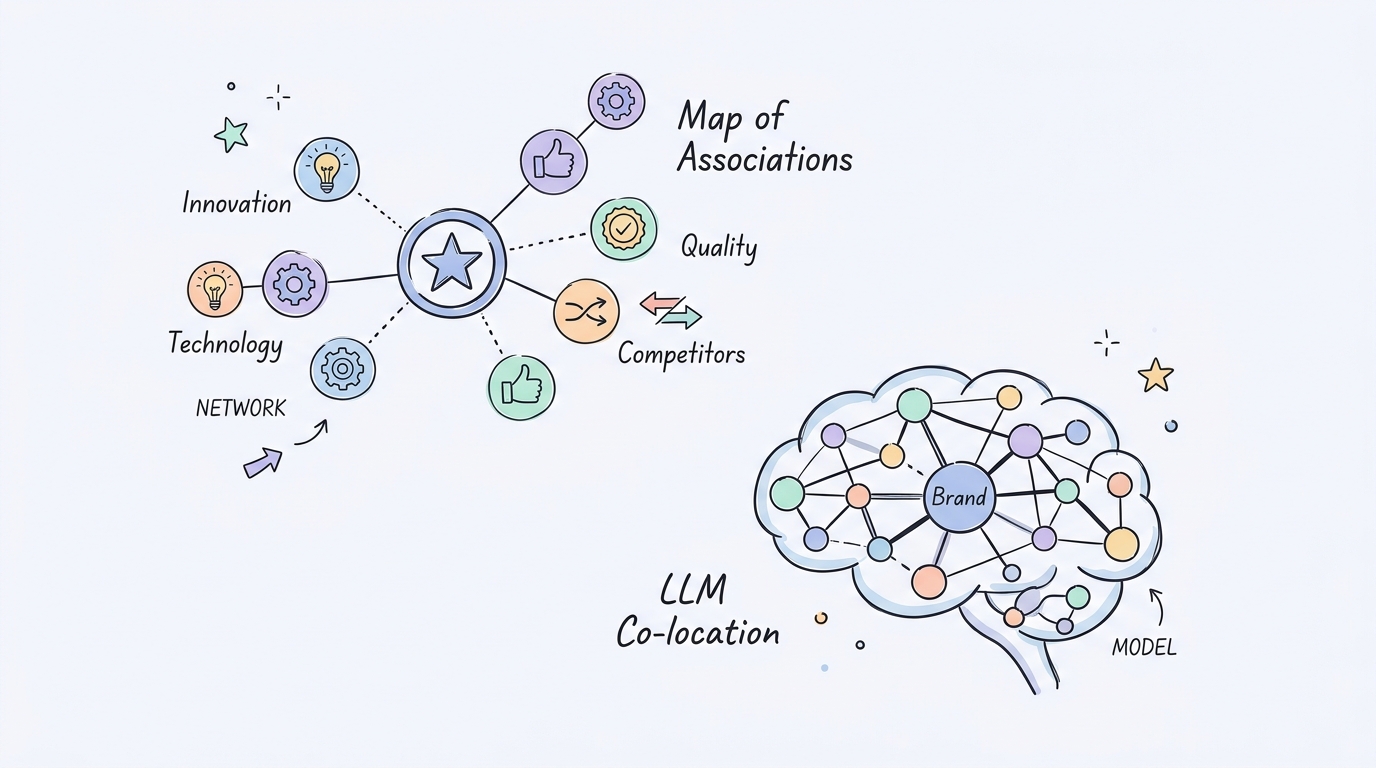
- Description: The map of entities and concepts the model co-locates with your brand.
- Features: Tracks which competitors you are grouped with and which solutions you solve.
- Verdict: Association determines which 'neighborhood' of the knowledge graph you live in.
Research from the Princeton GEO Research team confirms that adding unique statistics and expert quotes significantly boosts visibility over generic text.
Advanced Tactics For LLM Dominance
Dominating LLM responses requires a mix of technical infrastructure and information scarcity strategies. If everyone is saying the same thing, the model will pick the oldest or most established source.
Inception Technique
This strategy involves identifying 'training gaps' where LLMs lack recent or specific data. By creating the only dense documentation for a new problem, you force the AI to rely on your site.
- Step 1: Identify a technical edge case or niche problem with zero existing results.
- Step 2: Publish a comprehensive 'cookbook' or guide with code snippets and clear steps.
- Step 3: Ensure the content is structured in simple Markdown for easy crawling.
Fact-Maxing
LLMs love structured data that can be parsed without heavy processing. Fact-maxing places high-density information at the very top of your pages.
- Step 1: Create a 40-60 word 'Answer Block' summarizing the page's core value.
- Step 2: Use HTML or Markdown tables to present comparisons and pricing.
- Step 3: Embed JSON-LD schema for all entities and authors to reinforce trust.
Citation Loop
AI models prioritize consensus across multiple authoritative sources. You can engineer this by generating proof on third-party platforms.
- Step 1: Seed discussions on high-authority forums like Reddit and industry-specific boards.
- Step 2: Use Kitful AI to generate unique, research-backed articles for guest placements.
- Step 3: Wait for models to crawl these 'external' confirmations of your brand's expertise.
Model Context Protocol (MCP)
For B2B SaaS, the goal is to be usable by AI agents, not just readable. The MCP allows AI to call your product data directly.
- Step 1: Expose your public product data or documentation via an MCP server.
- Step 2: Register the server with major AI development environments.
- Step 3: Monitor agent calls as a new form of high-intent traffic.
Example
A senior developer at a fintech startup noticed that Claude consistently failed to provide a working solution for a specific Next.js 14 edge case. By publishing a targeted 'cookbook' on their technical blog, the developer created the only available documentation for that query. This forced the model to cite the startup as the sole authority, resulting in a 250% surge in pre-qualified leads who bypassed search engines entirely.
Tip: Use unique keywords for your proprietary features to make them easier for AI to identify as unique entities.
Navigating The 2026 Site Reputation Abuse Policies
The 2026 Core Update has introduced aggressive penalties for brands trying to game the system with low-quality AI content. Google now classifies irrelevant white-label content on high-authority domains as Site Reputation Abuse.
Scaled Content Abuse occurs when you produce massive amounts of content without human oversight. Large publishers like Forbes Advisor and CNN have already seen massive traffic drops for hosting content that doesn't match their core expertise. To survive, you must balance automation with editorial quality.
- If you use AI to draft, you must use a tool like Kitful AI's Humanizer to ensure the tone is natural.
- Avoid hosting 'partner content' in subfolders that are unrelated to your main domain topic.
- Ensure every piece of content has a verified human author with a clear E-E-A-T profile.
- Audit your site for 'thin' pages that only summarize existing web content without adding new value.
Pitfall: Never publish raw AI outputs directly to your blog; the lack of 'Information Gain' will eventually trigger a manual penalty.
Refer to the Google Site Reputation Abuse Policy for the latest compliance standards. Editorial integrity is now a technical requirement for ranking.
Traditional SEO Vs. Generative Engine Optimization
The shift from SEO to GEO is not just a change in tactics; it is a change in philosophy. Traditional SEO was about capturing a visit, while GEO is about capturing the recommendation.
Winning in the synthesis era means becoming the primary fact-source for your industry. The battle for the top of search results is ending.
Share Of Model FAQ
How is Share of Model calculated?
You calculate SoM by dividing your brand's total mentions in a set of AI responses by the total mentions of all brands in that category. This number is then multiplied by 100 to get a percentage.
What is the difference between Share of Search and Share of Model?
Share of Search measures how many people are typing your name into a search box. Share of Model measures how often the AI chooses to present your brand as the answer, even if the user didn't ask for you by name.
Can AI content avoid detection in 2026?
Google's focus has shifted from detecting 'AI' to detecting 'lack of value.' Using a high-quality humanizer and adding unique, first-hand data is the only way to avoid Scaled Content Abuse penalties.
Why is information gain more important than domain authority?
Domain authority tells the search engine your site is old and trusted, but information gain tells the AI you have something new to say. AI models prioritize the newest, most factual information to improve their own answers.
Adapting To The Synthesis Era
The transition from retrieval to synthesis is the biggest shift in digital marketing since the invention of the crawler. Your brand's survival no longer depends on where you rank in a list of blue links, but on whether an LLM considers you a relevant part of the answer.
Brands that optimize for AI inclusion are already seeing a 250% surge in Revenue Per Visit (RPV) because AI-referred leads are pre-qualified. They aren't just browsing; they have already been told you are the solution.
Stop chasing clicks and start capturing the mind of the model. Implement your first Run-and-Regenerate audit this week to see where you actually stand. The future of your brand is being written by the models right now.
 Kitful