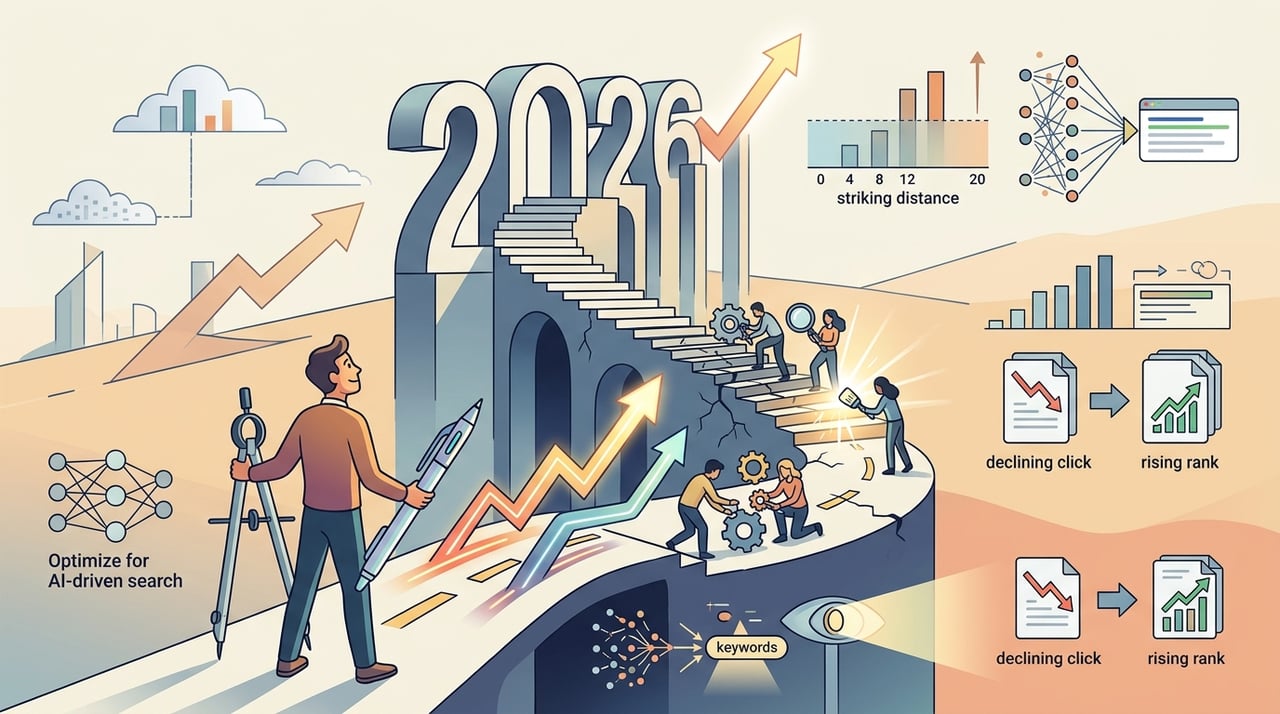
Every blog post you published two years ago is slowly bleeding traffic. Most creators think the answer is to write something new, but the real gold is buried in your archives.
Your old content is either an asset or an anchor. If it sits on page two or three of search results, it is a 'zombie' post consuming crawl budget without delivering leads.
Refreshing these pages is the highest-ROI move you can make in 2026. It takes less time than a fresh draft and leverages existing authority to jumpstart rankings.
Tip: Start by identifying posts that lost more than 20% of their traffic year-over-year to find the easiest wins.
The Content Refresh Playbook: BLUF
Refreshing your library is not just a maintenance task; it is a growth engine. Data shows that a strategic update can lead to a 533% increase in pageviews for a single piece of content.
- Target Striking Distance: Focus your efforts on keywords currently ranking in positions 4 through 20 for the fastest gains.
- Prioritize AI Optimization: With 60% of top content expected to be optimized for AI-driven engines by 2026, depth and 'information gain' are mandatory.
- Intent Overhaul: Always choose a full rewrite over a light refresh if the search intent has shifted from informational to commercial.
- Preserve Equity: Keep your URL slugs identical to maintain the link power you have already built.
Step 1: Audit Your Archives For 'Striking Distance' Hits
Finding the right candidates for a refresh requires a data-driven approach rather than guesswork. You want to locate the pages that search engines already trust but find slightly outdated.
Open Google Search Console and filter your performance report to look for pages with high impressions but declining clicks. Look for the 'striking distance' sweet spot where your average position is between 4 and 20.
These pages are often one or two updates away from the first page. Use Ahrefs Site Audit to cross-reference these URLs against your competitors to see who has recently leapfrogged you.
Targeting stable impressions with falling clicks usually indicates that your title or meta description is no longer enticing enough for modern searchers.
Step 2: Assign a 'Verdict' to Your Content
Not every decaying post deserves the same level of attention. You need to categorize your content into four distinct tiers to manage your team's time effectively.
- Monitor (No Action)
- Context: For pages ranking in the top 3 with consistent traffic.
- Implementation: Open Google Search Console and verify the 'Average Position' over 90 days. If the line is flat or trending up, do nothing except a quick monthly check for broken links.
- Tradeoff: You might miss out on small 'information gain' opportunities, but you avoid the risk of over-optimizing a winner.
- Light Refresh
- Context: For high-ranking seasonal posts or yearly listicles.
- Implementation: Update the year in the H1 and meta title to 2026. Audit all external links for 404 errors and replace them with current sources while updating minor pricing or version details.
- Tradeoff: This will not save a page that has deep structural content gaps or fundamentally outdated advice.
- Medium/Heavy Refresh
- Context: For pages in positions 4-20 with high authority but decaying relevance.
- Implementation: Identify subtopics competitors cover that you missed. Add at least two new H3 headers addressing these gaps and inject a unique quote from an internal expert to boost E-E-A-T.
- Tradeoff: Significant time investment is required for research and content production compared to a light update.
- Full Rewrite
- Context: For pages where the search intent has fundamentally changed since publication.
- Implementation: Study the top 3 results for your keyword. If they are now tool-based pages and yours is a blog post, archive the old text and write a new version from scratch.
- Tradeoff: You may experience temporary ranking fluctuations while search engines re-evaluate the entirely new content structure.
- If traffic decayed by 20% or more, perform a full content audit.
- If search intent shifted from informational to commercial, choose a Full Rewrite.
- If a page is in positions 4-20, prioritize a Medium Refresh.
- If the page has high authority but stale data, perform a Light/Medium Refresh.
Step 3: Align Content with Modern Search Intent
Search intent is not static. What readers wanted three years ago often differs from what they need in the current AI-heavy search landscape.
Take a software lead who keeps an 'Email Marketing Tips' guide from 2022 live without updates. As competitors pivot to AI-driven automation content, the old guide's traffic drops significantly in six months.
The consequence is a direct hit to the sales pipeline because the outdated content no longer solves the reader's modern problems. You must check the current SERP to see if the top results are now listicles, deep-dive guides, or interactive tools.
Capture featured snippets by answering questions found in the 'People Also Ask' section of your target keyword search. If the current winners are all using video or infographics, your text-only post will likely continue to slide down the rankings.
Information gain is the secret weapon for 2026 SEO. Google rewards content that adds unique value or data that competitors do not provide.
Start by replacing any stale 2021 statistics with fresh 2026 insights. Adding a unique expert quote or an internal case study provides the E-E-A-T signals that AI-generated fluff cannot replicate.
Updating the substance of your post is where the real rankings are won. Ensure you are not just 'faking' an update by changing the date; you must actually improve the utility for the reader.
- Update meta title and H1 with the current year (2026).
- Replace screenshots of old software interfaces with current UI visuals.
- Add a 'People Also Ask' FAQ section to target featured snippets.
- Inject unique data or a quote from a Subject Matter Expert (SME).
- Remove dead tools or products from listicles and add new alternatives.
Rule: Never allow AI to auto-publish a refresh without a human editor verifying the accuracy of the updated facts.
Step 5: Repair Technical and Link Equity
A content refresh is also a technical cleanup. Broken links and poor internal linking structures act as friction for both users and search crawlers.
Scan your post for dead external links and replace them with high-authority citations from 2025 or 2026. Link your refreshed post to newer content you have published recently to spread link equity across your site.
Ensuring your internal links flow from your homepage or major pillar pages can signal to Google that this old post is relevant again. Always verify that your URL slug remains exactly the same to avoid breaking your existing backlink profile.
Pitfall: Changing the URL slug during a refresh is a common mistake that destroys your existing ranking signals and backlinks instantly.
The Decision Matrix: Refresh, Rewrite, or Redirect?
Choosing the right path for every URL ensures you don't waste resources on content that cannot be saved. Use this matrix to guide your content team.
- The High Performer (Positions 1-3)
- Implementation: Conduct a technical audit for broken links every six months and monitor for aggressive new competitors.
- Outcome: Maintains your market share and protects your highest-converting traffic sources with minimal effort.
- Tradeoff: Over-optimizing these pages can sometimes lead to a ranking drop if the search engine re-evaluates the page too frequently.
- The Striking Distance Page (Positions 4-20)
- Implementation: Run a semantic gap analysis and add 300-500 words of new, relevant sub-sections and media.
- Outcome: Direct movement into the top 3 positions by proving your page is the most comprehensive resource available.
- Tradeoff: This is the most labor-intensive category and requires skilled writers or subject matter experts.
- The Intent Mismatch (Low CTR)
- Implementation: Completely restructure the post to match the current format of the top-ranking competitors on page one.
- Outcome: Recovers lost traffic by finally giving the searcher exactly what they are looking for in 2026.
- Tradeoff: A total rewrite takes as much time as starting a new post but yields faster results due to existing URL authority.
Step 6: Use a Content Refresh Tool for Speed
Scaling a refresh strategy manually is difficult once you have hundreds of posts. Using automation can help you identify which gaps to fill without hours of manual SERP research.
The Kitful Content Refresh Tool helps you audit your archives and maps out an update plan based on competitor gaps. AI can pinpoint specific subtopics that your current version is missing, allowing you to focus on the writing rather than the analysis.
Once your updates are live, you must tell search engines to take a look. Update the 'Last Modified' date in your CMS and request a manual recrawl through the URL Inspection tool in Google Search Console.
Most refreshes show ranking movement within 2 to 4 weeks if the updates effectively addressed search intent and information gain. Monitoring these changes helps you refine your refresh strategy for the next batch of content.
Stop Writing New Content Until You Do This
Stop writing new content until you have addressed the decay in your existing library. If an article is currently ranking number one, leave it alone and focus on your striking distance pages.
The average blog post length has increased by 77% over the last decade. Your old posts likely lack the depth required to compete in today's search environment.
Updates usually show significant results in less than a month. Start by picking your top 5 decaying posts today and apply the refresh playbook to see the impact on your bottom line.
That's it. Your next big traffic win is already sitting in your archives.
 Kitful