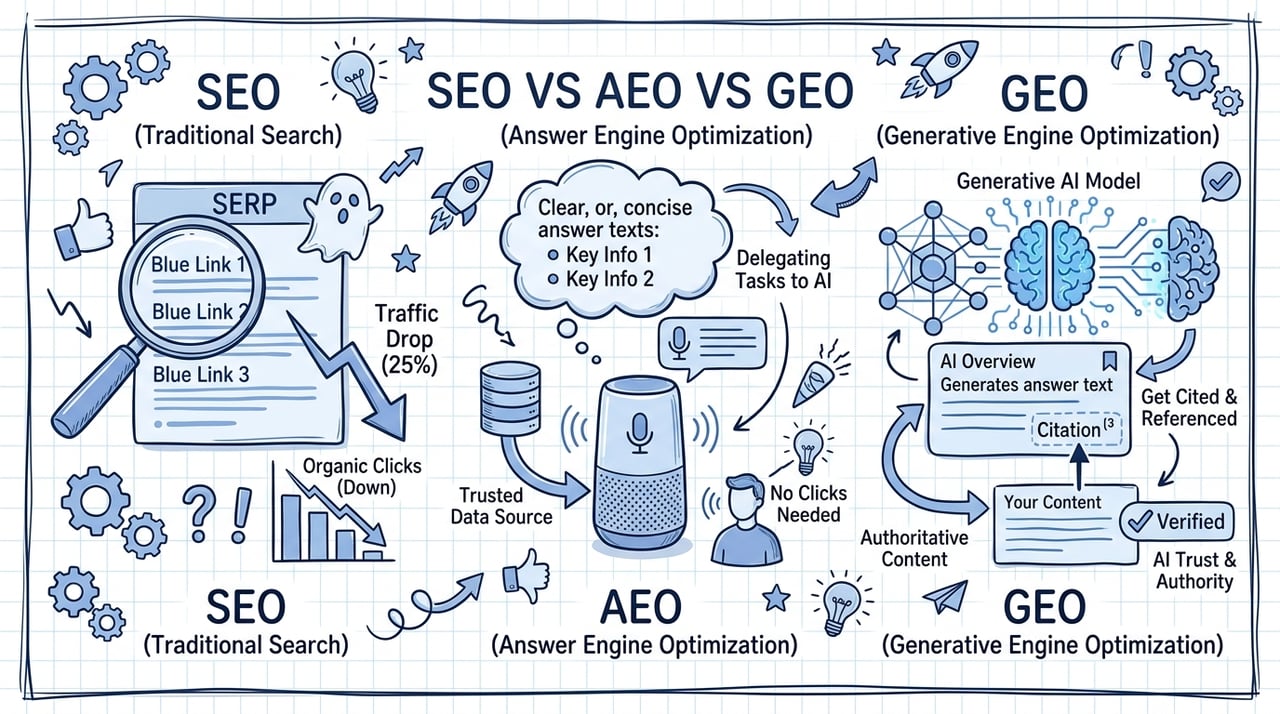
Your top-ranking position is about to become a ghost town. Traditional search traffic is projected to drop by a staggering 25 percent by 2026 as users stop browsing and start delegating tasks to AI assistants.
Google AI Overviews already cause a 61 percent reduction in organic click-through rates. When the answer is displayed right at the top, the incentive to click your link evaporates instantly.
Searching for links is being replaced by receiving answers. You are no longer competing for a spot on a list; you are competing to be the source that the AI trusts enough to repeat.
The 2026 Visibility Blueprint: At a Glance
Winning in 2026 requires a three-layered approach to visibility. You must transition from just ranking to being cited and synthesized by the models your audience uses daily.
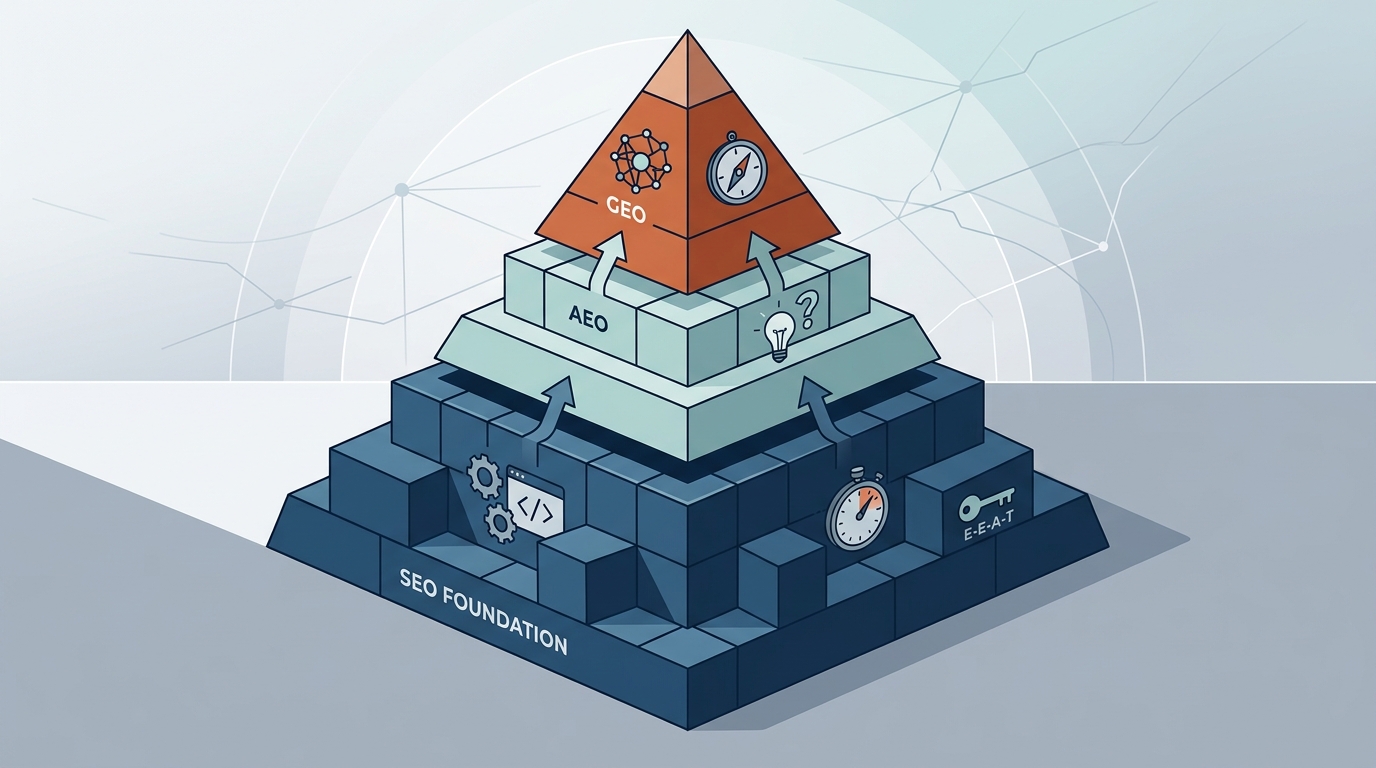
- SEO is the foundation. It establishes the technical health and E-E-A-T signals required for any search engine to trust your content.
- AEO is the stage. This focuses on making your data easily extractable for voice assistants and direct answer snippets.
- GEO is the main event. This strategy ensures your brand is the primary citation when LLMs like ChatGPT or Claude synthesize complex answers.
This hierarchy moves you from being an option to being the definitive answer.
Step 1: Strengthening the SEO Foundation
Traditional SEO is not dead, but its role has shifted. It now serves as the essential verification layer that AI models use to confirm your authority and relevance.
Clean code is the new prerequisite for AI trust. If your site structure is messy, AI crawlers like GPTBot and CCBot will struggle to parse your data, leading to total invisibility in generative results.
- Use semantic HTML and logical heading structures (H1, H2, H3).
- Maintain lightning-fast load times to prioritize user experience signals.
- Keep your robots.txt open to allow AI crawlers to index your latest insights.
- Focus on original, evidence-backed content that demonstrates real-world expertise.
Rule: Never block AI crawlers if you want your brand to appear in generative engine citations.
Technical health ensures you stay in the pool of eligible sources. Without this foundation, the more advanced optimization layers simply cannot function.
Step 2: Mastering AEO for Instant Answers
Answer Engine Optimization (AEO) is the art of being the exact piece of information a machine needs to resolve a query. It targets the moment an engine needs a specific fact rather than a list of possibilities.
Direct extraction requires highly structured data. By using Schema.org Documentation, you provide a map that tells search engines exactly what each piece of text represents.
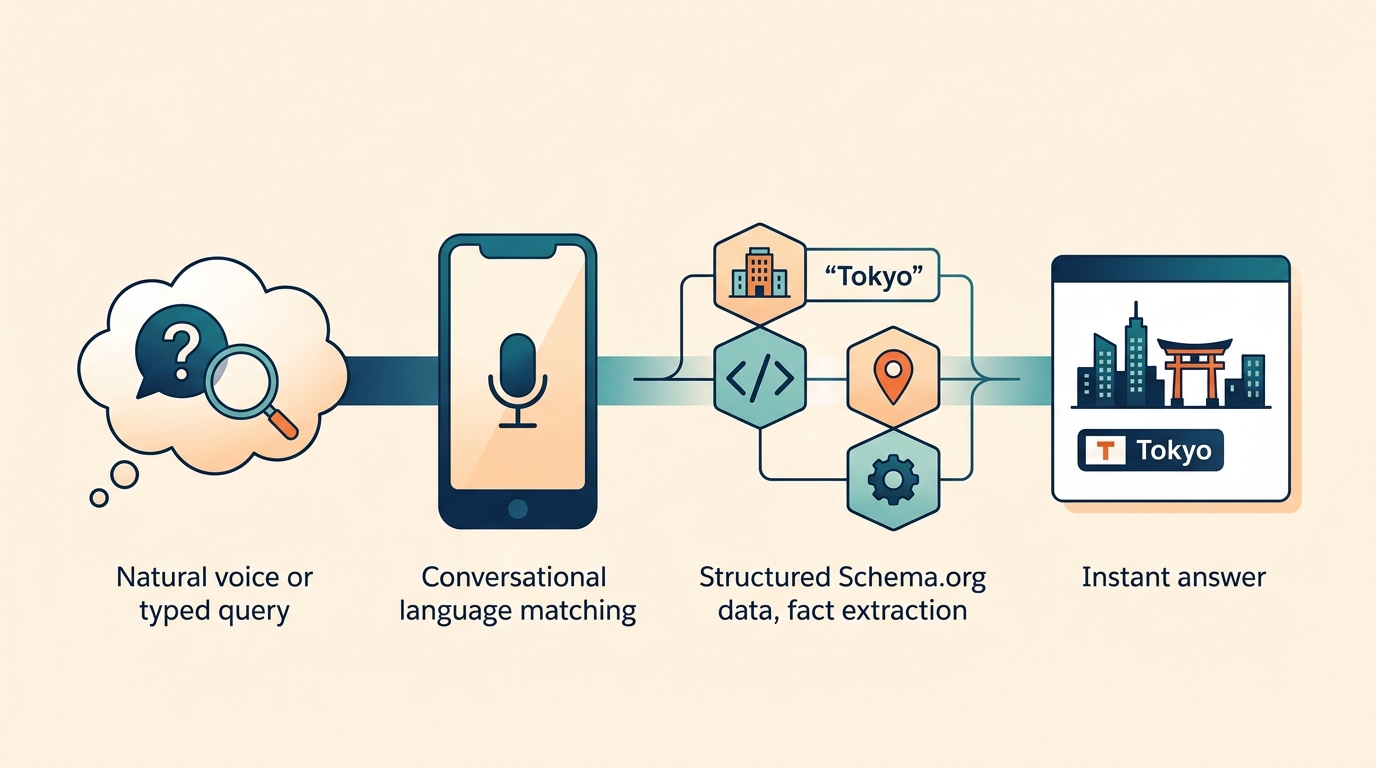
- Format content into clear Q&A blocks to mirror natural user queries.
- Use concise, factual sentences that are easy for AI to pull into featured snippets.
- Implement specific Schema types like FAQPage, Product, and Organization to clarify context.
- Write in a conversational tone that matches the way people speak to voice assistants like Alexa.
This approach turns your articles into a database of answers. When a user asks a specific question, the engine can pull your text directly into the spotlight.
Step 3: Optimizing for GEO and AI Citations
Generative Engine Optimization (GEO) is the newest frontier of digital visibility. While SEO gets you indexed, GEO gets you mentioned in the synthesized summaries provided by models like ChatGPT, Claude, and Perplexity.
Citations are the new currency of traffic. AI models synthesize information from multiple sources, and your goal is to be the authoritative voice they choose to cite as proof for their claims.
Implementation Strategy
To build a GEO-ready presence, move away from keyword density and toward topical authority clusters. You must provide the data that the AI cannot invent on its own.
- Conduct and publish original research to become a primary data source.
- Use internal and external linking to build a network of authoritative context around your main topics.
- Regularly test your brand queries in Perplexity to see which sources the AI currently prefers.
Example
A software company published an original study showing a 527 percent year-over-year jump in AI-referred sessions across their client base. Because this was a unique, verified statistic, multiple generative engines cited their blog post as the definitive source when users asked about AI traffic trends.
Tip: Focus on being the 'first mover' with original data to secure long-term AI citations.
SEO vs. AEO vs. GEO: A Side-by-Side Comparison
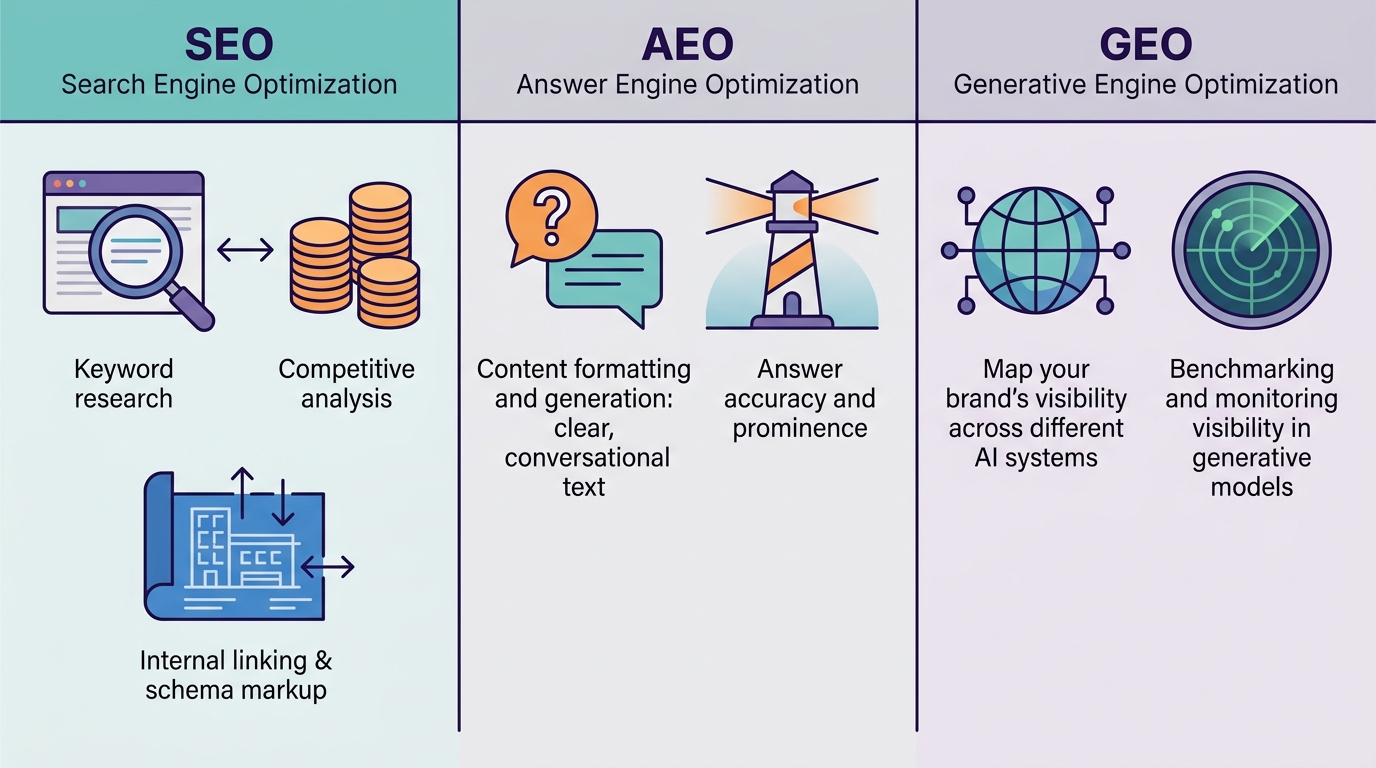
Understanding the differences between these strategies is vital for resource allocation. Each pillar serves a different part of the modern search ecosystem.
A balanced strategy covers all three visibility goals. You cannot ignore ranking, but you cannot survive without synthesis.
Implementing these strategies requires a specialized toolkit to track your impact in an AI-first world. You need to monitor how your content is being read by machines as much as humans.
Visibility monitoring is no longer a manual task. You must use tools that bridge the gap between traditional search and generative synthesis.
- kitful AI Writing Tools for generating AI-friendly content structures and semantic formatting.
- Perplexity for real-time testing of how generative engines summarize your brand or topic.
- Ahrefs for tracking the impact of AI Overviews on your traditional organic click-through rates.
- Search Engine Journal for staying updated on the latest CTR Impact Research and algorithm shifts.
- ZimWriter for bulk generation of SEO-optimized drafts that maintain a logical structure for AI parsing.
- Ubersuggest for identifying semantic keyword gaps that AEO strategies should fill.
These tools ensure your strategy remains data-driven and responsive to the rapid changes in AI behavior.
Future-Proofing Your Presence
The landscape of digital visibility has fundamentally shifted. Success in 2026 is reserved for those who provide helpful, authoritative, and original content that machines can easily understand.
Invisibility in AI is effectively invisibility in the market. You cannot wait for the transition to finish before you start adapting your content structure.
The blueprint is clear: build your foundation on SEO, earn your spot on the stage with AEO, and become the main event through GEO citations. Audit your structured data today to ensure you aren't being left behind in the zero-click era.
Frequently Asked Questions
What is the biggest difference between AEO and GEO?
AEO focuses on the direct extraction of facts for snippets and voice answers, while GEO focuses on being cited in a synthesized summary created by an LLM. AEO is about being the 'answer,' while GEO is about being the 'trusted source.'
Does traditional SEO still matter in 2026?
Yes, traditional SEO provides the technical health and E-E-A-T signals that AI models use to verify if a source is reliable. Without a strong SEO foundation, your site will likely be ignored by generative engine crawlers.
You should monitor referral traffic from AI engines like Perplexity and use 'brand mention' queries in ChatGPT to see if your business is cited. Tools like Ahrefs also help track the specific impact of Google AI Overviews on your click-through rates.
Should I block AI bots to protect my content?
Blocking bots like GPTBot will prevent AI models from citing your brand as a source, leading to decreased visibility in generative answers. It is generally better to allow access and optimize your content to be the cited authority.
 Kitful