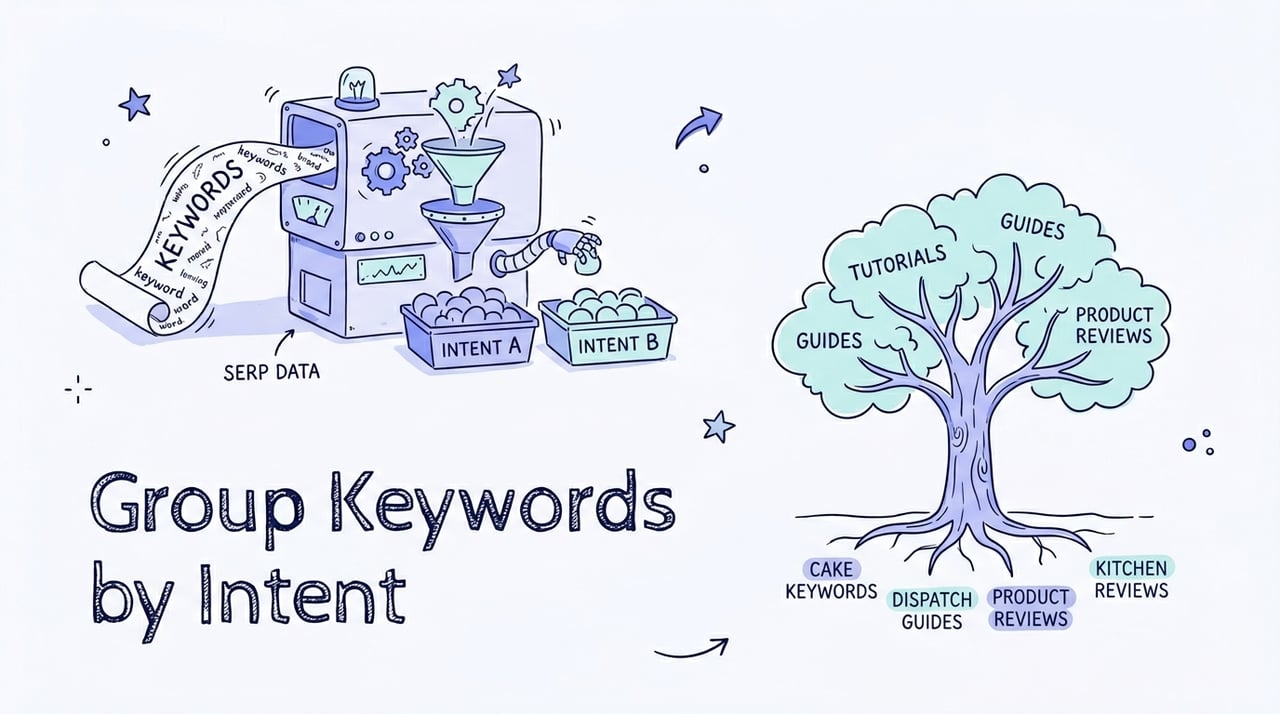
Your keyword research is likely drowning in a sea of long-tail data. With 70% of search traffic originating from specific long-tail keywords, the sheer volume makes manual sorting impossible for any modern team. Attempting to manage this in a standard spreadsheet is the fastest way to invite keyword cannibalization and wasted budget.
Pitfall: Manual clustering in spreadsheets is slow, error-prone, and deeply flawed.
The complexity of search intent in 2026 means you cannot just guess which terms belong together. If you target the same intent on multiple pages, you are effectively competing against yourself. This creates a ceiling on your rankings that no amount of backlinking can fix.
The Bottom Line Up Front
Moving from a messy list of terms to a structured content plan is no longer a manual chore. By adopting a SERP-based workflow, you align your strategy with how search engines actually group information.
- SERP-based accuracy: Groups keywords only when they share a significant percentage of ranking URLs in the top 10 results.
- Proven results: Programmatic SEO projects using automated clustering often see 200-500% organic traffic growth by eliminating content overlaps.
- Speed to market: Transition from raw data to AI-ready content briefs in minutes rather than days.
What is Keyword Clustering and Why Is It Essential in 2026?
The search landscape has shifted from individual keywords to topical ecosystems. Google no longer looks for specific word counts; it evaluates how well your site covers a whole subject area. This is why Google Search Central emphasizes understanding how search works at a conceptual level.
Here is the thing: topic clusters are replacing traditional linear keyword lists as the foundation of SEO. A cluster is a group of related terms that all point toward a single user goal or intent. By grouping these, you create a dedicated destination for that intent, building the topical authority that modern algorithms crave.
Approximately one-third of marketing professionals now use generative AI to manage these complex workflows. This shift ensures each page on your site has a unique, non-overlapping target. Without this structure, your content becomes a fragmented mess that confuses both users and crawlers.
Prerequisites: Preparing Your Keyword Dataset
Before you can automate your groupings, you need a high-quality dataset. Most clustering tools perform best when you feed them at least 500 to 1,000 terms to identify meaningful patterns.
- Identify broad head terms using Google Search Console or a keyword discovery tool.
- Download related terms including questions and long-tail variations.
- Define your primary content pillar topics to guide the site architecture.
- Export 1,000+ keywords from Ahrefs, Semrush, or GSC
- Verify access to a clustering tool with sufficient credits
- List your 3-5 main service or topic categories
Step 1: Clean and Refine Your Raw Data
The quality of your clusters depends entirely on the cleanliness of your input. If you leave noise in your data, the automated tools will create clusters that do not make sense for your business.
- Remove branded terms that do not align with your generic content goals.
- Delete duplicate entries and irrelevant modifiers like year-specific tags that are outdated.
- Filter out terms with zero search volume unless they are vital for topical completeness.
Tip: Focus on head terms and high-value long-tail variations to keep your data focused.
Step 2: Choose Your Clustering Logic (Hard vs. Soft)
Clustering is not a one-size-fits-all process. You must decide how strictly the tool should match search results before it decides two keywords belong on the same page. This is determined by the percentage of shared ranking URLs in the top 10 results.
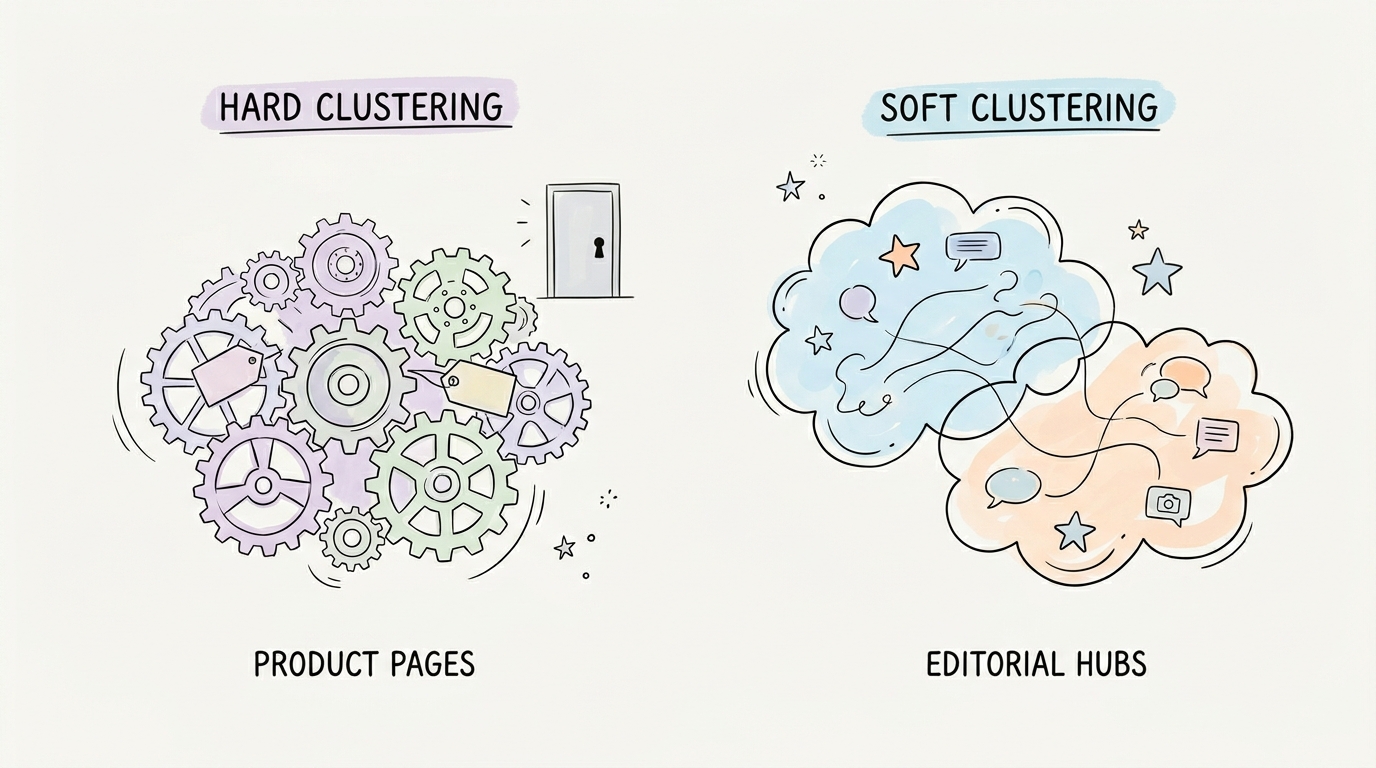
Imagine a retail SEO manager grouping running shoes and trail sneakers. By choosing Hard clustering, they prevent two pages from fighting for the same SERP, ensuring the trail page only targets off-road intent while the main page handles general queries.
- If SERP overlap is >40%, group the keywords into a single content piece.
- If keywords share intent but have low SERP overlap, consider creating separate sub-pages (spokes) under a pillar.
- Use Hard clustering for high-competition product pages to ensure zero cannibalization.
- Use Soft clustering for broad editorial hubs where semantic relationship is more important than identical rankings.
Step 3: Automate the Cluster Generation
Now you are ready to let the software do the heavy lifting. You can upload your cleaned dataset to a dedicated platform like the Keyword Insights Tool to begin the process. These tools analyze live search data to see which keywords Google already treats as synonyms.
An agency lead uploads 10,000 keywords for a new client in the fintech space. Instead of a month of manual labor, the tool identifies 150 unique content clusters in twenty minutes. This speed allows for quick wins with weak SERPs that competitors might have overlooked.
You can also use the Semrush Keyword Strategy Builder for an integrated view. If you need fine-tuned control, look for tools with an accuracy slider. This lets you adjust the sensitivity of the SERP overlap to match your specific niche.
- Upload your CSV file to the chosen clustering platform.
- Select the clustering type (Hard vs. Soft) based on your competition level.
- Run the analysis and export the grouped data.
- Use niche filters to identify clusters with low-competition results for immediate targeting.
Step 4: Map Clusters to Pillar and Spoke Architecture
Once the tool provides the groups, you need to organize them into a hierarchy. Your high-volume clusters should become Pillar Pages, while the more specific groups serve as supporting spoke content for those pillars.
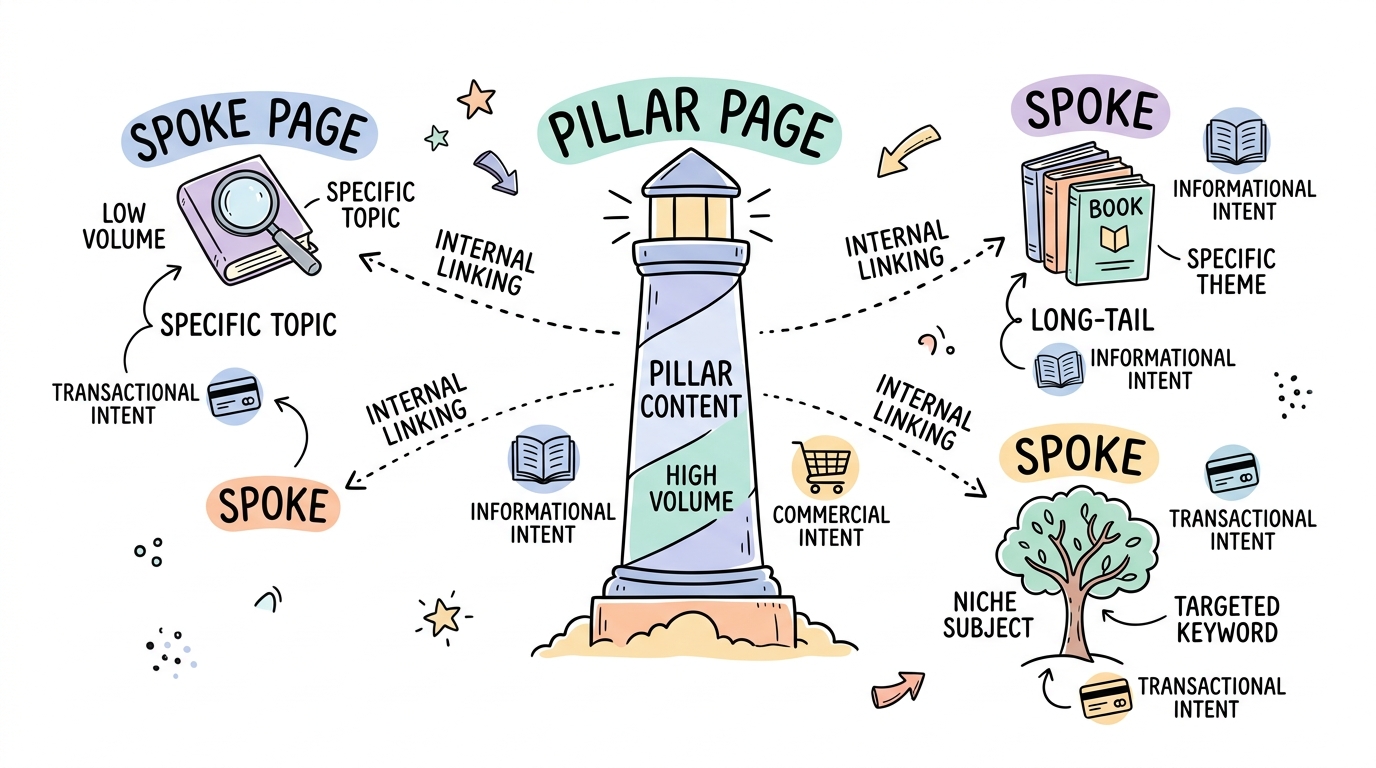
- Pillar Pages: Broad, high-volume clusters that cover a general topic.
- Spoke Pages: Niche, long-tail clusters that answer specific questions.
- Intent Labels: Mark every cluster as Informational, Commercial, or Transactional.
Rule: Every spoke page must include a direct internal link back to its central pillar page to pass authority.
Step 5: Transition from Clusters to AI-Powered Content Briefs
The final step is turning data into something a human can write. Automated clustering allows you to move from guessing what to write to executing a data-driven roadmap. You can use AI to transform these clusters into structured H2 and H3 outlines that reflect the intent of the entire group.
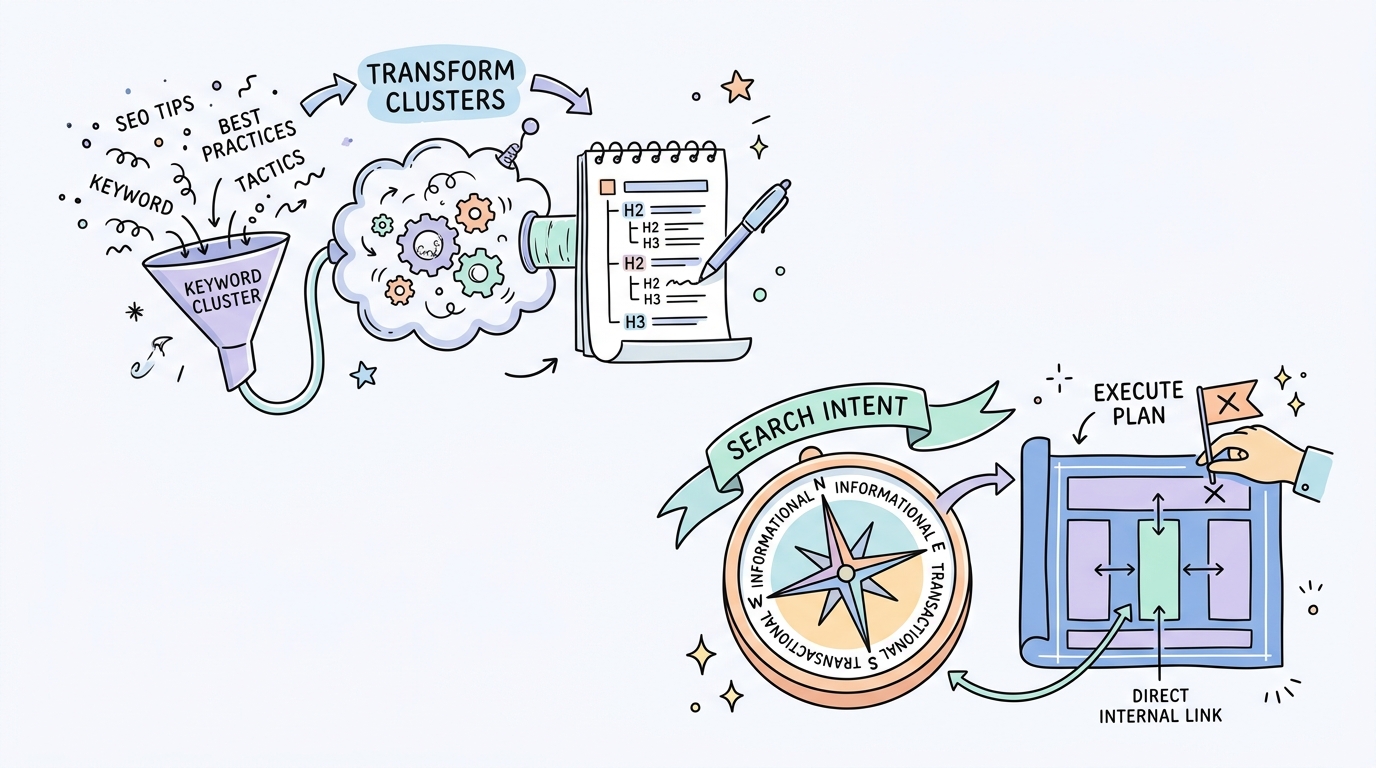
Example
- Cluster Name: Best Vegan Protein Powder 2026
- Primary Intent: Commercial / Transactional
- H2 Outline: Top-rated plant-based proteins, Key ingredients to look for, Comparison of pea vs. soy protein.
This ensures that when a writer starts, they aren't just targeting a single keyword. They are answering every relevant question within that specific cluster. This approach naturally builds the deep topical relevance that search engines reward.
Choosing the right tool depends on your budget and the scale of your keyword list. Larger projects require higher processing power and more robust SERP analysis.
Future-Proofing Your SEO with Strategic Clustering
Modern SEO is a game of topics, not just terms. Google evaluates how well a site covers an entire topic rather than looking at a single keyword in isolation. By automating your clustering workflow, you ensure every page you publish serves a distinct purpose.
30-50% higher conversion rates for clustered content.
This strategy prevents the internal competition that holds most sites back. Start by cleaning your data, choose your logic, and build a map that covers your niche from every angle. It is time to stop guessing and start grouping.
 Kitful