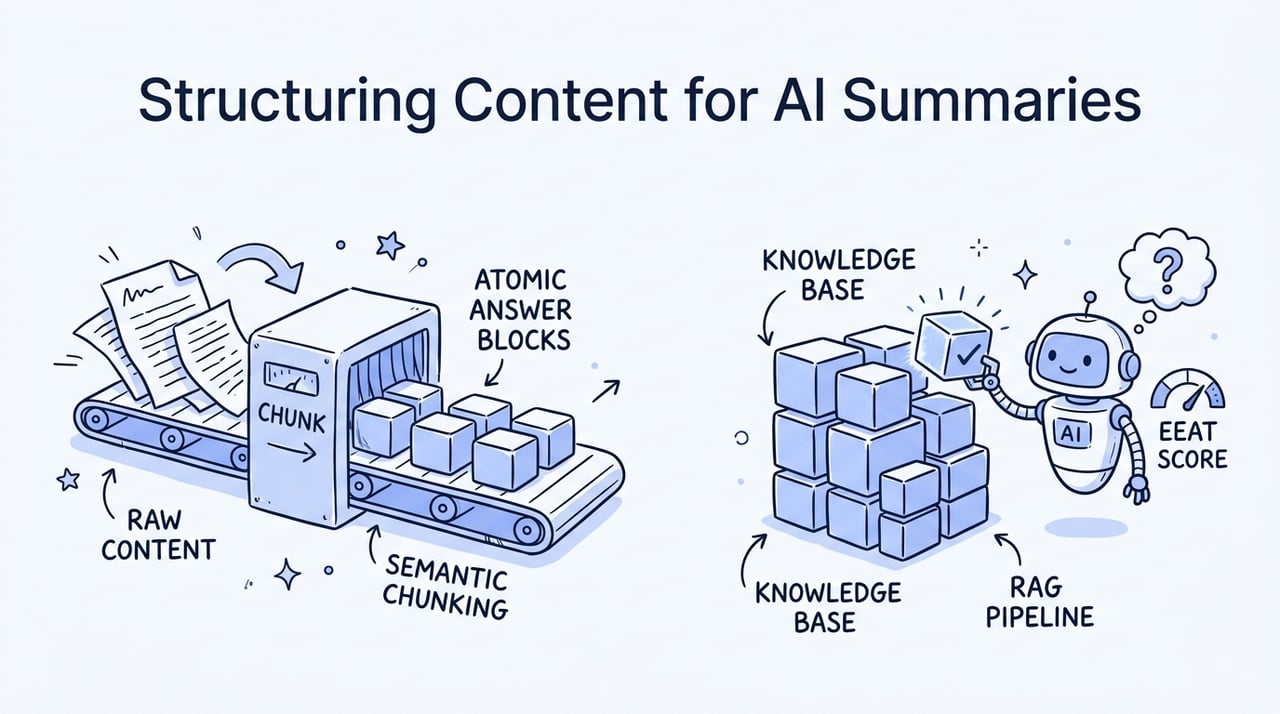
Ranking number one is a vanity metric that no longer pays the bills. In 2026, the real battlefield is the Generative Engine, where 83% of high-intent queries result in zero clicks. If your content isn't being pulled into the AI Overview, you don't exist.
The shift from traditional SEO to Generative Engine Optimization (GEO) isn't about keywords anymore. It is about citation rates and factual density. Machines don't care about your narrative flow; they care about how easily they can extract your data.
The problem is not AI, but thin content produced at a massive scale. To survive the next wave of core updates, you must treat every page as a modular knowledge graph. You are either cited or you are invisible.
The Bottom Line on AI-Ready Content
96% of AI Overview citations come from sources with strong E-E-A-T signals.
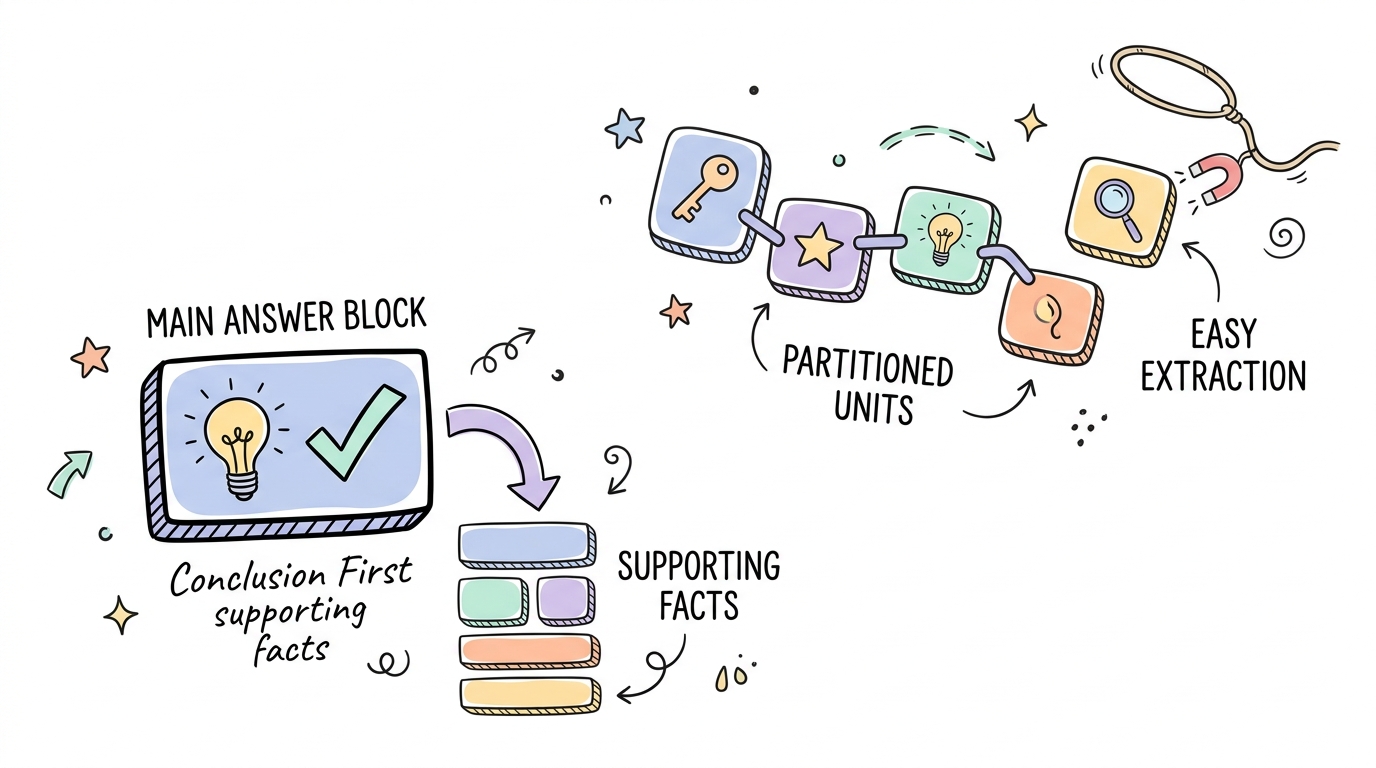
Traditional search looks for pages, but RAG pipelines look for chunks. To stay visible, your content must be partitioned into discrete units of 40-120 words for maximum extraction probability.
- Answer blocks must be 40-60 words to achieve a 2.7x higher extraction rate.
- E-E-A-T is now a binary gatekeeping filter rather than a quality nudge.
- Citations favor sites with verified author profiles and cross-platform consensus.
- Structure beats eloquence in the age of machine reasoning.
Atomic Answer Block
A concise, definitive response of 40 to 60 words that answers a specific user query immediately after an H2 or H3. This unit prioritizes factual density over narrative flair to ensure LLMs can pull the data without needing to summarize complex prose.
Implementation: Place the most critical conclusion in the first sentence. Bold key entities and recommendations to signal importance to machine scrapers and use clear, declarative language.
Tradeoff: This structure can feel abrupt to human readers used to long-form storytelling.
Heading structures that mirror exact natural language prompts like 'How do you...?' or 'What is...?'. These headers act as semantic signposts that tell an AI exactly what the following block is intended to solve.
Implementation: Research sub-questions using tools like Kitful AI or People Also Ask scrapers. Use H2 and H3 tags to create a logical hierarchy of information.
Tradeoff: Over-optimizing headers can make the table of contents look repetitive.
Semantic Triple Encoding
An advanced method of writing that explicitly states relationships between entities, such as 'Brand X developed Software Y'. This reduces the risk of AI hallucination by providing a clear subject-predicate-object structure for the RAG pipeline.
Implementation: Avoid using pronouns like 'it' or 'they' when referring to products or people. Always use the full entity name to maintain semantic clarity during the chunking process.
Tradeoff: The prose may feel slightly repetitive if names are used too frequently.
Q-Stack Blueprint
A layering technique that starts with a main broad question followed by 3 to 5 high-intent sub-questions. This creates a dense 'knowledge cluster' on a single page, making it a high-value target for citation.
Implementation: Map out a parent query and identify the top five adjacent questions people ask. Build a sequence of Answer Blocks that address each specific point in order of importance.
Tradeoff: Maintaining the blueprint across thousands of pages requires significant planning.
Tip: Machines prioritize factual density and structural clarity. Always state your conclusion first to capture the highest extraction probability.
Example
What is the Answer Block Framework?
The Answer Block Framework is a content methodology where information is partitioned into self-contained units of 40-120 words. This structure maximizes the probability of extraction by AI models like Gemini and ChatGPT by providing clear, fact-dense conclusions immediately following question-based headers.
Mastering Semantic Chunking for RAG Pipelines
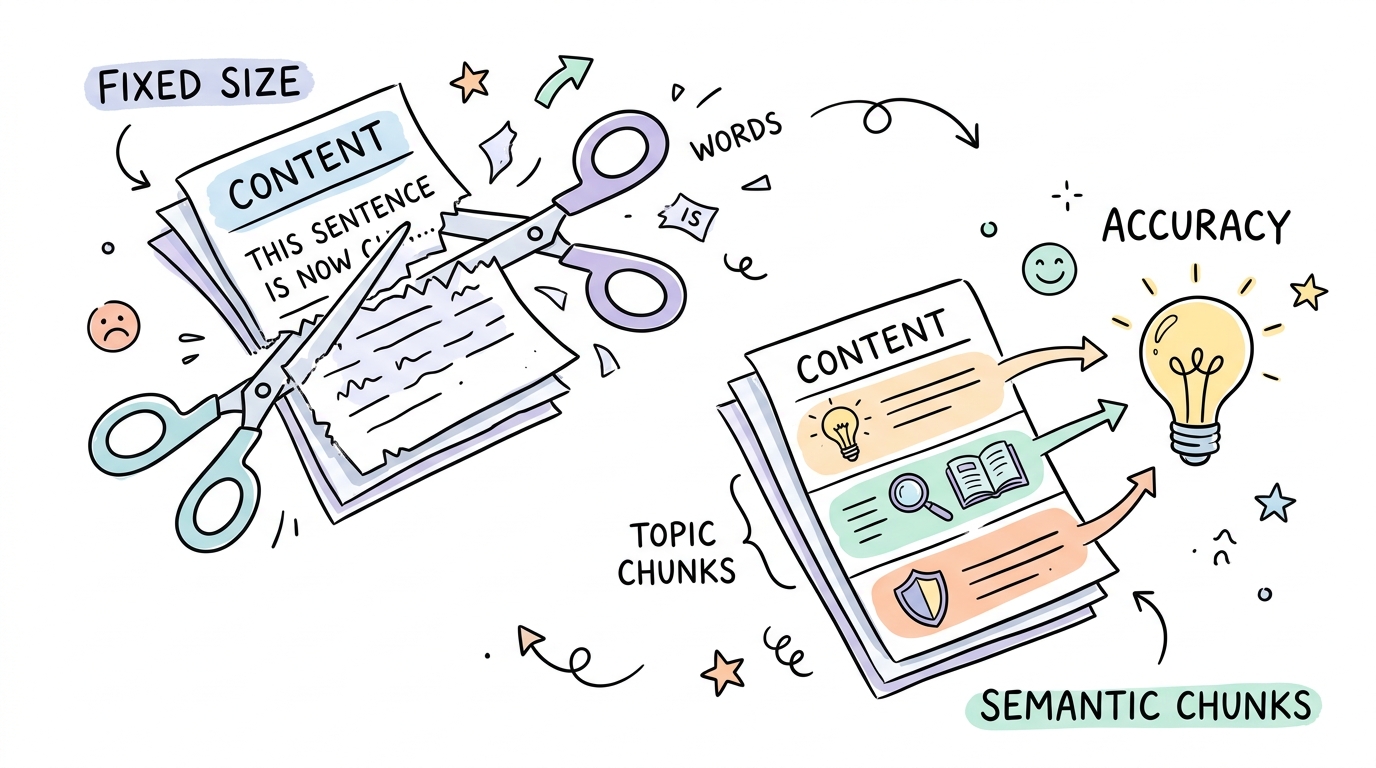
Retrieval-Augmented Generation (RAG) doesn't read your whole page at once. It breaks it into chunks, and if those chunks are split mid-sentence, the semantic meaning is lost forever.
- Fixed-Size Chunking: This method splits text every 300 to 500 characters regardless of context. It is the fastest for processing but often results in the lowest retrieval precision because it destroys logic.
- Semantic Chunking: This approach sets boundaries based on topic coherence. Using tools like the Salt.agency RAG Chunking Architecture can help you visualize how LLMs parse your content based on headers and paragraphs.
- Recursive Splitting: This progressive breakdown moves from paragraphs to sentences to tokens. It maintains the context needed for reasoning graphs while keeping the units small enough for fast retrieval.
- If the topic is a simple fact, then use a 40-word Answer Block + FAQ Schema.
- If the topic is a nuanced process, then use Recursive Splitting to keep context intact.
- If you are building a knowledge base, then prioritize semantic boundaries over character counts.
- If the query triggers an AI Overview, then place the primary Answer Block at the very top of the section.
The Q-Stack ensures your page isn't just a wall of text, but a navigable knowledge graph. By layering intent, you satisfy both the human reader and the machine scraper simultaneously.
- Identify Sub-Questions: Scrape high-intent sub-questions using 'People Also Ask' tools or AI researchers. Focus on queries that reflect deep informational needs rather than simple definitions.
- Define the Hierarchy: Layer a main H2 question followed by three to five H3 sub-questions. This creates a logical flow of data that machines can easily index.
- Draft the Answer Blocks: Write a 40-60 word block for each header. Ensure each block is self-contained so it can be cited independently by an LLM.
- Supplement with Data: Add a data-dense table or bulleted list under the block. This allows the AI to extract information in multiple formats based on user preference.
- Apply Schema: Use FAQPage or HowTo markup to map these questions directly to the machine layer. This makes the intent of the page undeniable to search engines.
- Use explicit entity names instead of pronouns.
- State conclusions in the first sentence.
- Bold the most impactful phrase in each block.
- Use tables for structured comparisons.
- Link to verified author profiles via
sameAs schema.
EEAT as a Binary Filter: Why Citations Favor the 1%
High-Authority Citations
AI systems treat E-E-A-T as a binary filter rather than a subtle ranking factor. If your site fails the authority check, your content is effectively invisible to generative engines, regardless of how well it is written.
Implementation: Focus on earning mentions from high-authority industry journals and news outlets. According to the Wellows Analysis of 2,400 AI Citations, almost all citations come from high-EEAT sources.
Tradeoff: Building this level of authority takes significantly more time than traditional link building.
Distribution is the new backlink in the age of AI. Generative engines look for consensus across multiple platforms like Reddit, YouTube, and news sites to verify that your brand is a trusted authority.
Implementation: Don't just publish on your blog; distribute your core facts across social and community platforms. AI models use these cross-platform signals to validate facts found on your website.
Tradeoff: Managing a multi-channel presence increases your content production costs.
Verified Author Profiles
AI search engines need to know exactly who is behind the content to assign trust. Every piece of content must be tied to a verified author profile with external citations like LinkedIn or Industry Press.
Implementation: Use Person schema to link your authors to their external social and professional profiles. This allows the AI to connect the author entity to established trust networks.
Tradeoff: It requires your authors to have a pre-existing public footprint.
Rule: You must treat E-E-A-T as a pass/fail gatekeeper. If you lack brand mentions, you will not appear in AI Overviews.
The Machine Layer: Schema and Semantic Triple Encoding
Schema is the bridge between human prose and machine logic. Without it, you are asking the LLM to guess the structure of your data rather than providing it as a definitive map.
- FAQPage Schema: Use this to explicitly label your Q-Stack questions and answers. It ensures the Answer Block is recognized as the definitive response to a specific query.
- sameAs Schema: Use this to link your brand and authors to trusted external profiles like Wikipedia or LinkedIn. This builds entity trust by connecting you to the wider knowledge graph.
- Semantic Triple Encoding: State relationships clearly in your text using a subject-predicate-object format. For example, explicitly write
Brand X provides Service Y to help the engine verify your service offerings without ambiguity.
/* /schema/faq-answer-block.json */
{
  "@context": "https://schema.org",
  "@type": "FAQPage",
  "mainEntity": [
    {
      "@type": "Question",
      "name": "How do you structure an Answer Block?",
      "acceptedAnswer": {
        "@type": "Answer",
        "text": "An Answer Block should be 40-60 words long, placed immediately under a Question-Based Header. It must state the conclusion first and include bolded entities to maximize AI extraction probability."
      }
    }
  ]
}
You can find more documentation on Schema.org FAQPage Documentation to ensure your JSON-LD is valid. Use a schema validator to confirm that your Answer Blocks are correctly mapped before publishing.
Scaling Safely: Programmatic SEO and the 2026 Abuse Penalty
Scaling content with AI can be a trap if you ignore human-in-the-loop oversight. Google's March 2026 update has led to an average 50-80% traffic drop for sites caught using scaled content abuse.
- Use Smart Templates: Instead of pure generation, use templates that inject unique entity data into a fixed Answer Block structure. This ensures every page has a verified factual core that AI can trust.
- Human Verification: Every Answer Block must be checked by a human for accuracy. AI humanizers, like the one provided by Kitful AI, can help make automated text feel more natural and expert-driven.
- Review Spam Policies: Stay updated on Google's Site Reputation Abuse Policy (2026 Update) to avoid penalties. Scaling is only safe when authority signals accompany the content volume.
Pitfall: Avoid pure AI generation without verification. Scaling 'thin' AI content without human oversight is a guaranteed way to trigger the Scaled Content Abuse penalty.
Audit Checklist: Are You Cited or Invisible?
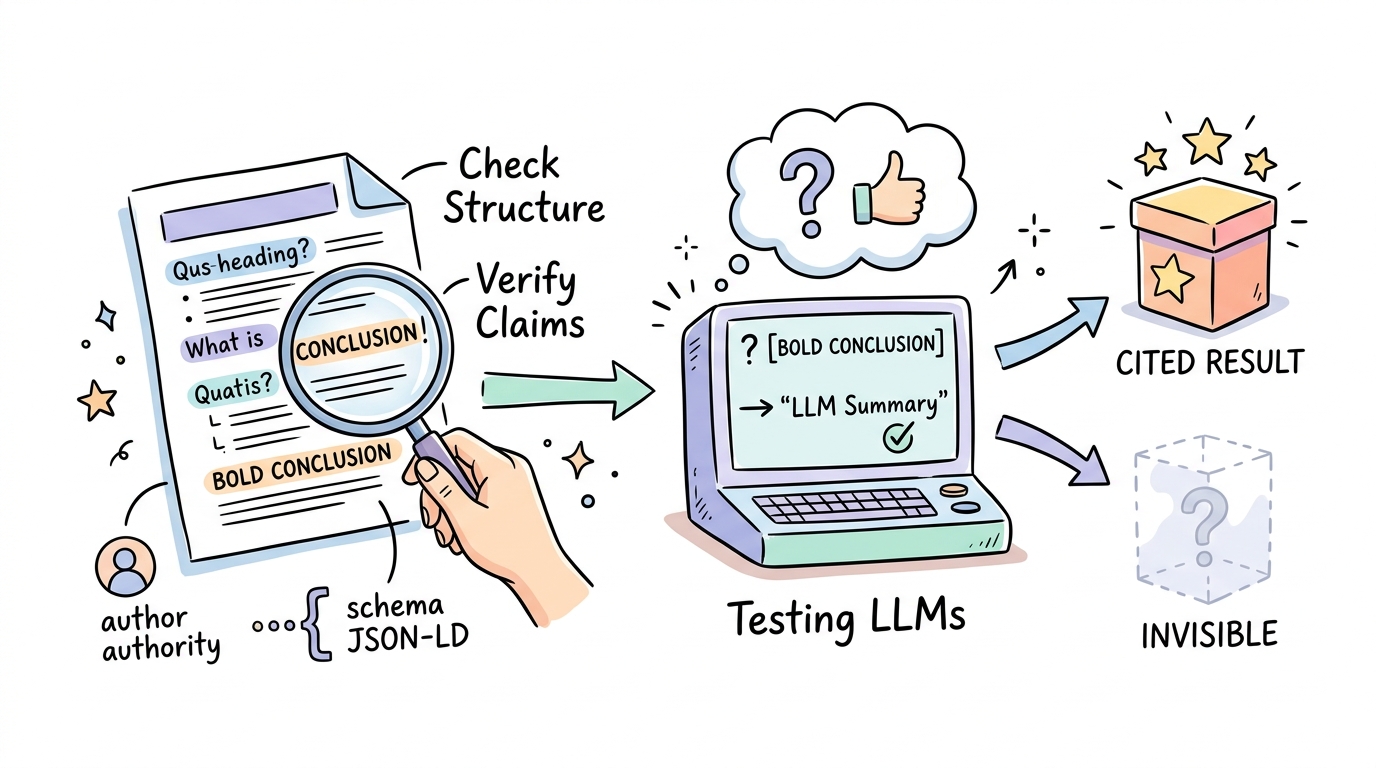
To verify your work, paste your content into an LLM and ask it to summarize the answer based only on the text. If the model can't find your conclusion in the first few lines, your structure needs more work.
The Future of Search is Modular
The era of the long-form narrative is being replaced by the era of the modular knowledge graph. To stay relevant, you must prioritize factual density and structural clarity over flowery prose.
Modern RAG systems are designed to reason through your content, not just find keywords. If your site isn't built to be cited, it effectively doesn't exist in the modern search landscape.
Start auditing your top-performing pages for Answer Block compatibility today. Your future visibility depends on how well you map your knowledge for the machines.
Expert AEO & Chunking Questions
What is semantic chunking for RAG?
Semantic chunking is a method of breaking content into pieces based on topical boundaries rather than character counts. This ensures that the context and logic of a paragraph are preserved, which improves AI retrieval accuracy by up to 5x.
Why does EEAT matter for AI Overviews?
AI systems use EEAT as a pass/fail filter to ensure they aren't citing misinformation. Data shows that 96% of all AI citations come from sites with high authority and verified author entities.
How long should an Answer Block be?
The ideal length is between 40 and 60 words. This size is small enough for a machine to extract without needing to summarize, but long enough to provide a complete factual conclusion.
Can I use AI to write Answer Blocks?
You can, but you must use human-in-the-loop oversight to avoid penalties. Using a tool like Kitful AI to research and draft, followed by human fact-checking, is the safest way to scale content for 2026.
 Kitful