BlogAdvanced Programmatic SEO with AI Workflows: Fine-Tuning LLMs for Dynamic Content Generation in 2026
Advanced Programmatic SEO with AI Workflows: Fine-Tuning LLMs for Dynamic Content Generation in 2026
Traditional template-and-spin programmatic SEO is dead. Learn how to implement advanced AI workflows, fine-tune LLMs, integrate Model Context Protocols, and secure your search presence against Google's latest scaled content abuse guidelines.
•8 min read
Publishing thousands of templated pages in a single afternoon will destroy your organic search visibility in 2026.
Google's strict spam policies systematically flag repetitive, low-value scaled content that relies on basic keyword-swapping. Traditional programmatic methods are completely obsolete.
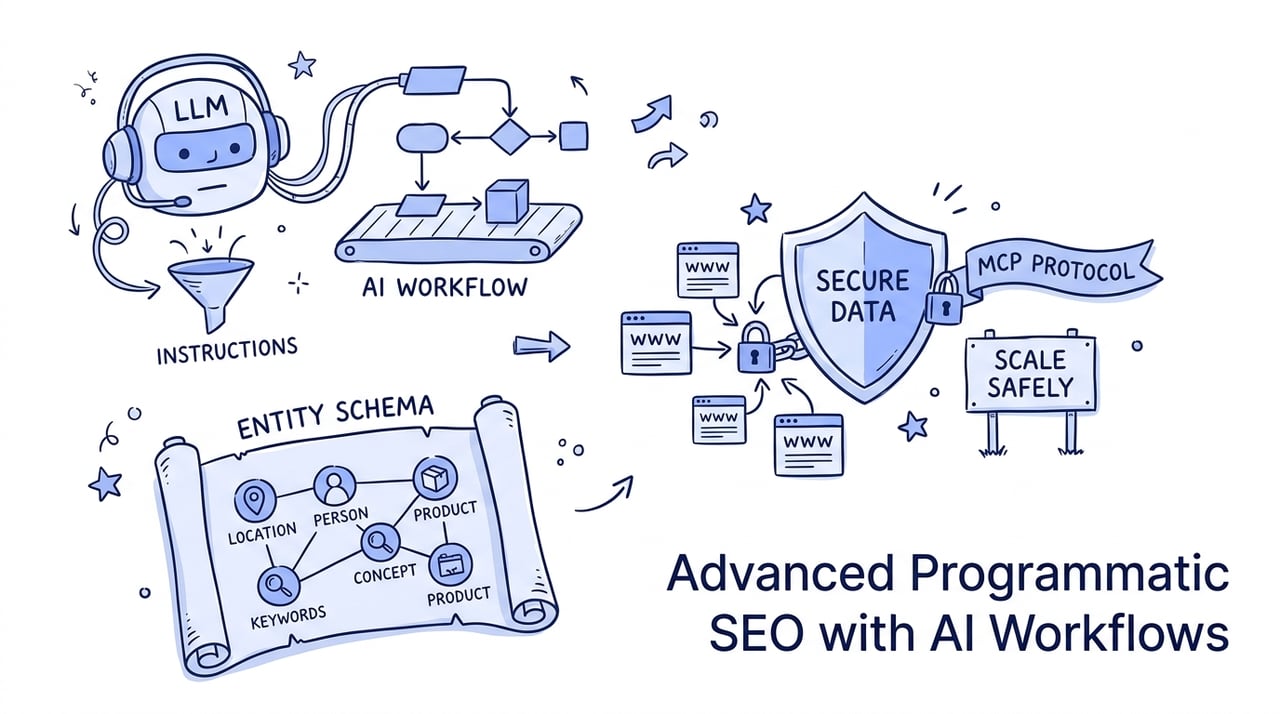
Modern scale requires a fundamentally different approach. Instead of rigid variable-swapping, sophisticated programmatic SEO with AI workflows lets you move past rigid templates and build something actually useful.
With nearly 30% of product research shifting directly to generative AI assistants, your content must satisfy both traditional search algorithms and generative engines.
This guide explains how to build a highly unique, entity-first programmatic pipeline that survives algorithmic scrutiny and secures priority citations in modern AI search results.
The 2026 AI-Powered Programmatic Playbook
To succeed with automated publishing, you must prioritize semantic depth and dynamic layout variety over pure production speed.
Here is your quick summary of the modern programmatic strategy:
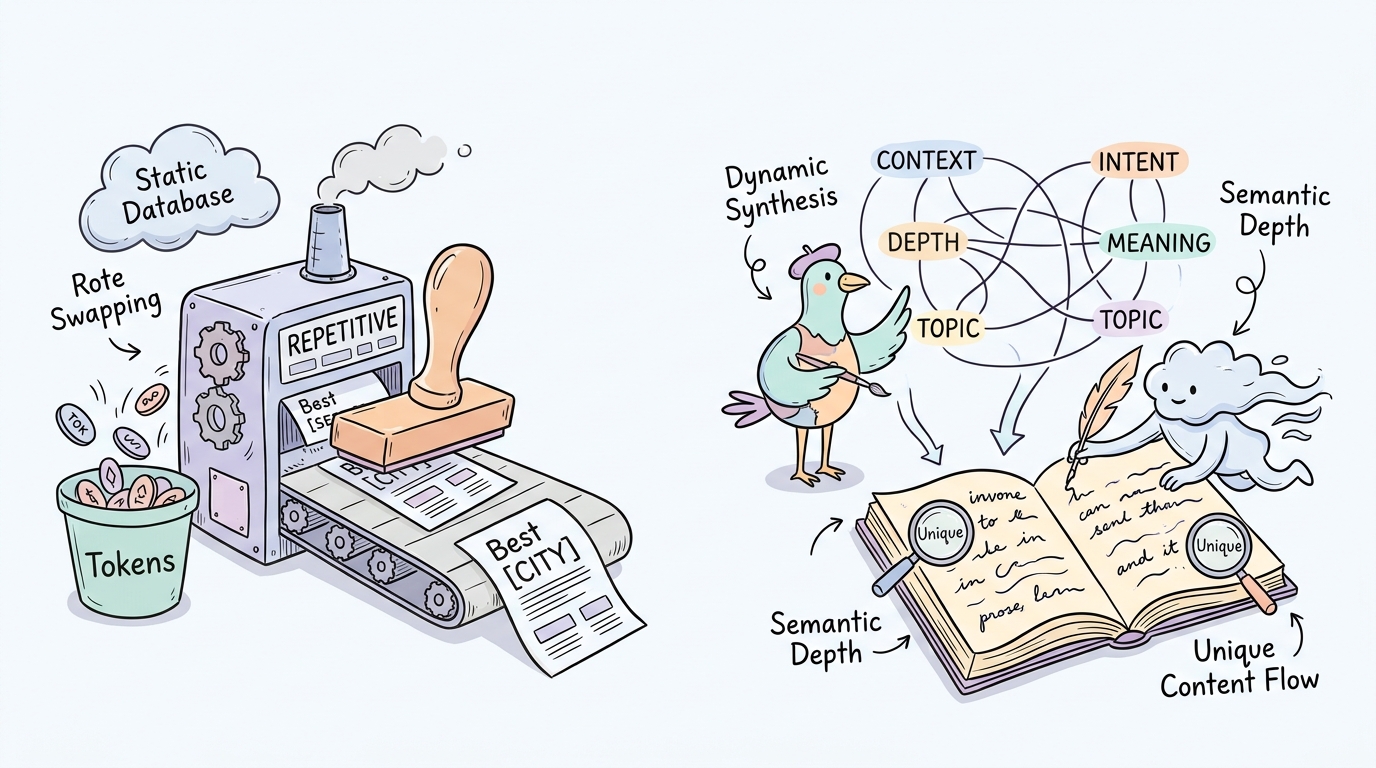
Dynamic AI Synthesis: Move away from static templates and deploy fine-tuned models to write contextually unique sections for each individual leaf page.
Uniqueness Thresholds: Implement automated quality controls ensuring at least 60% text uniqueness across all generated sibling pages.
Entity-First Scaffolding: Construct comprehensive JSON-LD schema linking local and product properties to reputable external Knowledge Graphs.
Siloed Linking: Connect programmatic nodes into clean parent-child directories to preserve and distribute your site authority.
Why Legacy Templates Fail: The Modern Paradigm Shift
Legacy programmatic SEO fails because search systems evaluate semantic depth and structural uniqueness instead of rote variable templates.
To build a defensible traffic channel, you must transition your workflow from static database swapping to dynamic agentic synthesis. This shift ensures every published node contains highly differentiated insights.
Here is a walkthrough that covers the key steps of this modern execution:
Keep these core structural transition rules in mind as you migrate your system:
If your pipeline relies on simple keyword-swapping templates, then expect immediate indexation drops and site quality flags.
If you deploy fine-tuned local models to synthesize unique contextual paragraphs, then you will maintain high indexation rates.
If you optimize exclusively for blue links, then you will miss out on key generative engine citations.
Prerequisites for Defensible Programmatic Infrastructure
A resilient programmatic architecture requires a structured database, clean CMS integrations, and secure API permissions.
You cannot build a defensible pipeline using scraped web feeds. Secure, isolated API controls prevent unauthorized administrative access during execution.
Note: Always restrict writing agents to drafting permissions only. Never give an LLM administrative root access to your live CMS environment.
Make sure your development environment has the following components ready:
A structured source database containing specific proprietary data points rather than general public lists.
Standard CMS access configured with limited, non-admin editing permissions.
API access to models like Gemini or local Llama instances mapped securely.
Automated similarity audit scripts to evaluate sibling pages before they go live.
Step-by-Step: Setting Up Your Programmatic SEO with AI Workflows
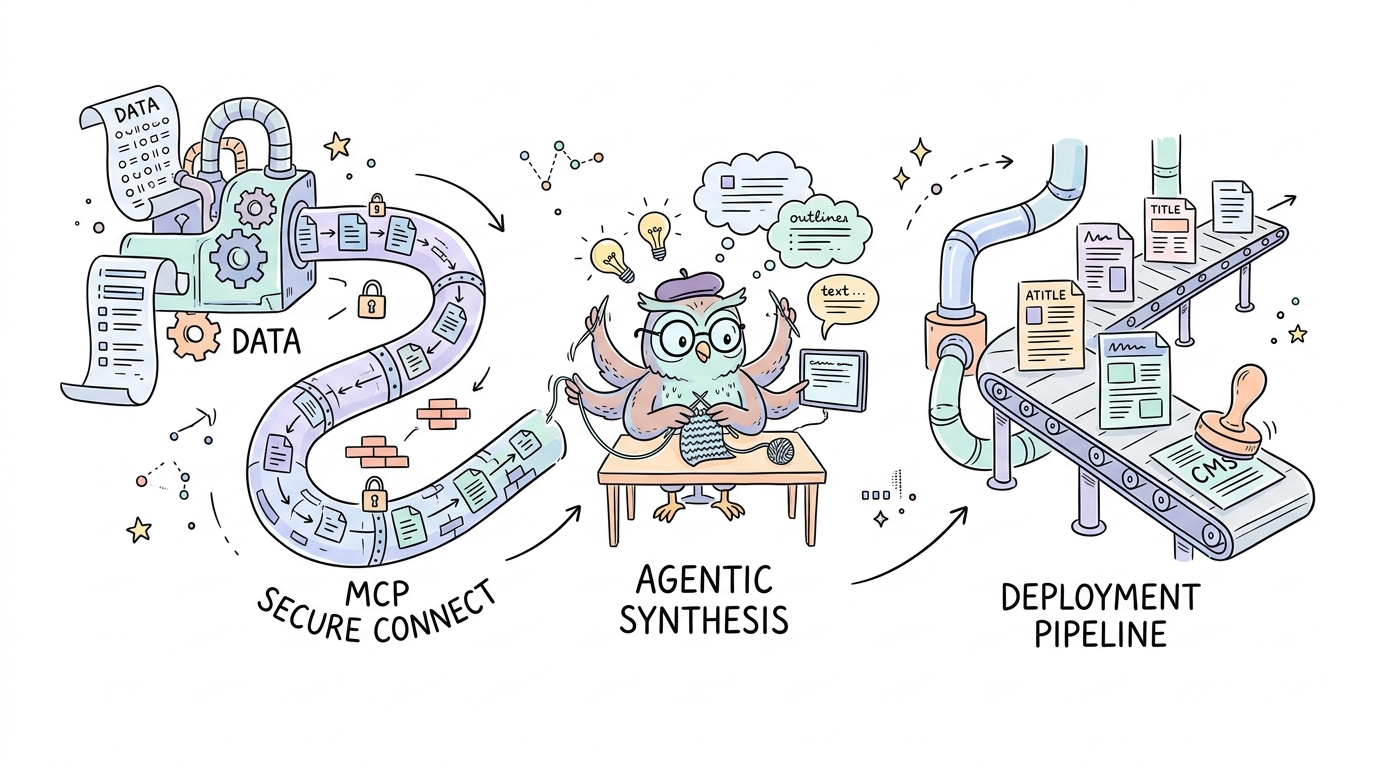
Building an advanced programmatic pipeline requires converting structured database rows into unique editorial sections through secure protocols.
This workflow ensures every node is deeply informative and highly secure. We start by preparing our database, configuring an interface adapter, and running automated drafting agents.
Clean Your Source Dataset: Extract and organize your unique data points within a standard database. Avoid generic lists and focus on proprietary metrics, API responses, or specialized local files.
Configure a Model Context Protocol: Set up secure Model Context Protocol adapters inside your CMS to establish a safe communication bridge with your writing agent.
Deploy Fine-Tuned Agentic Synthesis: Direct your LLM agent to ingest database variables and draft custom paragraphs. Use the WordPress PageForge Plugin to handle localized SEO structures and integrate these dynamic writing outputs directly.
Execute Uniqueness Audits: Run programmatic checks on draft folders to verify every piece of content meets similarity requirements.
Consider the case of Sarah, an affiliate site operator who stacked Claude Code with Perplexity to audit competitor keyword gaps. She was struggling to maintain indexing on her local comparison guides during core updates. By deploying automated agentic rewriting to build highly specific regional market insights, her directories regained 100% indexing and secured prime featured listings within weeks.
Here is a sample configuration representing a secure CMS adapter connection policy:
Entities, Schema, and the Generative Engine Optimization Matrix
Entity schemas and structured relationships serve as the primary map that search engines and AI assistants use to parse your site.
While adding JSON-LD schema is vital for setting up your site structure, it is not an instant shortcut to top rankings.
+2.4% change in Google AI Mode citation frequency after adding JSON-LD schema alone, proving schema must be combined with high domain authority to drive rankings.
Optimize your site for Generative Engine Optimization by connecting your internal organization schemas to verified external entities. Use sameAs properties pointing directly to Wikidata or official authority profiles. This builds a robust Content Knowledge Graph that AI crawlers can easily reference and cite inside Google AI Overviews and ChatGPT responses.
Siloed Internal Linking and the Content Knowledge Graph
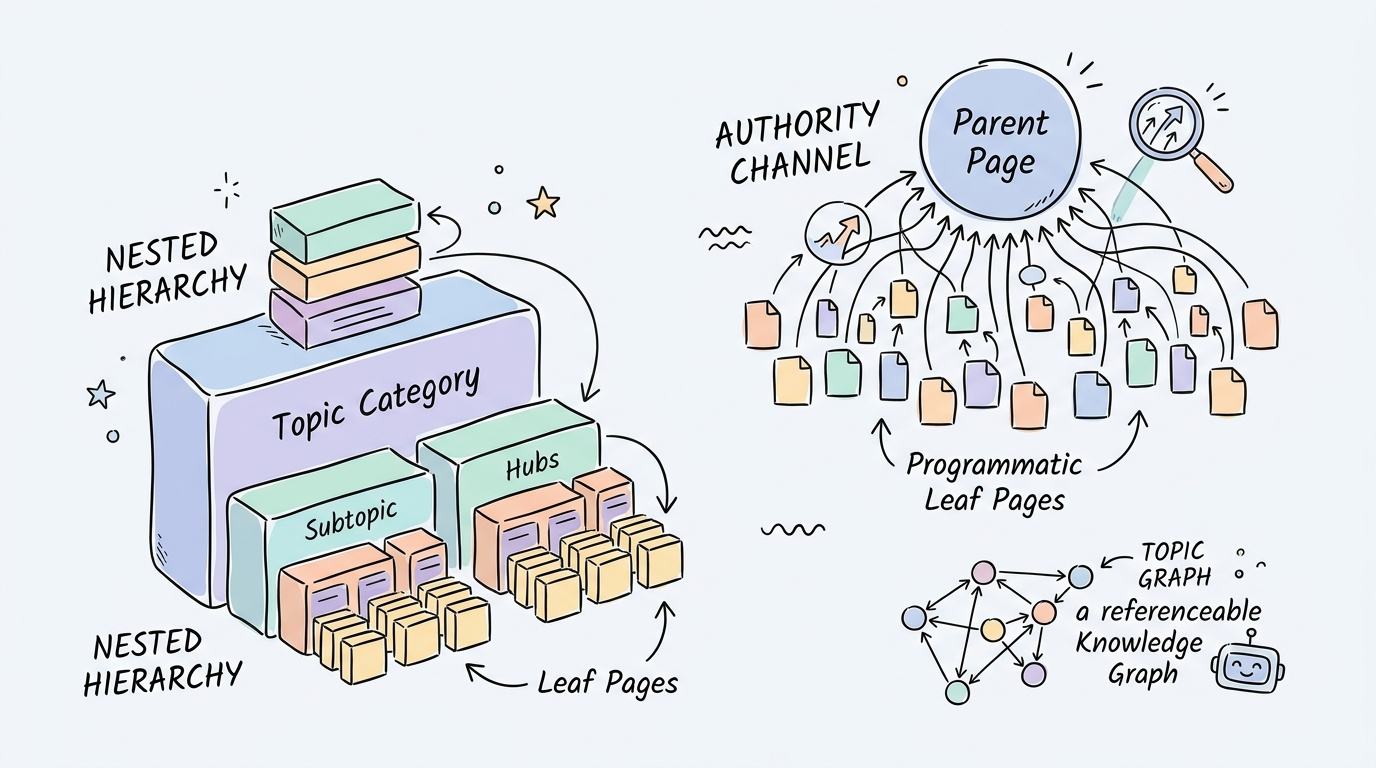
A structured parent-to-child linking architecture ensures search spiders can navigate thousands of programmatic pages without wasting crawl budget.
This organized framework establishes clear topical relationships and channels authority from individual dynamic nodes back to your main category pages.
Design your directory structure so leaf pages always link back to parent category pages. This keeps your topical coverage logically grouped.
While advanced writing platforms like Kitful AI have smart internal linking features listed as coming soon, you can easily implement automated database scripts to map your parent-to-child internal linking loops dynamically.
Safeguarding Against the 2026 Scaled Content Abuse Penalties
Defending your site against Google's modern spam updates requires establishing strict programmatic quality controls before publishing.
If your pages merely swap single terms inside identical layout blocks, search systems will systematically classify your directories as thin content.
Configure automated similarity sweeps to verify that each draft contains a minimum of 60% unique content compared to its sibling pages. Avoid releasing large blocks of pages all at once. Instead, schedule a gradual rolling publication of 10 to 15 verified, reviewed drafts per day to keep your crawling patterns natural.
The 2026 Tool Stack for Advanced Programmatic Operators
Modern programmatic campaigns rely on a combination of automated page builders, developer terminal tools, and monitoring suites.
Selecting the right tools keeps your automated drafting fast, safe, and highly optimized for modern search environments.
PageForge Pro: Excellent for automated page generation inside self-hosted WordPress environments. Link to the PageForge Pro Platform to get started.
Tradeoff: Requires managing a self-hosted CMS.
Implementation: Connect PageForge directly to your local CSV export and run batch processing of under 100 pages.
Claude Code: A powerful terminal interface designed for automated audits and fast local file modifications.
Tradeoff: Requires comfort with command-line tools.
Implementation: Run Claude Code locally to analyze search console data and update internal linking structures.
Sight AI: A specialized content monitor for tracking brand mentions across AI search engines.
Tradeoff: Can be expensive for early-stage sites.
Implementation: Use Sight AI webhooks to monitor how generative models quote and summarize your pages.
Kitful AI: An automated SEO writing platform offering high-quality text humanization and direct publishing integrations.
Tradeoff: Restricted by a monthly credit system.
Implementation: Set up the Autoblog tool to schedule and humanize high-quality programmatic draft folders automatically.
Tool
Best For
Pricing
Tradeoff
PageForge Pro
Automated WordPress Generation
Pro Plans
Requires self-hosted WP
Claude Code
Terminal-based automated audits
Usage-based
Requires developer comfort
Sight AI
Citation Tracking & GEO
Enterprise
Expensive for small teams
Kitful AI
Automated SEO & Multilingual Drafting
$49/mo (All-In-One Plan)
Monthly credit limits
Strategic Decision Matrix: Choosing Your Pipeline
Your programmatic pipeline must match your specific business model and industry risk profile.
Highly regulated niches demand strict factual validation routines, while local transactional sites can run on lightweight templates.
Use these strategic rules to determine the best approach for your programmatic campaign:
If you operate in highly regulated niches, then enforce a minimum 3-source enrichment rule and include explicit schema verification.
If you are building transactional service directories, then deploy PageForge templates utilizing precise local datasets.
If indexation rates drop suddenly, then pause bulk publishing and schedule 10 to 15 highly reviewed drafts daily.
Building a Defensible Moat in the Generative Era
Scaling content in the generative search era is no longer about who can publish the fastest.
The competitive edge belongs to brands that build deep, contextually rich page variations powered by secure AI architectures.
By implementing secure protocols, maintaining strict uniqueness thresholds, and establishing cohesive internal linking structures, you create an enduring search presence.
For teams looking to streamline this workflow without complex manual coding, Kitful AI offers a complete content automation platform with direct publishing features, native-quality writing in over 50 languages, and built-in text humanization starting at just $49 a month. Take control of your publishing pipeline and build your competitive moat today.
Expert FAQ: Programmatic Scale & Search Safety
How does Google classify programmatic content as scaled abuse?
Google flags scaled content that lacks human editing, exhibits massive volume without original value, and uses repetitive templates that simply swap keyword strings. If your automated pages fail to reach the 60% uniqueness threshold, your domain risks manual action or algorithmic demotion.
Can schema markup alone help my pages rank in AI Overviews?
No, schema is not an instant rankings lever. While it organizes your content, tests show schema markup on its own has a minimal impact on AI mode citations. It must be paired with high domain authority and deep, unique text to drive consistent citations.
Why is Model Context Protocol security important?
Giving LLM writing agents full administrative access to your CMS exposes your site to severe vulnerabilities. Secure adapters isolate your agent, restricting its access to simple draft generation and preventing unauthorized code execution or database alterations.
 Kitful