BlogAI-Driven Internal Linking: Using Semantic Graphs to Power Link Equity in Large pSEO Sites
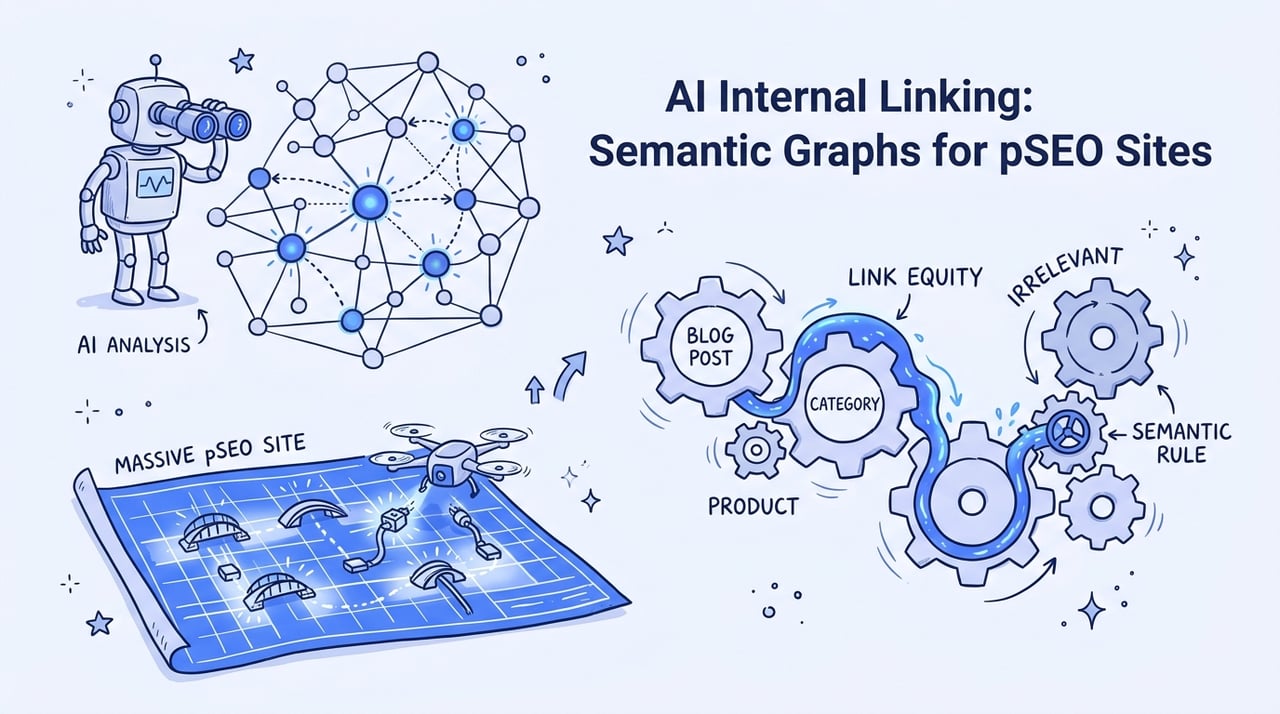
AI-Driven Internal Linking: Using Semantic Graphs to Power Link Equity in Large pSEO Sites
Scale your programmatic SEO safely in 2026. This technical guide outlines how to build an automated semantic internal linking pipeline using vector embeddings and database queries instead of outdated keyword matching.
•7 min read
Imagine launching 10,000 highly optimized programmatic pages, only to watch them rot in a dead state for three months.
This is the reality of many programmatic SEO campaigns. They get stuck in Google Search Console as "Discovered, currently not indexed" because search engines cannot crawl them efficiently.
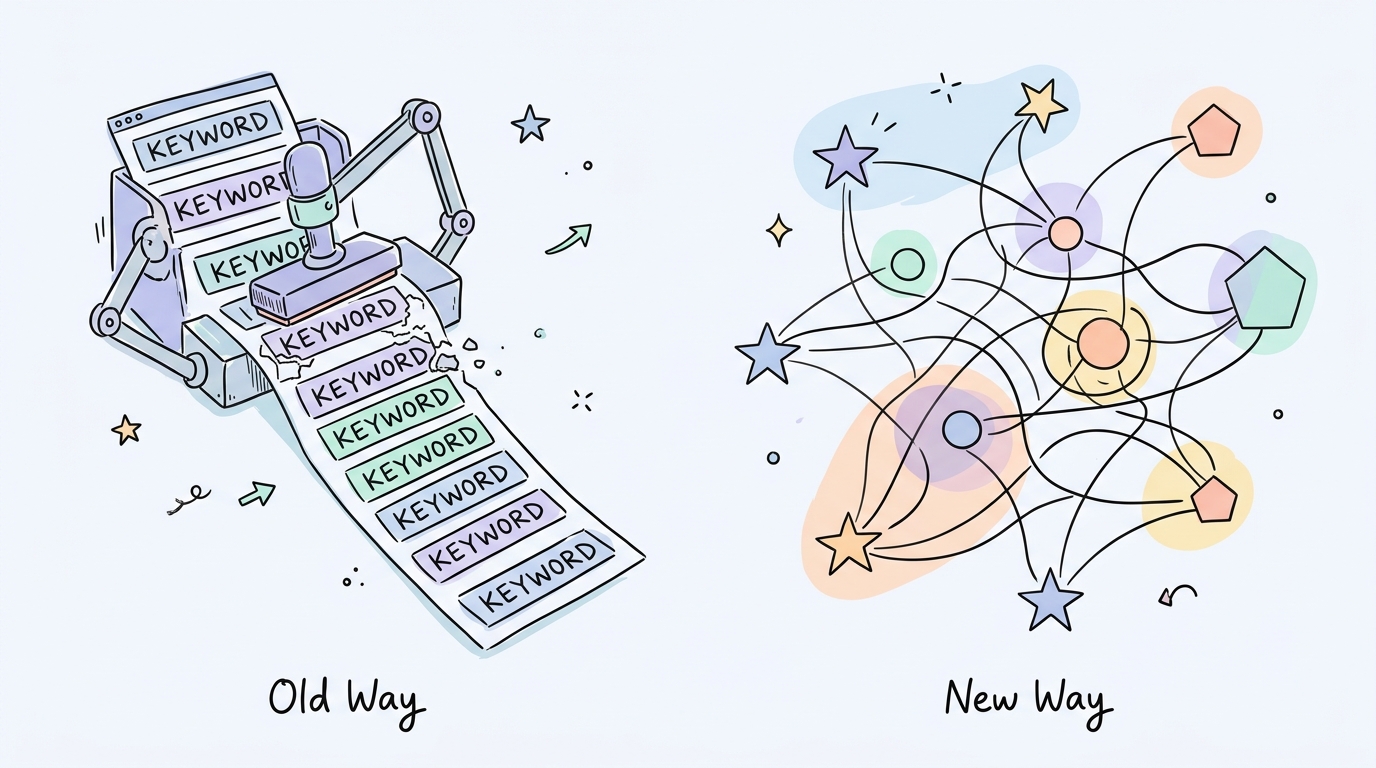
Traditional keyword-exact scraping for internal linking is too fragile. It relies on hardcoded string matches, which often miss the deeper context of your content. Worse, repeating exact-match anchors across thousands of pages makes your site highly vulnerable to Google's spam algorithms.
Internal linking is the single biggest driver of indexing scale and speed. To win, you must transition from fragile string matching to building a resilient semantic web. This guides search bots naturally through your domain hierarchy, ensuring every single page gets discovered and valued.
Bottom Line Up Front: Semantic Graphs vs. Rigid Architecture
Traditional internal linking methods leave massive amounts of organic traffic on the table. Here is the direct path forward.
Keyword scraping is fragile, triggers spam alerts, and typically misses up to 82% of potential contextual internal linking opportunities.
Constructing a contextual semantic graph guides both Google's search algorithms and modern AI crawl bots effectively through your domain hierarchy.
High-dimensional vector embeddings turn flat text into coordinates, allowing you to mathematically determine and link topical relevance.
Why Traditional Keyword-Based Linking Fails at Scale
Traditional keyword-based internal linking fails because exact-match strings are too rigid for modern search engines.
If your linking script only looks for exact words, it ignores semantic context and creates highly repetitive anchor text distributions. This footprint looks highly unnatural to automated quality filters.
Google core and spam updates successfully cleared a massive amount of thin, repetitive text from search results.
45% reduction in low-quality, unoriginal content achieved in SERPs shows how aggressively modern search engines target automated footprints.
Instead of helping crawl bots, repetitive templated keyword chains signal that your programmatic pages are mass-produced with minimal unique value.
To build a highly resilient architecture, you must move beyond raw keyword matching and focus on mathematical vector relationships.
Here is a walkthrough that covers the transition from keywords to vectors:
Keep your structural layout clean and contextual instead of hiding links where bots ignore them.
Pitfall: Placing all internal links in massive, sitewide footer blocks carries minimal link equity and triggers helpful content flags.
What Is the Ideal Internal Linking Architecture for pSEO?
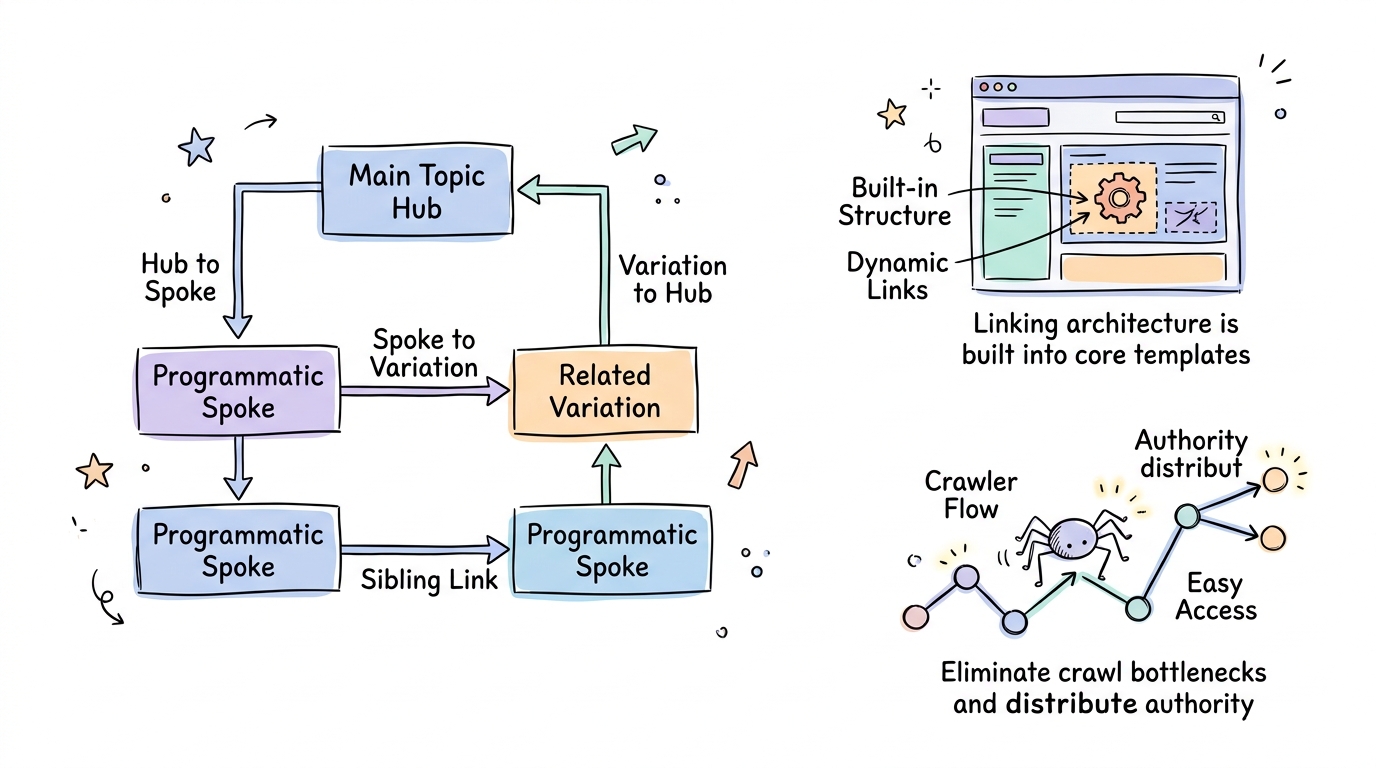
An ideal programmatic internal linking architecture must be built directly into your database templates. By establishing systematic, multi-directional relationships, you eliminate crawl bottlenecks and distribute link equity evenly across your entire domain.
Instead of leaving links to chance, organize your page relationships systematically to maintain a shallow crawl depth.
Link Type
Category
Primary Purpose
Hub to Spoke Link
Link Type Architecture
Links from category hub pages down to granular programmatic child pages.
Spoke to Variation Link
Link Type Architecture
Connects individual spoke pages to closely related modifier pages or adjacent locations.
Variation to Hub Link
Link Type Architecture
Provides vertical reverse paths back up the structural hierarchy to distribute authority.
Variation to Variation Link
Link Type Architecture
Lateral linking between sibling variations to prevent orphaned pages and keep crawl depth shallow.
How Do Vector Embeddings and Cosine Similarity Automate Relevance?
Vector embeddings and cosine similarity automate relevance by transforming raw text into mathematical coordinates and calculating the angular distance between them.
This methodology allows you to determine topical relevance programmatically without relying on exact-match keyword strings.
Instead of looking for raw strings, we use natural language processing to represent every web page as high-dimensional coordinates. For instance, when using the OpenAI Embeddings API Guide, we turn our raw page content into a vector. A page about "Brooklyn Apartments" and another about "Dumbo Real Estate" will naturally map near each other in this high-dimensional coordinate space.
Calculating the cosine similarity between these coordinates yields a mathematical score. A score above 0.82 typically indicates highly relevant, contextual relationships.
This system maps deep contextual connections that standard exact-match tools completely miss. Your site crawler, like the Screaming Frog SEO Spider, will then crawl a perfectly structured web of semantic relevance.
How to Build an Automated Semantic Vector Pipeline
Building a custom vector-embedding pipeline is the best way to maintain technical control over your site architecture.
While platforms like Kitful AI simplify SEO content generation and automate publishing workflows, building your own semantic linking script gives you absolute logic ownership. Follow this step-by-step roadmap to construct your automated pipeline.
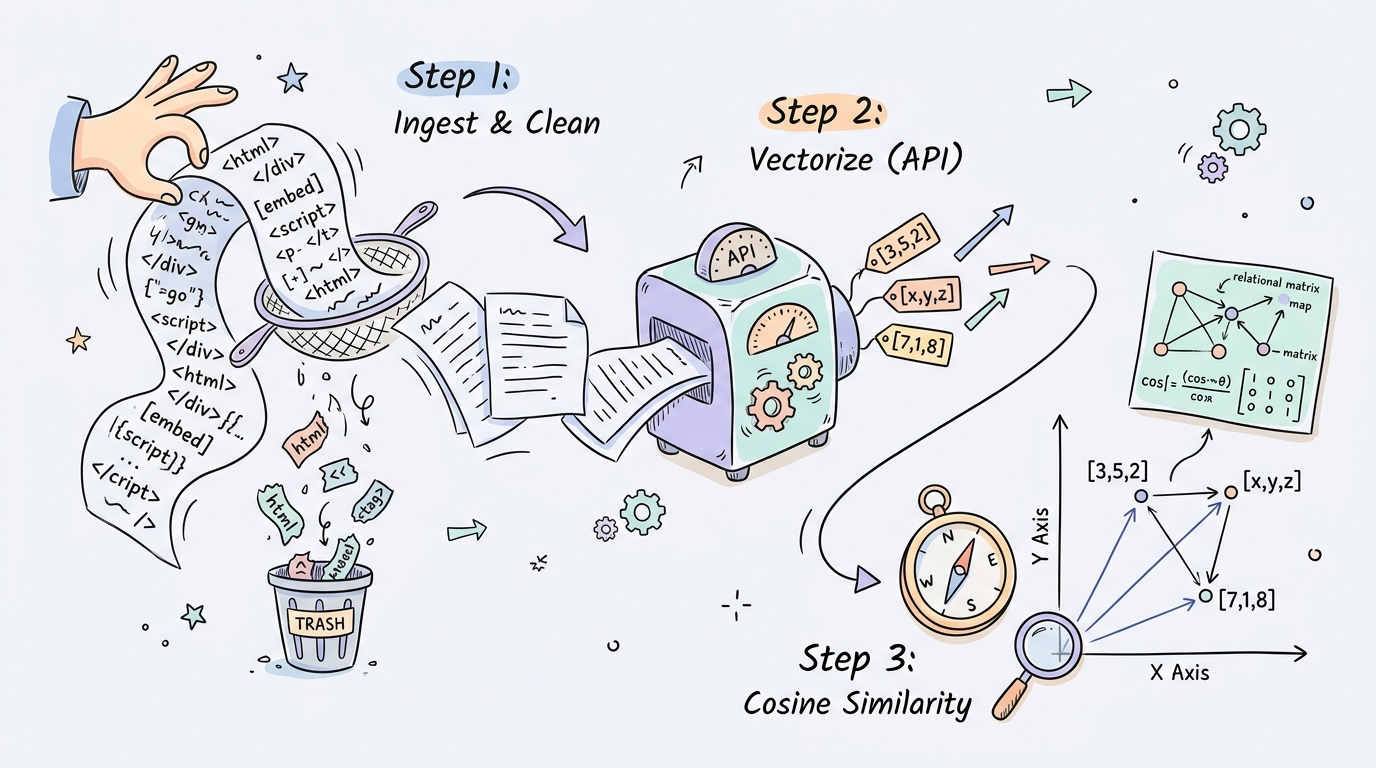
Ingest & Clean
Scrape the raw HTML content from your database. Strip out DOM tags, scripts, and shortcodes to isolate raw prose.
Vectorize
Run the isolated text chunks through an embedding model API to generate high-dimensional vector representations.
Calculate Similarity
Compute the cosine similarity score between all document vectors to build a relational semantic matrix.
Here is a clean Python script to calculate similarity scores between document embeddings:
# script.py
import numpy as np

def calculate_cosine_similarity(vec_a, vec_b):
    """
    Computes the cosine similarity between two high-dimensional vectors.
    Expected output is a float value between -1.0 and 1.0.
    """
    dot_product = np.dot(vec_a, vec_b)
    norm_a = np.linalg.norm(vec_a)
    norm_b = np.linalg.norm(vec_b)
    return float(dot_product / (norm_a * norm_b))

# Example: Comparing two page embeddings
embedding_page_1 = [0.15, -0.22, 0.85]
embedding_page_2 = [0.14, -0.20, 0.81]
similarity = calculate_cosine_similarity(embedding_page_1, embedding_page_2)
print(f"Similarity Score: {similarity:.4f}")  # Expected output: 0.9989 (highly similar)
Generate Anchors
Feed the surrounding text block and target page topic to an LLM to generate a natural, contextually appropriate anchor text.
API Injection
Write the generated anchor text and <a href> tag directly back to your CMS using REST API endpoints.
Tip: Implement randomized temperature checks in your LLM script to vary anchor text structure. This prevents Google from flagging exact-match anchor patterns.
Structuring Your Database for Dynamic Scale
Handling dynamic internal links across thousands of pages requires structured database logic to prevent slow load times.
Instead of running live, on-the-fly similarity calculations for every single page view, store your page vectors directly within your database.
Using PostgreSQL with the pgvector GitHub Repository extension allows you to run vector similarity searches directly inside your database queries. This keeps page loads lightning fast.
To prevent crawl chaos, avoid purely randomized link distribution. Implement a weighted relevance scoring formula that combines system categories with vector similarity:
This ensures that your dynamic links strictly respect your established architectural siloes while maintaining high semantic relevance.
How Do You Audit and Verify Your Dynamic Linking Health?
Auditing your dynamic internal links is the only way to guarantee crawlability and pass link equity cleanly.
Without continuous verification, scripting errors can easily leave thousands of programmatic pages stranded from search engines.
Ensure your linking script meets the necessary performance metrics by following this verification process:
Run post-publish crawls in Screaming Frog to identify and eliminate orphan pages entirely.
Verify that click depth across all generated programmatic pages is no deeper than 3 hops from the homepage.
Review the internal anchor text distribution report to confirm that keyword-exact anchor frequency is balanced with branded and descriptive variants.
Check that every programmatic page has at least two high-quality incoming internal links.
Critical Risk Mitigation: Site Reputation Abuse and AI Overviews
How does Google's site reputation abuse policy impact programmatic SEO?
Google's site reputation abuse policy targets automated sections hosted on authoritative domains purely to exploit borrowed PageRank. To protect your site, keep programmatic content aligned with your main domain topic and ensure your templates maintain at least 30% to 40% unique content variations.
How do you secure citations in AI search engines without FAQ schema?
Since the deprecation of FAQ schema, building deep semantic links is the most sustainable way to establish topical authority. These structured internal links help search engines and modern AI crawlers map the exact relationships between concepts on your website.
How many internal links should each programmatic page have?
Each programmatic page should have at least two to three incoming links and pass equity to related sibling pages. This lateral structure keeps your crawl depth shallow and ensures that no page is left orphaned in a "Discovered, currently not indexed" state.
Establish Your Technological Sovereignty
Stop relying on basic CMS plugins that trap your site architecture in proprietary databases.
When you build your own script, you own the programmatic logic. This is technological sovereignty in modern search engine optimization.
Controlling your own semantic coordinates means you control exactly how search engines understand your website. Start by vectorizing your top pages, calculating their cosine similarity, and injecting your first mathematical link paths.
 Kitful