BlogAutomated Topical Authority: An AI Internal Linking Framework for Affiliate Site Silos
Automated Topical Authority: An AI Internal Linking Framework for Affiliate Site Silos
Mass-produced AI content fails without robust site architecture. This technical guide outlines a scalable, 6-step AI internal linking framework built to secure topical authority, accelerate indexation, and defend against core spam updates.
•9 min read
I watched a niche site owner push 2,000 AI articles in a single weekend, only to see indexation flatline at exactly four percent. The site died before it ever had a chance to rank.
The truth is simple. Flat site structures fail under modern search evaluation. In 2026, launching isolated programmatic pages without a logical structure is the fastest way to get your domain ignored by Google.
When you scale content without dynamic internal linking, you create orphaned nodes. Search engines do not waste crawl budget on pages that sit in a dark corner of your sitemap. To survive, you must transform your site from a random pile of keywords into a tightly knitted web of semantic authority. Here is how I do it.
The Playbook at a Glance
To scale successfully in the modern search landscape, your site must run on an automated structural loop.
30% to 50% average increase in indexation rates achieved by programmatic sites using automated internal link silos.
A quick summary of the core items in our framework:
Vectorize your entire sitemap to map semantic connections.
Define strict hierarchical routing from high-level pillars to long-tail variations.
Extract natural anchors using LLMs to avoid unnatural keyword stuffing.
Audit your internal linking graph monthly to eliminate orphaned nodes.
Why Do Traditional Site Structures Fail Under 2026 Search Evaluations?
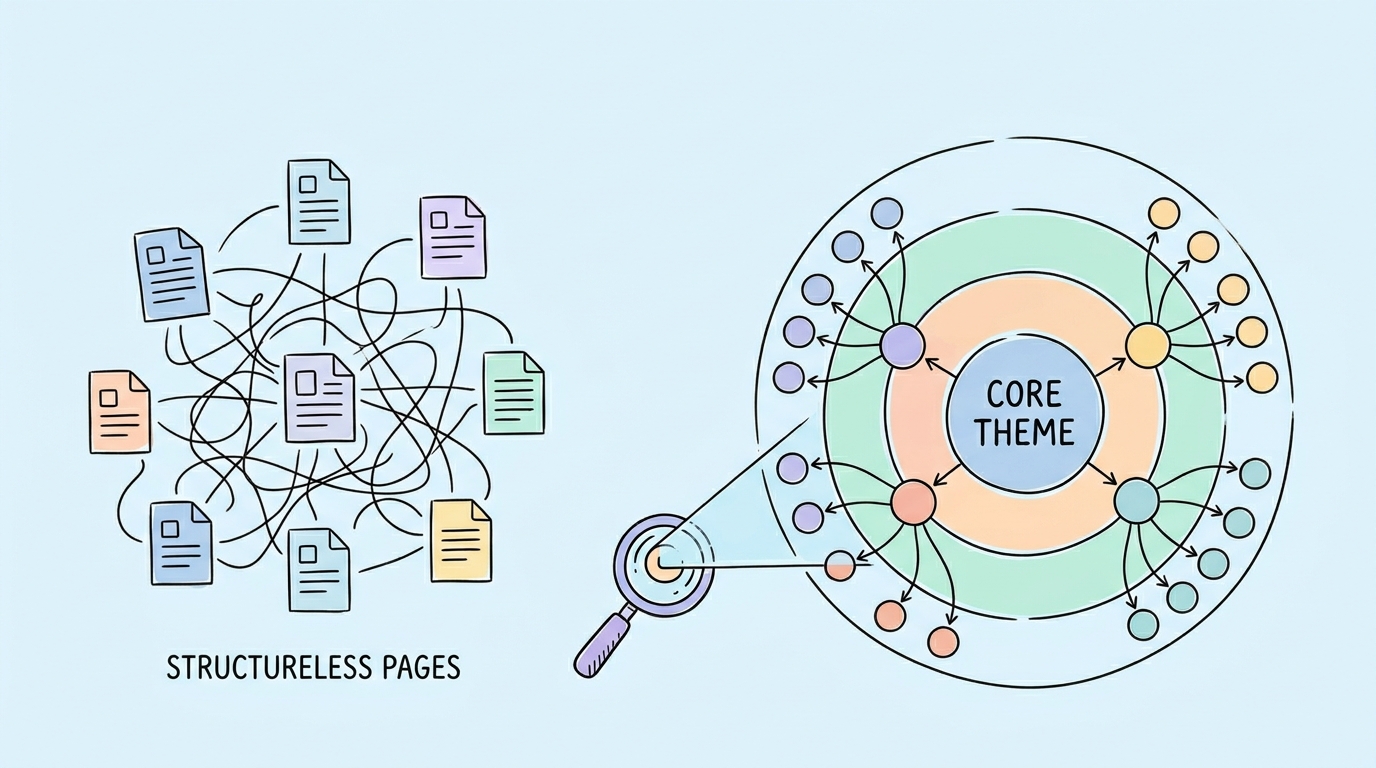
Traditional flat site structures fail because they do not communicate clear thematic boundaries to modern search engines. A modern semantic content hub nests Pillar, Spoke, and Node pages to concentrate PageRank effectively and map clear contextual relationships across your entire domain.
Here is a visual breakdown of how link equity flows through a semantic silo:
When you dump articles onto a flat directory without logical connections, search crawlers struggle to understand which page is your primary authority. Generative AI engines like Perplexity and ChatGPT rely heavily on descriptive anchor texts to verify entity relevance. They view every contextual link as an entity-relationship declaration, using them to map your brand's authority.
Deploying these cohesive topical content clusters can yield a massive 300% boost to organic traffic. By linking supporting nodes back to their master pillars, you tell search engines exactly which entity is the source of truth.
Tip: Always use descriptive, natural language in your anchor text rather than raw keywords. This tells both LLM engines and Googlebot exactly how the target page relates to the current content.
Step-by-Step: Deploying the AI Internal Linking Framework
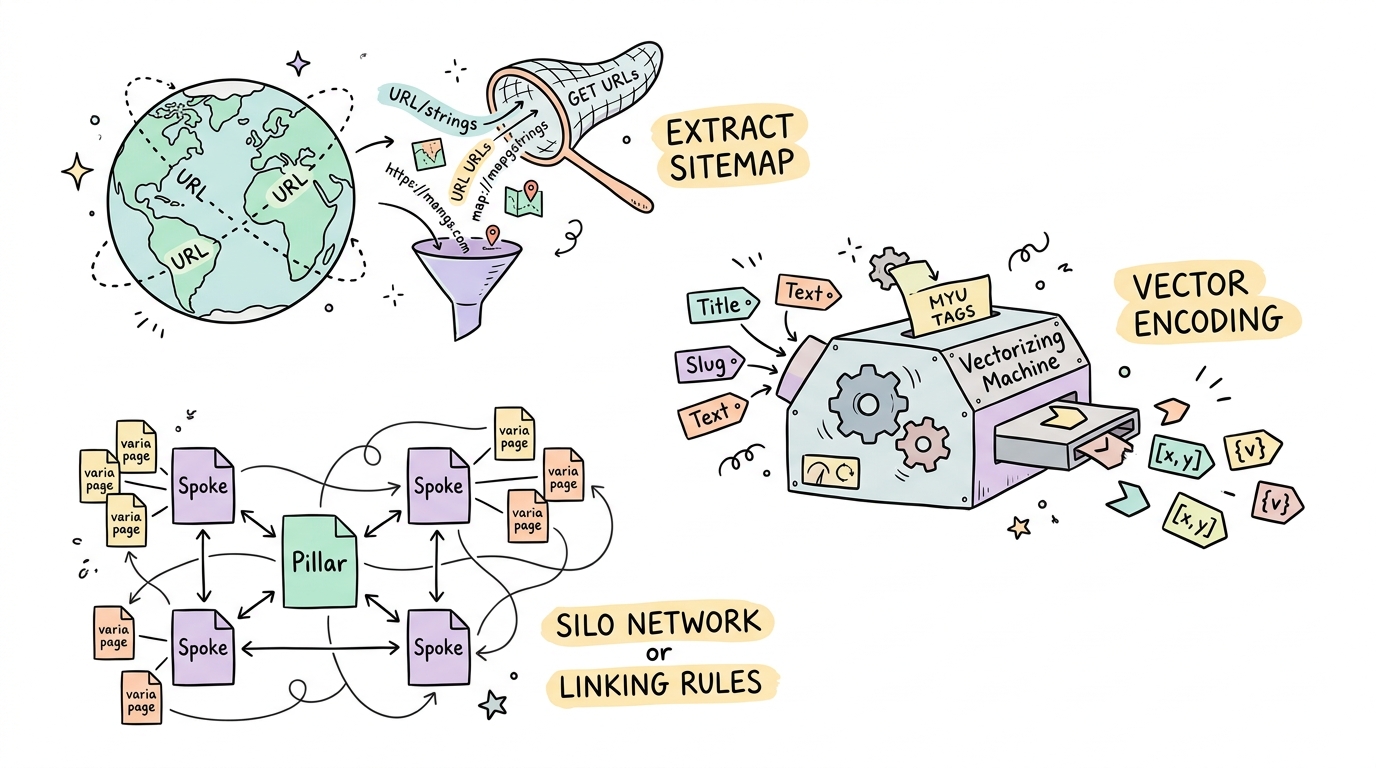
Building a modern, automated linking system requires shifting from manual editing to systematic, programmatic rules. I use a structured six-step pipeline to extract, map, and deploy links automatically across hundreds of pages.
Here's a walkthrough that covers the key steps:
Before executing, we must map our site's architecture. The pipeline begins by extracting our complete database of URLs and clustering them by topical relevance.
Consider Sarah, a high-ticket affiliate marketer who launched 400 deep-dive pages on indoor golf tech. Because she did not connect them structurally, Googlebot ignored her new pages for months, keeping her revenue at zero. Once she deployed this six-step framework, the automated internal links distributed crawl equity, forcing Google to index all 400 pages within ten days.
Here is the step-by-step system you should follow:
Extract the Sitemap: Download your complete sitemap.xml file. This acts as your live database of URLs, categories, and titles.
Vectorize URL Metadata: For sites with hundreds of pages, convert your page titles and URL slugs into vector embeddings. This allows an LLM to map semantic relationships without exceeding contextual token limits.
Define Silo Routing Rules: Categorize your pages into structural tiers. High-value hub directories act as Pillars, subtopic guides act as Spokes, and highly specific long-tails act as Nodes or Variations. Establish routing paths where Nodes must link to Spokes, and Spokes link back to Pillars.
Execute Anchor Extraction: Use a secondary LLM review on your article drafts. Instruct the model to find existing, natural sentences that align with your target URLs instead of forcing awkward keywords.
Configure Programmatic Templates: Build dynamic contextual link sections in your database templates to automatically link variant pages based on shared variables.
Run AI Drift Control: Audit your internal links monthly using custom scripts or crawling tools to find orphaned pages and verify crawlability.
Using a structured checklist keeps the system running smoothly over time as you publish more articles.
Ensure every new draft is parsed against your vectorized URL database.
Check that no page is more than three clicks away from the homepage.
Confirm that every Spoke page links back to its parent Pillar.
Verify that variations link laterally to other relevant variations.
How Do I Build Automated Link Rules for 1,000+ Programmatic Pages?
When you manage over a thousand pages, editing links by hand becomes impossible. You must establish logical routing rules within your database templates. This allows you to construct pathways that distribute PageRank automatically without manual intervention.
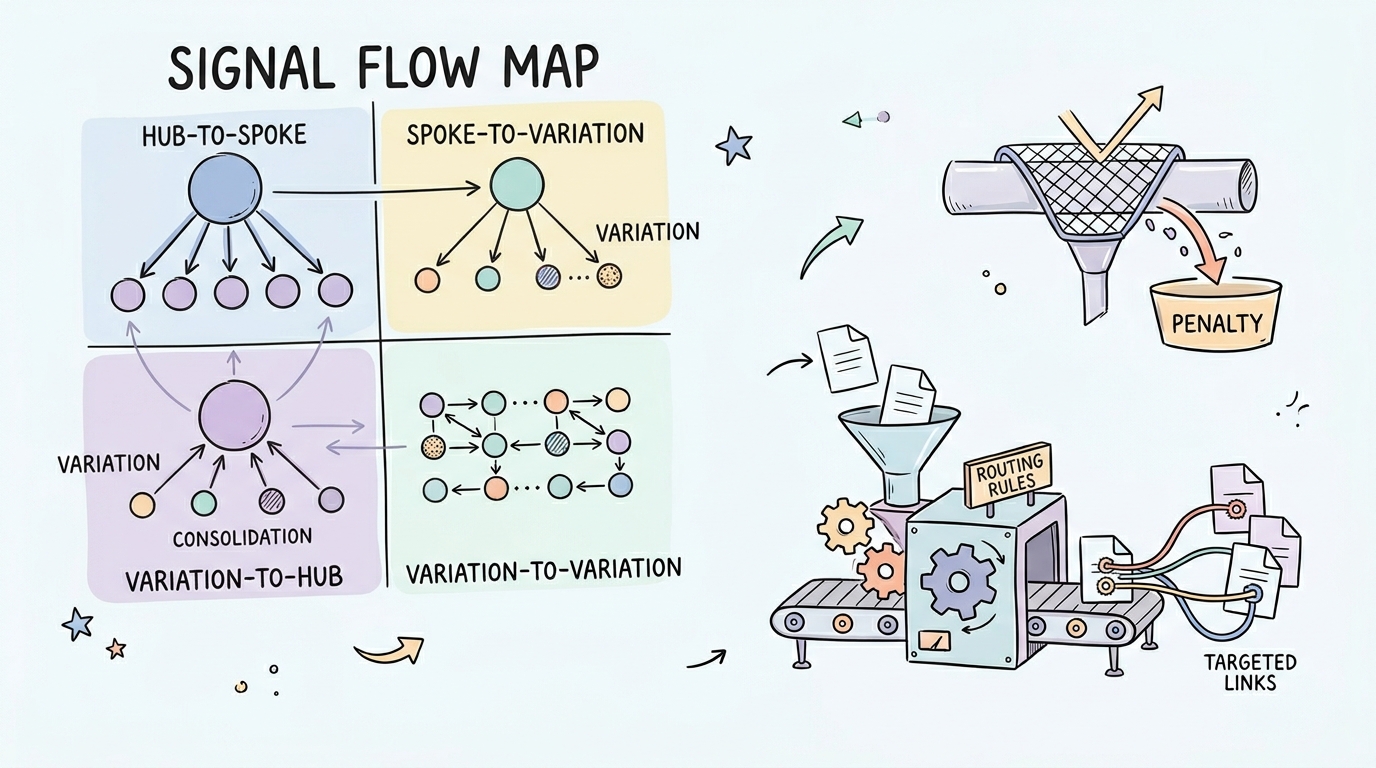
The diagram below displays how authority flows across the four programmatic link types:
To execute this, we rely on four primary programmatic link types:
Hub-to-Spoke: Broad directory pages linking down to category guides.
Spoke-to-Variation: Subtopic guides linking to highly specific programmatic pages.
Variation-to-Hub: Deep nodes passing link equity back up to the primary business directory.
Variation-to-Variation: Lateral links connecting related geographical or attribute pages.
Relying purely on generic footer links or dynamic related widgets is a critical mistake. These widgets create excessive code bloat while carrying very low semantic weight for search engines.
Pitfall: Avoid utilizing repetitive exact-match anchor texts across thousands of programmatic pages. This behavior triggers automated keyword stuffing filters outlined in the Google Search Central Spam Policies, which can tank your search visibility.
The AI Linking Stack: Best Automation Tools to Use in 2026
Here is a breakdown of the leading AI-powered internal linking automation tools in 2026.
This tool is best for AI-driven WordPress silos and bulk auto-linking. It builds semantic internal networks by crawling your WordPress database and generating inline contextual paragraphs containing the links. The main tradeoff is that it is heavily optimized for WordPress, making it less suitable for custom static sites.
This tool is best for constructing entity-based semantic knowledge graphs automatically. It analyzes your site's content to identify core entities and injects optimized JS links to establish clear relationships. The main tradeoff is that script-based dynamic links may take longer for some search bots to crawl compared to hard-coded HTML links.
This tool is best for real-time inline anchor suggestions as you write. It scans your text in the WordPress editor and suggests relevant internal link opportunities and target URLs. The main tradeoff is that it requires manual approval for suggestions, which limits true hands-off programmatic scale.
This tool is best for custom keyword mappings and varied anchor text tracking. It automates massive link insertions based on predefined anchor rules while tracking overlapping links. The main tradeoff is that the configuration interface is complex and requires careful management to avoid over-optimization.
This tool is best for hands-off, contextual link insertion. It automatically scans your content and updates internal links dynamically based on contextual relevance and user journeys. The main tradeoff is that you lose granular control over the exact placement of individual links.
Use these decision rules to choose the right software for your setup:
If you run a high-volume WordPress portfolio, then use LinkBoss or Link Whisper to manage inline anchors.
If you want to build a deep, entity-based knowledge graph on a custom platform, then implement InLinks via JavaScript snippets.
If you are scaling content generation using automated systems like Kitful AI, then configure your primary templates to handle structural relationships before publishing.
Securing Your Authority: How to Avoid Algorithmic Spam Penalties
Publishing thousands of unmonitored, raw AI pages carries a 40% higher probability of indexation removal. Google's algorithmic updates penalize low-effort, low-context content directories that fail to establish authentic expertise.
To safeguard your site, you must integrate explicit trust factors and author-entity definitions. Every page should link out to verified entity profiles and contain structural metadata.
I recommend injecting structured JSON-LD schema into your programmatic templates. You can validate this code using the Google Rich Results Test Tool and follow guidelines on Schema.org Official Documentation to ensure search engines recognize your E-E-A-T signals.
Here is a template to declare your author entity and its connections:
This simple addition turns a generic page into a verified entity node that search engines can easily trace back to a trusted source.
How Do I Verify My Automated Internal Linking is Actually Working?
Once your automated internal linking framework is active, you must run quality control audits. Do not assume your template-level rules are executing flawlessly without verifying the actual crawl patterns.
A major A/B test showed that aligning semantic clusters resulted in up to a 237% increase in Googlebot crawl frequency. When search bots discover logical, uninterrupted paths, they crawl your domain far more efficiently.
Verify your system is working by completing these audits:
Run a complete crawl using Screaming Frog to ensure you have zero orphaned pages.
Monitor Google Search Console's Page Indexing report to confirm programmatic pages are moving from 'Discovered, currently not indexed' to fully indexed status.
Check your server log files to verify Googlebot's fetch frequency increases on newly linked semantic variations.
Frequently Asked Questions
How does automated internal linking affect my crawl budget?
It optimizes your crawl budget by giving search bots a clear roadmap. Instead of hitting dead ends, crawlers follow structured paths from hubs to spokes, indexing your pages faster.
Can generative AI search engines discover my pages without internal links?
No. Generative search engines like Perplexity rely on established entity graphs and anchor relationships to discover and cite your content. Without clear internal links, they cannot associate your site with specific search topics.
Will dynamic link widgets slow down my site's loading speed?
Yes, if they rely on heavy database queries. It is better to pre-render internal links inside your HTML templates or use lightweight plugins to ensure your loading speeds remain fast.
Build a Defensible Organic Moat for the AI Era
Structured internal linking determines whether your pages index in two weeks or linger unseen for months. In the era of rapid content scaling, topical authority is your only real defense against algorithmic updates.
Stop publishing isolated pages and hoping for organic discovery. Map your sitemap, define your routing rules, and build a connected semantic network.
If you want to streamline your overall writing workflow, Kitful AI is an exceptional platform to scale research-backed content. While they work on launching automated internal linking tools, you can use their high-quality SEO content generator to build the ideal pillars and spokes for your niche silos.
 Kitful