BlogBeyond Position 1: Why Pixel Tracking is the New Standard for Google Rankings in 2026
Beyond Position 1: Why Pixel Tracking is the New Standard for Google Rankings in 2026
Traditional numerical rankings are a lie in the age of AI Overviews and massive ad stacks. This guide explains how to track pixel depth and measure your true 'visual rank' to protect your search traffic.
•6 min read
Your rank tracker says you are in position one. You log in to your analytics and see the traffic is nearly non-existent. This is the reality of modern search where an AI Overview and four ads push your top result 1,200 pixels down the page.
Position one is no longer the gold standard because it does not guarantee your content is actually visible. If a user has to scroll twice to find you, that ranking is a vanity metric that fails to drive revenue. Success in 2026 requires looking past the number and measuring the vertical distance between the search bar and your link.
The 2026 Visibility Baseline
Understanding your visual footprint is the only way to protect your search real estate in an AI-first environment.
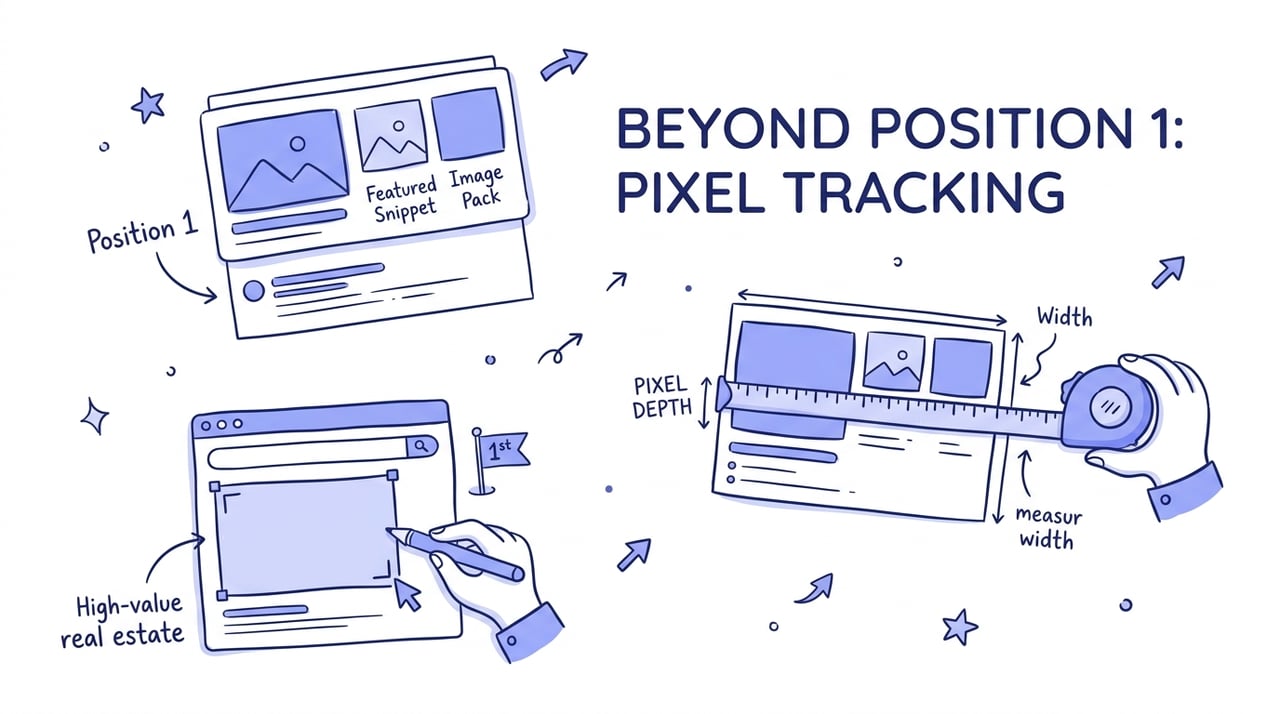
Pixel depth measures the vertical distance in pixels from the top of the SERP to your specific listing.
Traditional rankings are vanity metrics while pixel coverage across the first 900 pixels is the new baseline for success.
800-900 pixels is the standard desktop fold; anything deeper experiences a catastrophic drop in click-through rate.
Visual Rank represents your true prominence on the screen from the perspective of a real human searcher.
The New Vocabulary Of Visual Rank
To win today, you need to abandon ordinal thinking. A result at position three that sits at 200 pixels is infinitely more valuable than a position one result buried at 1,200 pixels.
The Metric Breakdown
Metric
Definition
Strategic Value
Traditional Rank
Your ordinal spot in the list (1, 2, 3)
Low (Vanity)
Visual Rank
Your prominence compared to other features
Medium (Context)
Pixel Depth
Numeric distance from the top edge
High (Actionable)
This shift matters because of how AI Overviews work. These generated responses often occupy the top 600 pixels of the screen. Data shows that 55% of citations in AI Mode come from the top 30% of a page's pixel real estate.
Tip: Focus your optimization on the 'Share of Squares' within AI Overviews to stay above the fold even when organic results are pushed down.
If you aren't tracking where you appear visually, you are flying blind. You might be winning the ranking war but losing the visibility battle.
The High Cost Of Being Deep: CTR Benchmarks
The math behind pixel depth is brutal and unforgiving. A standard Rank 1 listing on a clean SERP usually enjoys a 30-40% CTR.
800px+ pixel depth for a Rank 1 result under an AI Overview causes that number to plummet to roughly 15%. This represents a 58-61% reduction in organic clicks specifically when AI Overviews are present.
58-61% CTR reduction for organic results when AI Overviews appear.
However, there is a silver lining for those who adapt. Brands that earn a citation within the AI response itself see up to a 35% CTR increase compared to standard listings. You must decide if you will be the buried link or the highlighted source.
The Tech Stack: Tools To Track Google Rankings Pixel Depth
Measuring these metrics requires specialized software that can render the SERP and calculate coordinates. Here is the walkthrough on how to monitor your visual presence at a pixel level:
Nozzle
Nozzle is an enterprise-grade platform that pioneered the Pixels from Top and SERP % Coverage metrics. It gives you a granular view of how much of the screen your brand actually owns across different devices.
Why it fits: It provides the most comprehensive dataset for visual real estate analysis.
Tradeoff: The sheer volume of data can be overwhelming for smaller teams.
AccuRanker uses pixel position data to feed its dynamic AI CTR model, giving you a more accurate traffic forecast than traditional trackers. It is built for speed and high-frequency updates.
Why it fits: It translates pixel depth into estimated visitors automatically.
Tradeoff: It lacks the deep visual overlay tools found in some competitors.
DemandSphere focuses on Visual Intelligence by providing a Visual Rank metric that mimics the searcher's perspective. It helps teams understand their share of voice across complex SERP features.
Why it fits: Excellent for reporting visual dominance to stakeholders.
Tradeoff: Primarily targeted at large enterprise organizations.
SerpApi is a developer-focused tool that returns X, Y, Width, and Height coordinates for every SERP element via a clean API. It is the best choice for teams building internal dashboards.
Why it fits: Complete flexibility to manipulate raw pixel data.
Tradeoff: Requires technical resources to build and maintain an interface.
Auditing your pixel real estate is a four-step process that replaces manual rank checking with visual intelligence. This workflow ensures your team is working on keywords that actually move the needle.
1. Define Your Device Viewports
You must set different benchmarks for desktop and mobile. Standardize your reporting on 900px for desktop and 600-800px for mobile to define what counts as Above the Fold.
2. Connect Visual Tracking Tools
Integrate an enterprise tracker that supports pixel-level data. This allows you to pull the numeric vertical distance for every keyword in your portfolio rather than just the ordinal position.
3. Map the SERP Landscape
Identify dead zones where massive AI Overviews or ad clusters push organic results out of view. Use this to categorize keywords into High Visibility or Buried buckets.
4. Filter and Prioritize
Stop optimizing for Position 1 if that position is deeper than 900 pixels. Use your tracker to filter for keywords with low pixel depth and high search volume to find the quickest wins.
Define desktop and mobile viewport heights.
Link your rank tracker to your data warehouse.
Run a baseline report for current pixel depth.
Flag all keywords with a depth greater than 900px.
Re-evaluate the content strategy for buried terms.
If pixel depth is > 900px, then pivot to content optimization for AI Overviews or snippets.
If pixel depth is > 1200px, then increase PPC spend for that specific term to reclaim the fold.
If mobile pixel depth is significantly higher than desktop, then prioritize mobile UX and page speed metrics.
Optimization Playbook: Reclaiming The Fold
Reclaiming your search real estate requires a tactical shift. If you cannot move the organic link up, you must move your brand into the features that occupy the top pixels.
Example
A search for project management software might have four ads and a large AI Overview. This pushes the first organic result to 1,200 pixels. Instead of fighting for that buried spot, the brand optimizes for AI Overview citations and a video pack. By securing a mention in the AI summary, they jump to 150 pixels, bypassing the ads and reclaiming the fold.
Rule: Never report an organic ranking as a success without including its pixel depth measurement.
To effectively reduce pixel depth, you should target People Also Ask (PAA) boxes and video packs. These features often sit higher than the first blue link and provide a shortcut to visual prominence. Targeting visual noise often yields a better ROI than trying to displace an entrenched competitor in the organic list.
Winning The War For Screen Real Estate
Visual Rank is the new standard for understanding search performance from the user's perspective. The days of celebrating a Position 1 ranking that sits buried 1,200 pixels down the page are over.
Shift your focus to pixel-level data to see what your customers actually see. Measure your depth, optimize for AI citations, and stop chasing vanity numbers. Start your pixel audit today to see how much of the fold you truly own.
 Kitful