BlogBeyond SEO Tools: A 5-Step Guide to Calculating Keyword Difficulty Manually
Beyond SEO Tools: A 5-Step Guide to Calculating Keyword Difficulty Manually
Keyword difficulty tools are often misleading proxies. This guide provides a manual framework to identify 'cracks' in the SERP and calculate true ranking potential.
•6 min read
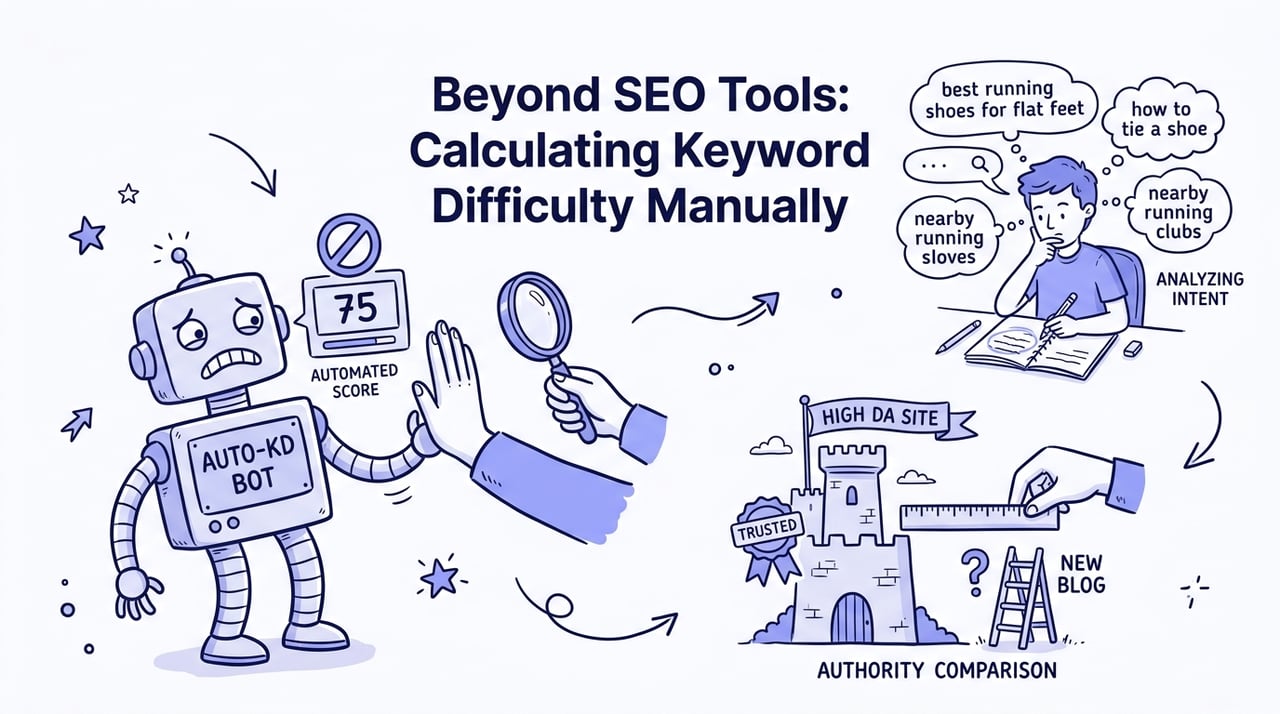
Your favorite SEO tool is lying to you. Most platforms calculate Keyword Difficulty by simply averaging the number of backlinks pointing to the top 10 results.
This creates a massive blind spot because backlink quantity is a proxy, not ground truth. You can find a keyword with a 'Difficulty 0' score that is actually impossible to crack because the SERP is owned by high-authority titans.
On the flip side, tools often label keywords as 'Hard' just because the ranking pages have many links. If those pages are outdated or irrelevant, the actual difficulty is much lower than the software suggests. Manual analysis is the only way to see the real opportunity.
The Playbook At A Glance
60%+ of total clicks are captured by the top three organic results.
Automated scores ignore the physical reality of the search page. To win, you must identify 'weak spots' in the top 10 that metrics cannot quantify.
Intent satisfaction now carries more weight than raw domain strength.
Manual audits reveal 'nuisance' features like AI Overviews that steal your traffic.
Finding high-authority sites in the wrong niche is the fastest way to find ranking gaps.
Prerequisites: Preparing Your Manual Audit Environment
Before you analyze a single keyword, you must strip away personalization. Google shows you results based on your history, which skews your perception of ranking difficulty.
Start by opening an Incognito or Private window to see the 'clean' SERP. This ensures you see exactly what a fresh user experiences when they search.
These tools provide the data layer you need to judge the raw power of your competitors.
Step 1: Verify Search Intent Alignment
You can write the best article in the world, but if it doesn't match the intent Google prefers, you will never rank. This step is about identifying the format Google wants for a specific query.
Implementation
Scan the top 10 results and label them as Informational (blogs), Transactional (product pages), or Navigational. If you see only e-commerce product pages, do not try to rank a blog post for that term. Refer to the Google Search Intent Guide to align your content structure with these user expectations.
Tradeoff
Matching intent perfectly is a prerequisite, but it also means you are restricted to a specific content format. You cannot always innovate on the medium if the SERP is rigid.
Step 2: Map The Authority Landscape
Not all high-authority sites are created equal. You need to distinguish between 'Domain Titans' like Wikipedia and niche-specific authorities that own the topical space.
Implementation
Look at the Domain Rating (DR) of every result on page one. If you see 'best hiking boots' results dominated by giants like Wirecutter, the difficulty is extreme. However, if a high-DR site ranks but its content is outside its primary niche, you have found a topical gap.
Tradeoff
Raw authority metrics are easy to read but don't account for recent trends. A site with a lower DR might be climbing rapidly due to topical relevance.
Step 3: Identify 'Cracks' And Weak Spots
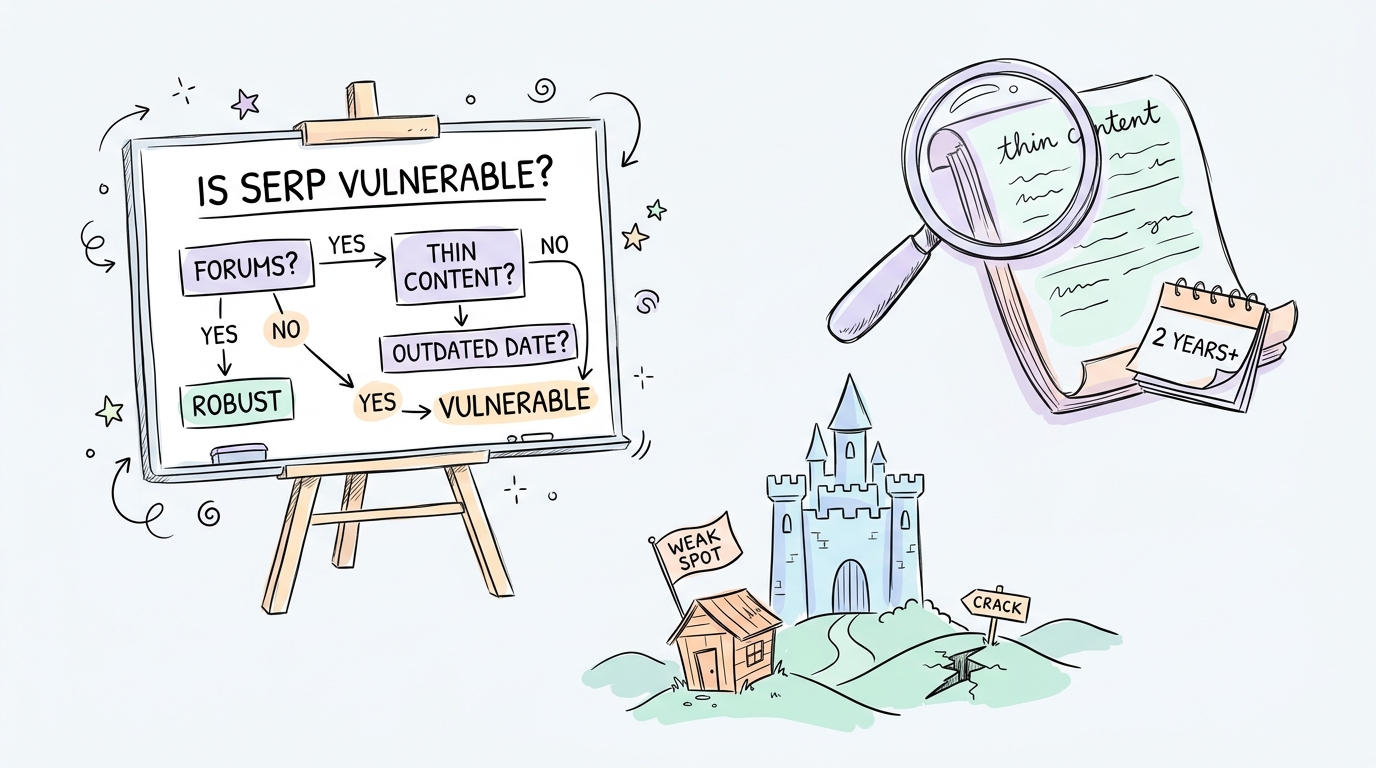
The most reliable indicator of an easy keyword is the presence of 'cracks' in the top 10 results. These are signals that Google is settling for mediocre content because nothing better exists.
Imagine Sarah, a niche blogger, trying to rank for a DIY repair guide. She sees a high automated KD score and almost gives up, but manually checks the SERP to find the top results are 4-year-old forum threads. She publishes a fresh, expert guide and hits page one in two weeks because she found a crack the tools ignored.
Implementation
Look for specific signals that indicate a vulnerable ranking landscape:
Forums like Reddit or Quora in the top 7 results.
Pinterest boards ranking for non-visual queries.
Results that are more than 2 years old.
Thin content with low word counts or poor formatting.
Tradeoff
Finding these cracks takes time and cannot be easily automated at scale. It requires manual scrutiny for every target keyword.
Do you see Reddit or Quora in the top 7?
Is any result over 2 years old?
Are there pages with a low DA (under 20) ranking?
Does the content look like it was written for a different query?
Step 4: Conduct A Content Quality Audit
Once you know who is ranking, you must evaluate how well they served the user. If the current winners are generic or hard to read, you can win on quality alone.
Implementation
Open the top 3 results and look for content gaps. Check if they use specific solutions or just generic advice, like a 'door repair guide' that fails to mention specific tools. Rate their readability, mobile UX, and whether they provide the most recent data available.
Tradeoff
Quality is subjective and Google's algorithms may still prefer a high-authority mediocre page. Superior content is a powerful lever, but it rarely overcomes a massive authority gap alone.
Rule: If the top three results satisfy the search intent perfectly and are updated within the last 6 months, the keyword is likely high difficulty regardless of backlink counts.
Step 5: Audit SERP Real Estate and Crowding
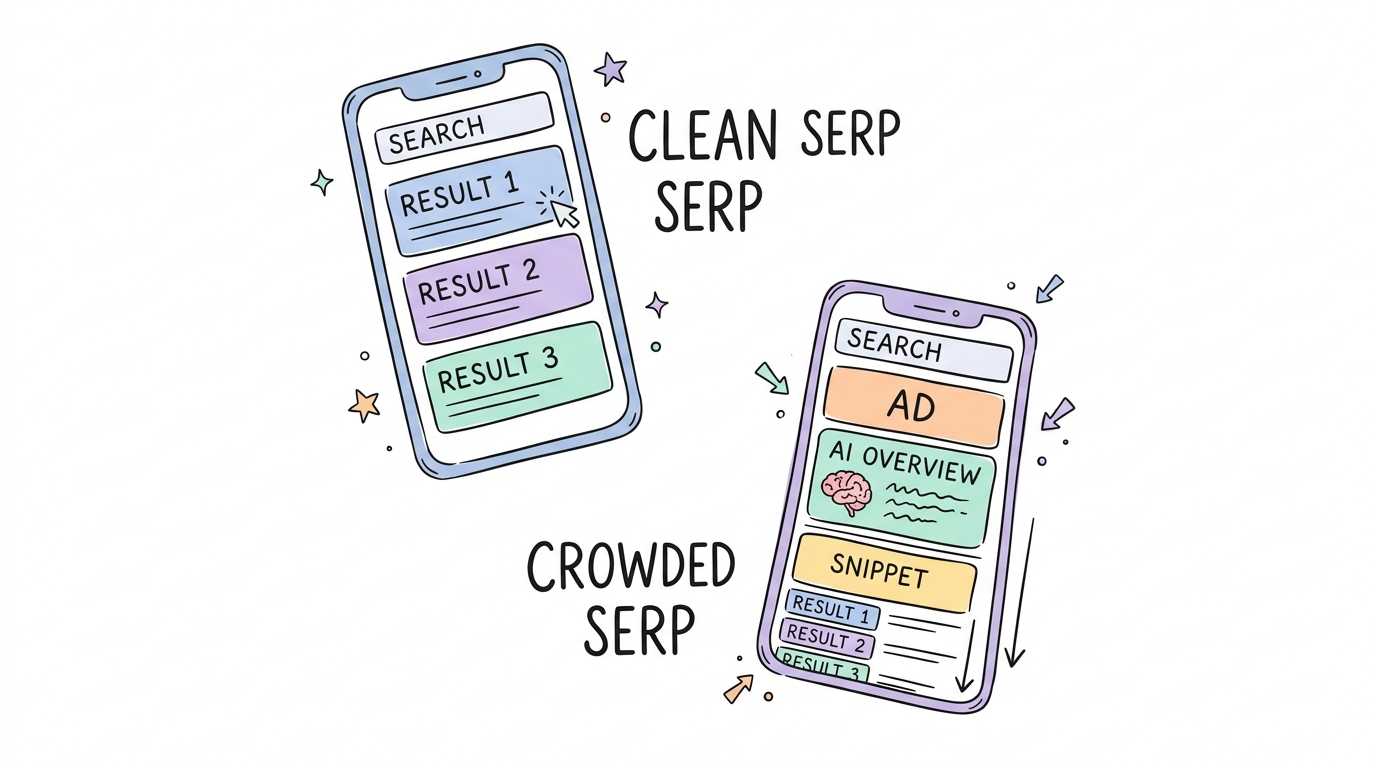
Effective difficulty isn't just about competition; it is about the physical space left for your link. If the first two scrolls are covered in ads, you are fighting for a tiny slice of traffic.
Example
A search for 'buy car insurance' might have a low KD in some tools, but the SERP features three top ads, a local map pack, and an AI Overview. Even if you rank #1 organically, your link is effectively at the bottom of the page. This crowding makes the keyword high difficulty in practice.
Implementation
Check for 'nuisance' features that push organic results down. Note the presence of AI Overviews, People Also Ask boxes, and heavy ad placements. If organic results start below the fold on desktop, consider if the effort is worth the limited click-through rate.
Tradeoff
SERP features can fluctuate daily, making it hard to maintain a consistent traffic estimate. Today's clean SERP could be crowded with AI summaries tomorrow.
The Manual KD Scoring Matrix
Use this scorecard to determine the final viability of your target keyword based on your manual findings.
Factor
Low Difficulty (Target)
High Difficulty (Avoid)
Search Intent*******
Content type matches 100%
Content type is a mismatch
Authority*******
Sites with DR < 30 present
All results are 'Domain Titans'
Content Age*******
Results are 2+ years old
Results updated this month
Weak Spots*******
Reddit/Quora in top 7
Professional media outlets only
Real Estate*******
Clean SERP, no AI/Ads
AI Overview + 4 Ads at top
If you find articles that are 2-3 years old in the top spots, there is a significant opportunity to rank by providing fresh, updated content. Conversely, a keyword with a 0-14 KD score is only 'Very Easy' if you can actually match the intent of the sites already there.
Moving From Proxies To Profit
Manual keyword analysis is your competitive advantage in an era of automated, generic SEO. While your competitors rely on a single number from a dashboard, you are looking at the actual battlefield.
If the top 10 results include forums like Reddit, the keyword is likely easy.
If the top 10 are all high-DA 'Domain Titans,' the difficulty is high regardless of links.
If Google displays only product pages, do not target it with a blog.
If top articles are outdated, there is an immediate opening for fresh content.
Stop chasing scores and start analyzing intent. The best opportunities are often the ones the tools are too blind to see.
 Kitful