BlogBeyond Text: Automating Featured Images and Meta Tags for Your AI-Generated Content Pipeline
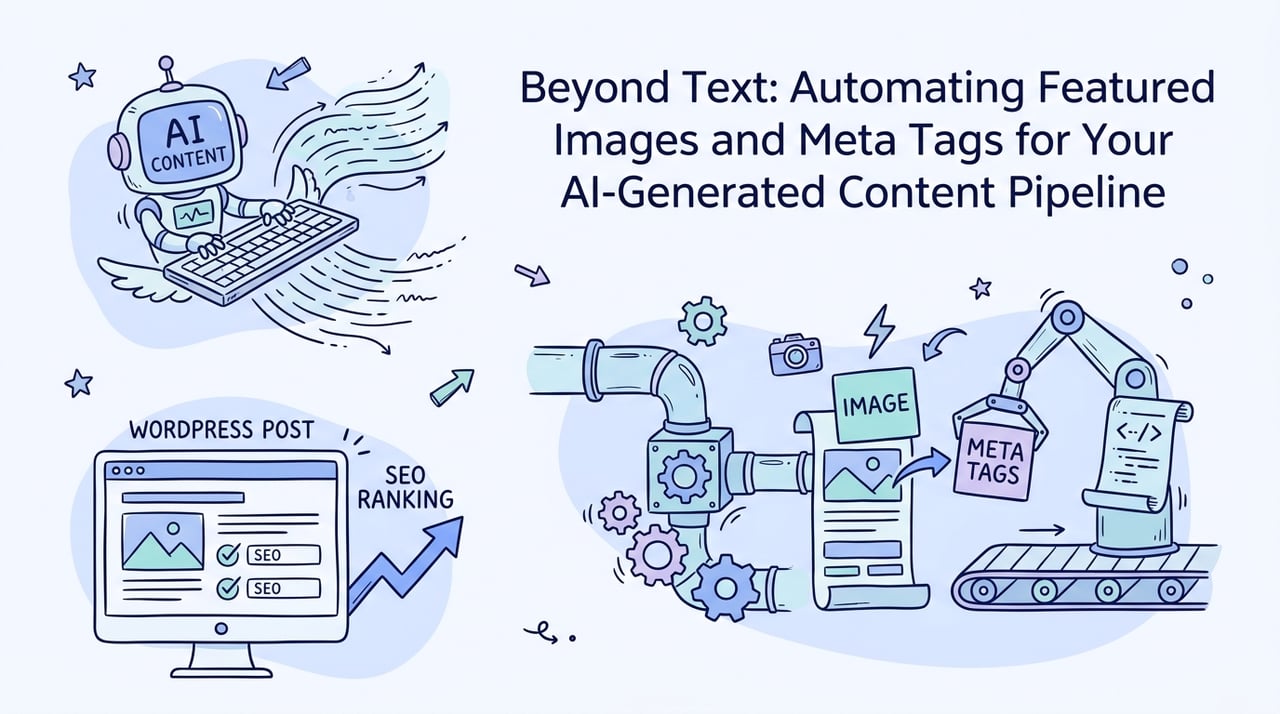
Beyond Text: Automating Featured Images and Meta Tags for Your AI-Generated Content Pipeline
Pure textual AI content is a target for Google's Scaled Content Abuse penalties. This guide outlines how to build an advanced media, meta, and schema automation pipeline that indexing crawlers and LLM search engines love.
•12 min read
We can launch thousands of AI-generated articles in an afternoon, but most of them will end up as digital ghost towns. They sit unindexed and ignored because pure textual automation is incomplete. Real scale requires automating advanced asset dependencies like metadata structures, schema architectures, and featured images.
Publishing a text-heavy post with a blank header image and a generic meta tag signals to search crawlers that your page is a low-effort template. Search engines easily identify these hollow shells. In the current search landscape, automated image and SEO meta insertion for AI posts is not a luxury. It is the dividing line between high-ranking organic traffic and a manual penalty.
If we want our content engines to succeed, we must stop building halfway. We need to transition from basic drafting scripts to fully autonomous production lines that handle every visual asset and technical tag before the publish button is ever clicked.
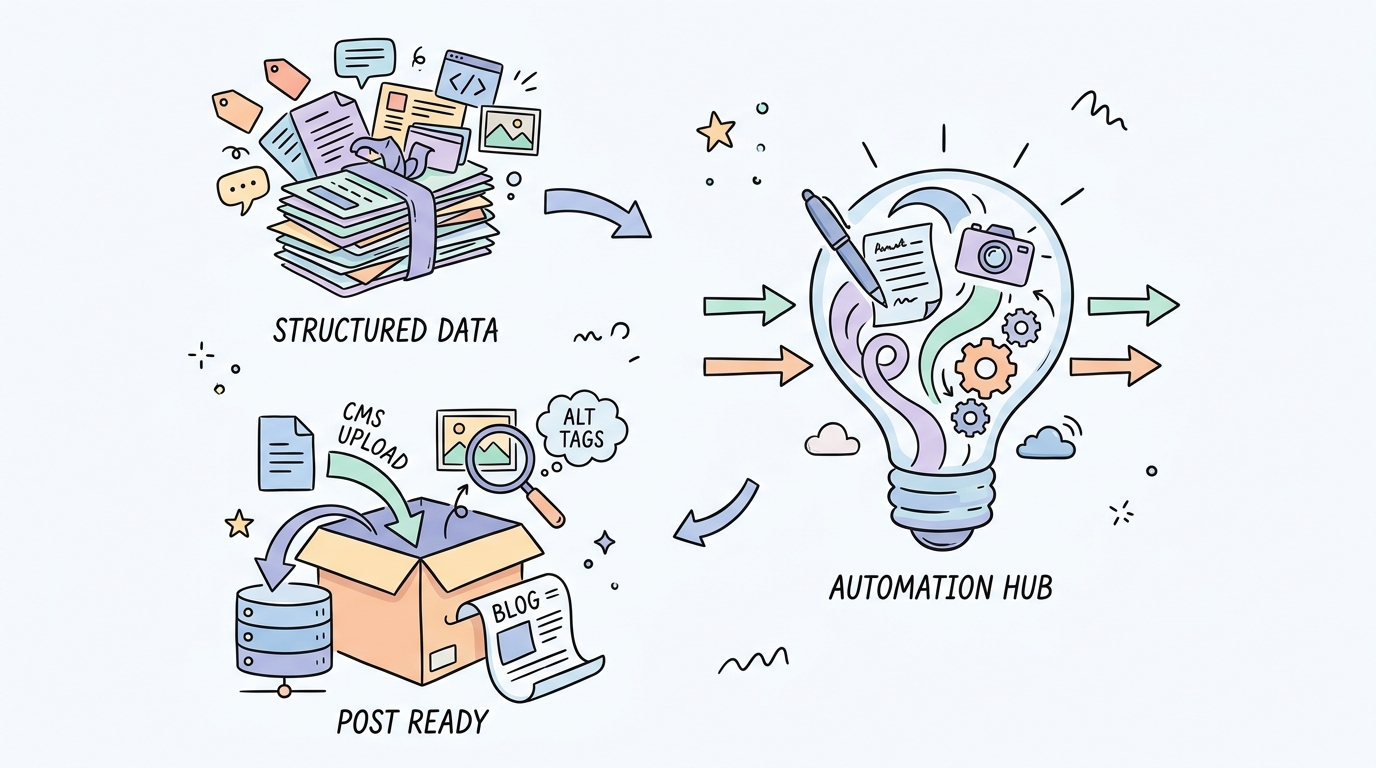
A robust pipeline takes control of the entire asset lifecycle. It ensures that when your server receives a new article body, it also receives matching featured media and verified structured schemas. This is how we build authority in an era of automated volume.
The Automated Asset Pipeline: Quick Summary
Building a modern, search-safe programmatic pipeline requires looking past raw text. Here is a quick summary of the architecture needed for a safe, fully optimized autonomous programmatic pipeline.
End-to-End Asset Automation: A post pipeline that writes drafts but leaves every featured image blank is not automation. It is unfinished admin work wearing a suit.
Text Uniqueness Rules: Programmatic systems must achieve at least a 60% uniqueness threshold across page variants to bypass automated quality filters.
Native API Integration: Uploading images directly via the WordPress REST API bypasses slow plugins and prevents database locks during heavy runs.
Generative Engine Optimization: Embedding nested JSON-LD schema into pages turns simple blog posts into highly structured data blocks optimized for modern AI search assistants.
Programmatic SEO with AI support is not the end of high-quality content. It is the beginning of scalable expertise.
Why Does Pure Text Automation Trigger Google's Scaled Content Abuse?
Google penalizes simple template-swapped doorway pages because they provide zero incremental value to users and try to manipulate search indexes with repetitive text. In 2026, search algorithms use advanced semantic filters to flag and demote websites that rely on basic keyword placeholder swaps (such as city-only updates) across hundreds of pages. Programmatic pages must maintain distinct semantic data layers to survive these quality filters.
60% Minimum target threshold of distinct on-page copy variation required per programmatic URL to avoid Google's Scaled Content Abuse automated demotions.
To survive these automated filters, every programmatic page must stand on its own as a unique, data-rich resource. This means you cannot just swap a location tag or a single product name. You must synthesize entirely new paragraphs, dynamically fetch external data tables, and generate completely unique images for each page.
Pitfall: Relying on post-generation plugins that run heavy client-side processes instead of executing native, direct API workflows for media assets will slow down your site and lock your database during bulk imports.
Consider an enterprise content team that attempted to deploy bulk city landing pages using basic keyword swaps. The campaign triggered Scaled Content Abuse demotions and completely stalled their indexation. Only when they redesigned their pipeline to achieve over 60% copy variation and automated visual assets did they reverse the demotion.
When you hit this uniqueness mark, the financial returns of programmatic automation become clear. Websites see an average of 200-400% organic search engine traffic growth within six months of launching a properly optimized autonomous programmatic pipeline. This growth is accompanied by a massive 60% reduction in cost-per-page when implementing AI-powered programmatic SEO instead of traditional manual article production.
REST API Uploads vs. WordPress Plugins: Choosing Your Pipe
When deciding how to deliver visual assets to your content hub, the underlying technology stack makes or breaks your system scalability. Handling media through direct API communication is the elite pattern for programmatic publishers.
Execution Path
Core Mechanism
Best For
Pros
Cons
REST API Upload
Directly injects raw binary via endpoint
High-volume programmatic workflows
Bypasses plugin bloat Highly stable at scale Easy to integrate with n8n
Requires API authentication setup Needs technical pipeline configuration
WordPress Media Plugins
Runs processing scripts on the server
Low-volume hobby sites
Simple point-and-click interface No coding required
High resource overhead Fragile connections Prone to database locks
If you are automating featured images at scale, prioritize raw binary uploads directly to the /wp-json/wp/v2/media REST endpoint over plugin-based sync systems. This prevents your server from failing under heavy parallel loads. Plugins often create bottlenecks when processing multiple images simultaneously, leading to database timeouts. Using the native REST API allows you to offload processing and maintain a clean media library.
This architecture also makes your entire pipeline more modular. If you ever decide to migrate from WordPress to another headless CMS, your image processing node in n8n remains exactly the same. You only need to swap the final HTTP request destination rather than rebuilding a complex plugin framework from scratch.
How Do You Set Up an Autonomous Image and Meta Tag Pipeline?
To build an automated, search-safe pipeline, you need the right foundations. First, verify your prerequisites. You must have a robust CMS with an active REST API (such as WordPress), an automation engine like n8n, developer credentials for OpenAI or an aggregator like OpenRouter API Interface, and a structured database containing your core post variables.
Here is a walkthrough that covers the key steps:
Once your foundational systems are connected, you can configure your automation canvas to handle data processing, image creation, and metadata insertion in parallel.
Follow this sequential deployment roadmap to set up your pipeline:
Set Up Data Rows: Configure your database (Google Sheets or Airtable) to hold your target keywords, categories, and custom page variables.
Trigger the Canvas: Create an n8n workflow that triggers whenever a new row is marked as ready for production.
Draft the Content: Route the row variables into an LLM node to write highly unique content body blocks that maintain over 60% differentiation.
Construct Meta Fields: Simultaneously command the LLM to generate optimized meta titles, descriptions, and a valid nested JSON-LD schema payload.
Synthesize Your Image: Pass the post core concepts to DALL-E 3 or Stability AI to generate a custom featured image.
Upload Binary to CMS: Send the raw image binary output directly to the WordPress REST API /wp/v2/media endpoint to register the asset and retrieve its unique ID.
Describe the Image: Send the generated image URL or binary to an AI vision model to return a natural alt-text description.
Publish the Compilation: Send a POST request to /wp/v2/posts mapping your drafted content, the retrieved featured media ID, metadata fields, and your alt text.
Ping the Search Indexes: Add a webhook node to ping IndexNow immediately after publishing to alert search engines of your new URL.
To execute the crucial media upload step via n8n, you can use the following HTTP Request configuration to POST the raw binary data to your server:
Your final integration checklist before running a full test:
Create custom database columns for your generated image IDs.
Configure API keys for both your text and image LLM models.
Verify your server allows binary media uploads through REST requests.
Set up an application password inside your WordPress user profile.
How to Structure Nested JSON-LD Schema for Generative Engine Optimization (GEO)
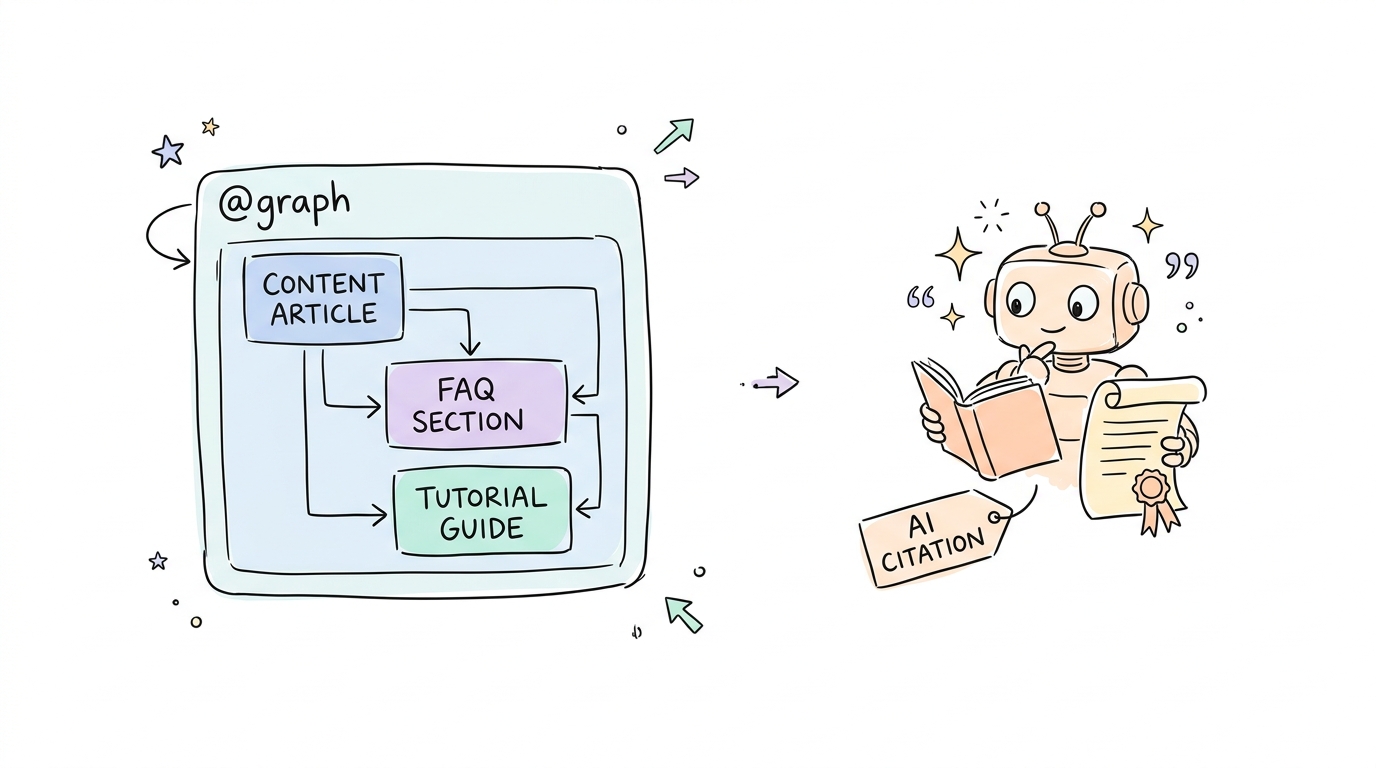
Nested JSON-LD schemas satisfy modern generative search engines by grouping multiple schema types inside a single graph structure to provide search bots with unambiguous context. When you connect multiple schemas under a main node, AI crawlers can effortlessly parse how your content, FAQs, and product variations relate to each other. This semantic clarity is the foundation of Generative Engine Optimization (GEO).
Instead of stuffing keywords, your focus must shift to building a highly structured database of entities and semantic relationships. Ranking high in classic search pages does not guarantee visibility in modern conversational interfaces. Ranking first does not mean much if an AI assistant reads ten pages, picks three to cite, and yours is not one of them.
To secure these citations, we must transition toward structured graph blocks. If you bundle schemas incorrectly, the parser will fail, and search engines will ignore the structural associations.
Here are the core decision rules for structuring your schema layouts:
If you are optimizing for Google AI Overviews, bundle Article, FAQPage, and HowTo schemas inside a single JSON-LD @graph block to prevent parsing errors.
If your page mentions specific real-world organizations or locations, explicitly reference their official Wikipedia or Wikidata URLs in the sameAs array.
If your database contains structured steps, map them inside a nested HowTo schema rather than relying on standard paragraph tags.
If you are deploying local landing pages, ensure your LocalBusiness schema is nested alongside your primary article data.
By implementing these rules, you turn simple blog posts into authoritative data nodes. Generative engines search for relationships between concepts, and nested graphs provide that architecture directly. For example, a product variant page should not just link to a category. It must embed the category entity directly inside its local structured block. This lets the LLM understand that your page is a specific, verified variation of a larger, trusted subject.
Why Does Your Programmatic Site Need an Automated Internal Linking Taxonomy?
Dynamic internal linking taxonomies establish a logical crawling route that allows search engines to discover and index thousands of deep database-driven pages without relying on flat HTML sitemaps. By mapping programmatic linkages directly into your database templates, you pass authority from authoritative categories down to transactional endpoints automatically. This structured flow of PageRank is the single most important factor for getting large sites indexed quickly.
Without strict structural connections, search crawlers struggle to navigate your database. Internal linking is the difference between a program that indexes in 2 weeks and one that sits in "Discovered, currently not indexed" for 3 months.
To avoid orphan pages, you must establish three distinct levels of database-driven links:
Hub to Spoke Linkage: Connects core topical category hubs directly down to specific sub-niche long-tail programmatic pages.
Spoke to Variation Linkage: Pipes authority directly from informational hub guides to individual transactional variant pages.
Variation to Variation Linkage: Links related local or product variance pages together dynamically to prevent orphan page issues.
Implementing this multi-tier architecture prevents the structural gaps that plague automated sites. When pages link horizontally, search bots can crawl your entire site directory in a single pass.
Tip: If your site scales beyond 1,000 programmatic URLs, shift from manual internal linking to automated database-driven relational templates to ensure perfect link integrity.
Instead of building custom scripts, platforms like Kitful AI offer built-in systems to automatically schedule and structure your content, although their advanced automated linking system is listed as coming soon. If you prefer a hands-off approach, utilizing their direct publishing can save massive engineering time. For those running custom workflows, ensuring your n8n engine calculates relative internal URLs before updating the database is essential.
By combining custom relational databases with programmatic structures, you ensure your platform remains structurally sound and highly indexable. This proactive link generation keeps your crawl budget optimized and your indexing rates high.
The QA Checklist: Validating Post Integrity Before Publishing
Before launching a massive programmatic run, you must put your data through rigorous quality assurance filters. Automating content at scale without strict verification parameters is a fast track to indexation issues.
A robust validation workflow ensures that every element of your automated asset delivery operates without failure. Implement the following verification checks on your staging environment before deploying the pipeline to production:
Verify that the media API response returns a valid attachment ID before attempting post compilation.
Check that final post payloads on the CMS contain the featured_media ID tied to the correct generated image.
Perform a programmatic crawl of the live post URL to ensure that meta titles, descriptions, open graph tags, and nested @graph schemas are rendering without formatting breaks.
Run programmatic content checks on draft variations to confirm a minimum of 60% textual uniqueness prior to hitting the live publishing endpoint.
Testing a batch of ten posts thoroughly will catch API timeouts, payload formatting errors, and schema parsing breaks before they scale to thousands of live URLs. This simple automated check saves hours of manual cleanup.
Programmatic SEO & Image Automation FAQ
How do you prevent WordPress from timing out during bulk media uploads?
To prevent server timeouts, upload your media assets asynchronously using a worker queue rather than initiating concurrent post creations. Send the raw binary file to the REST API media endpoint as a separate initial step, cache the resulting attachment ID, and reference that ID when launching the main post payload.
Does DALL-E 3 support automated alt text tags?
No, DALL-E 3 only generates the visual image asset based on your prompt. To obtain optimized alt text, you must route the newly generated image URL through a vision-capable LLM to return a descriptive, keyword-aligned alternative text string.
Why is nested JSON-LD schema preferred over standard meta blocks?
Nested JSON-LD schema wraps multiple content schemas into a unified, consolidated entity block that search engines can parse easily. This prevents parsing conflicts and directly supports Generative Engine Optimization by mapping complex entity relationships.
Can you run an automated image pipeline without heavy server plugins?
Yes, direct REST API execution is the elite pipeline pattern for scaling media because it bypasses fragile plugin connections. This native database injection allows you to handle thousands of image transfers without risking server-side database locks.
How does IndexNow help programmatic content indexation?
IndexNow immediately notifies search engines when a page is created, updated, or deleted. By automating this ping inside your publishing pipeline, you bypass traditional search engine crawling delays and ensure your dynamic metadata is processed instantly.
What are the credit costs of generating automated visual assets?
If you are using custom API endpoints, you pay per image and token. Platforms like Kitful AI offer a subscription model with 500 credits per month, where complex articles with integrated images can cost between 10 to 20 credits per run.
Scale Responsibly: Building the Defensible Media Machine
Scaling content in the modern search landscape requires looking past basic textual drafts. True automation means building complete, crawl-ready assets where every page contains unique images, rich metadata, and nested schemas.
This high-context differentiation is what transforms standard programmatic outputs into authoritative properties that search engines trust and AI tools cite.
If you want to build a truly defensible media engine, start auditing your asset workflows today. Swap out fragile client-side plugins for clean, native REST API connections. Map out your entity relationships inside nested JSON-LD blocks. Treat every image, tag, and link as a critical component of your system. It is time to build content engines that scale safely and rank reliably.
By focusing on these deep asset integrations, you protect your sites from quality penalties and position your brand for long-term organic growth.
 Kitful