BlogEnterprise AI Content Engines: Managing Auto-Publishing for 50+ Client Sites from One Dashboard
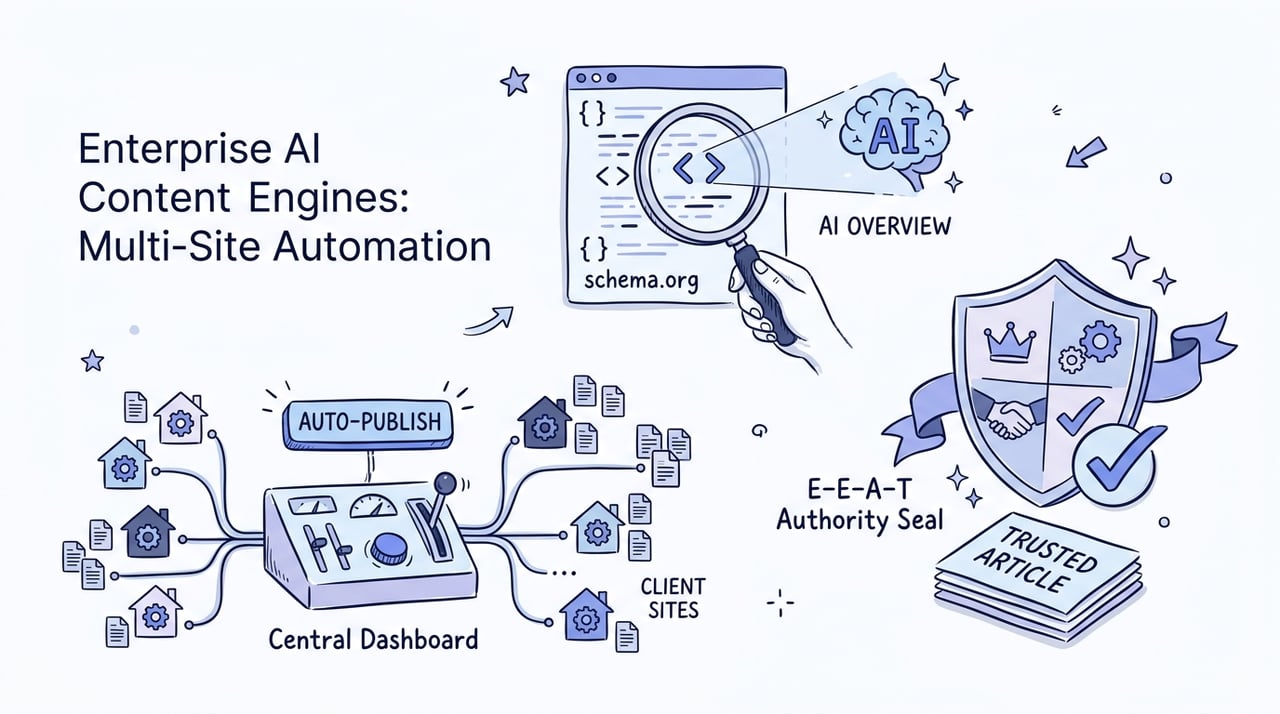
Enterprise AI Content Engines: Managing Auto-Publishing for 50+ Client Sites from One Dashboard
Scaling SEO across 50+ client sites requires more than simple AI generation. It demands a highly programmatic, structured dataset architecture, multi-agent workflows, and semantic internal linking to command authority in the AI Search era.
•8 min read
The traditional search index is fractured. Standard blue-link rankings are yielding to AI-synthesized search overviews, forcing modern agencies to optimize for extractability, verifiability, and LLM citations.
If you are still trying to scale an agency using simple template-and-spin content, your traffic is on a timer.
Google does not penalize AI content simply because it was created by a machine.
Instead, it aggressively targets unoriginal, zero-value, mass-produced text designed solely to abuse the index.
The real challenge of 2026 is managing fifty client sites without triggering Google's Scaled Content Abuse filters.
It requires moving past simple writing tools into true enterprise content orchestration.
The Enterprise AI Playbook: Core Pillars
Managing scaled content across portfolios is difficult.
This enterprise playbook outlines the essential strategies to maintain indexation and high organic performance.
Compile proprietary, structured datasets including API outputs, localized industry metrics, or unique customer reviews to fuel your content engines.
Deploy isolated Multi-Agent workflows to run keyword gap analyses, write contextually distinct content per page, and generate clean JSON-LD schema blocks.
Implement strict quality controls to ensure every single generated page maintains at least a 60% uniqueness ratio.
Configure automated JSON-LD templates directly into your page headers to make your content easily digestible for generative search engines.
What Is Multi-Site AI Content Automation for Agencies?
Multi-site AI content automation is the centralized orchestration of programmatic SEO (pSEO) across isolated client portals to target high-intent, repeating long-tail queries without triggering spam filters.
Programmatic SEO itself relies on using structured datasets and scalable templates to build hundreds of highly tailored pages. However, mass production without distinct value triggers Google's Scaled Content Abuse policy, which prohibits low-value, unoriginal content regardless of whether it was built by hand or by machine.
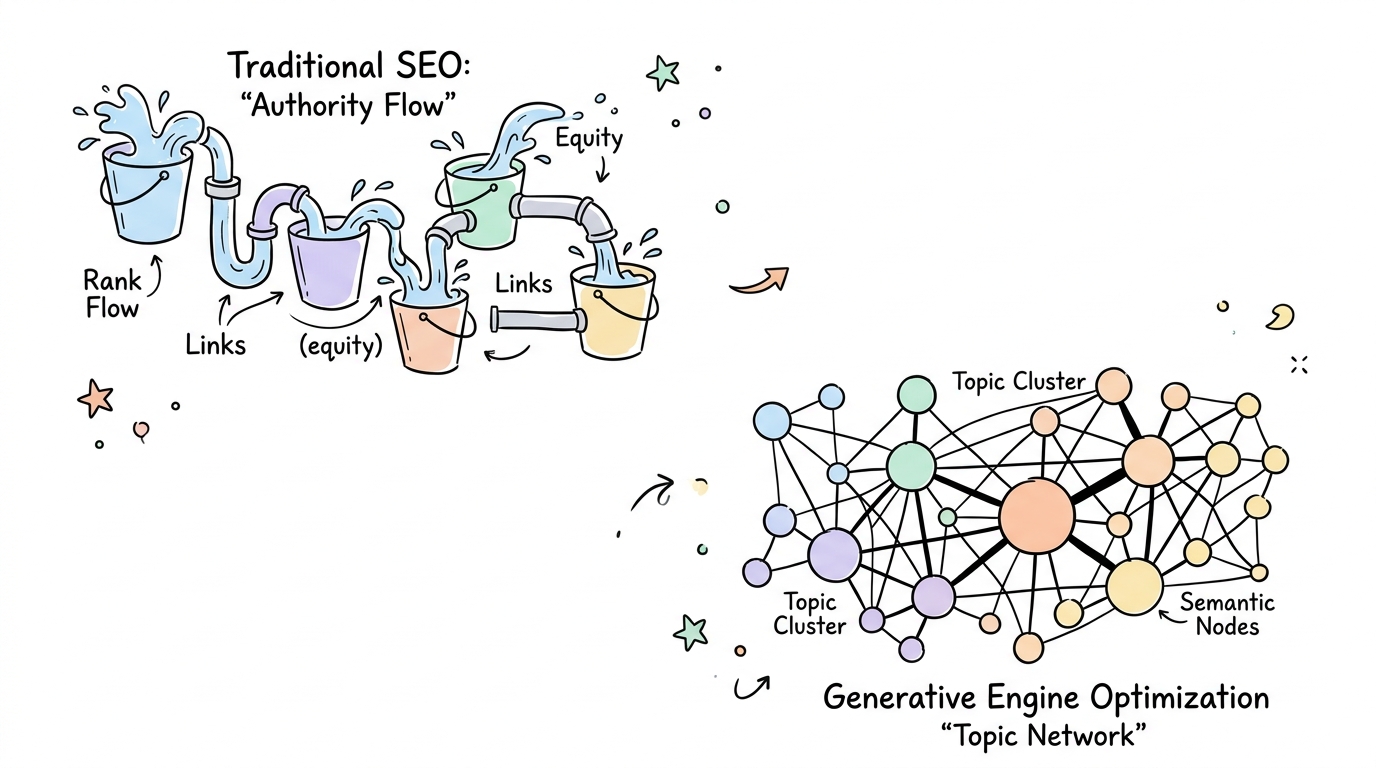
The shifting search landscape means moving away from traditional SEO, which primarily passes PageRank authority through link equity. Generative Engine Optimization (GEO) focuses instead on topical link density and semantic node relationships.
15% to 50% average reduction in organic click-through rate (CTR) on informational queries when Google AI Overviews are displayed.
Freshness also matters, as there is a 3.2x increase in AI search citations for content updated or published within the last 30 days compared to older pages.
If you want to understand why simple automated content pipelines inevitably fail, this detailed industry breakdown shows the risks of scaling without a proper quality framework:
To avoid this boom-and-bust cycle, you must build robust template engines that pull from actual database records rather than relying on generic LLM prompts.
How Do You Build a 1,000+ Page Programmatic Engine Safely?
Building a safe, high-performing programmatic engine of over 1,000 pages requires mapping structured, non-public data directly to semantically rich layouts.
This methodology ensures that every page provides unique utility that can survive automated quality reviews.
Compile your unique dataset by gathering proprietary metrics, verified client reviews, or API outputs.
Build semantically structured templates to incorporate comparison matrixes, dynamic local variables, and targeted FAQ sections.
Restrict your templates so your system pulls from at least three different source data points for every page.
Enforce strict uniqueness filters to verify that each page maintains at least a 60% distinct text ratio.
Establish metered direct-publishing routines via REST APIs or webhooks to slowly drip content to CMS hosts like WordPress instead of publishing all pages at once.
If you are hosting on WordPress, you can orchestrate this using bulk tools such as the PageForge WordPress Directory Listing plugin to control template rendering.
Here is an example of a payload structure used to register programmatic templates with a headless CMS:
Rule: Never publish more than 100 programmatic pages per day on a single domain to prevent crawl budget crashes.
Why Is Schema Markup Critical for AI Overviews?
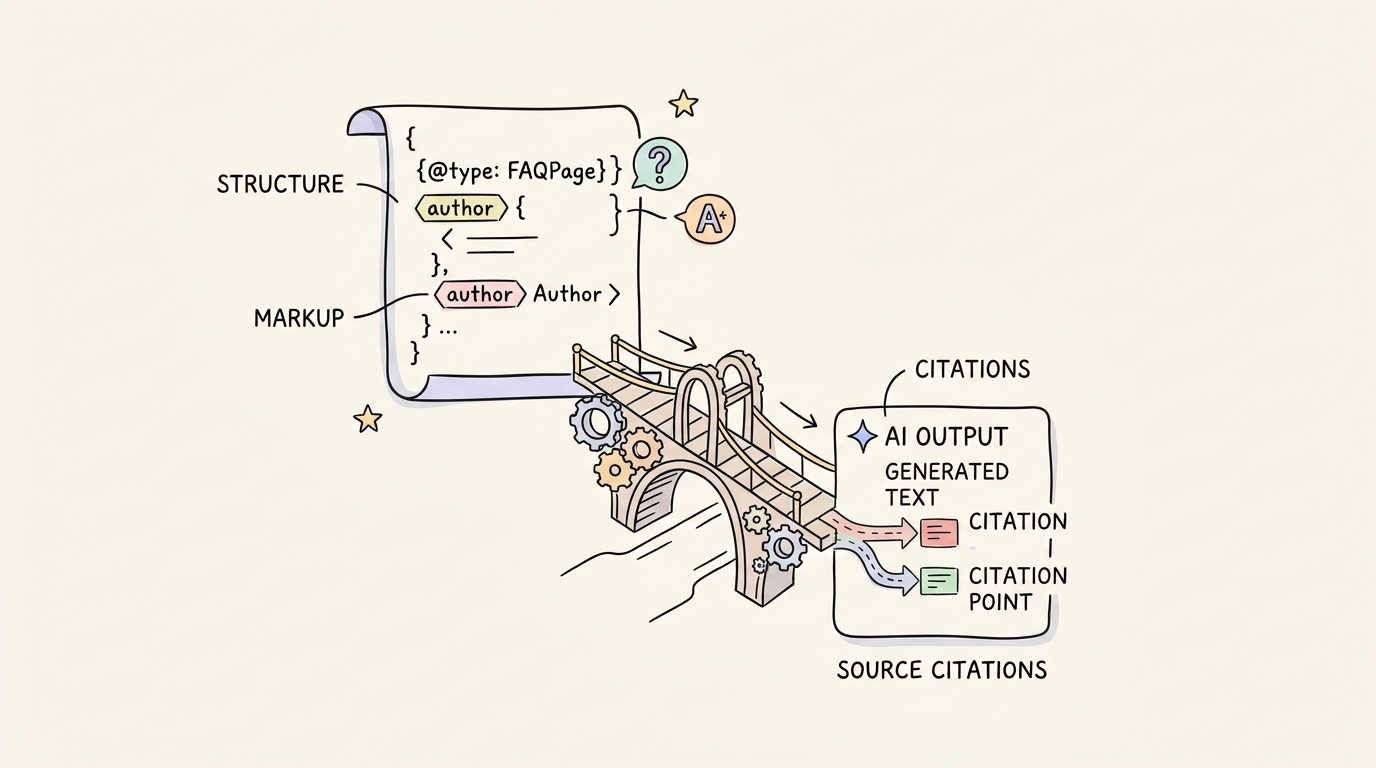
Structured JSON-LD schema is the machine-readable language that translates your page's context directly for LLM crawlers.
Because search engines must quickly parse and verify data to generate AI Overviews, adding structured markup drastically increases your chances of being featured.
Pages with structured schema markup (JSON-LD) are three times more likely to be cited by AI models compared to those without it.
You should configure automated FAQPage, Organization, Article, and Author schema directly into your page header templates. Use cases like Model 2 (Use Case and Vertical Pages) require specialized schema that maps industry-specific workflows. Meanwhile, Model 3 (Comparison and Alternative Pages) should use structured entities to explicitly contrast competitor features.
The technical details can be structured using the official vocabulary found at the Schema.org Technical Vocabulary database.
Schema Selection Guide
If targeting local terms, then use Organization schema populated with sameAs properties linking to external, verified directory listings.
If deploying editorial pages, then inject Author and Article schema with verified contributor social links to establish authority.
If targeting high-volume informational queries, then implement FAQPage schema with clear, direct answers to win direct citations.
How Does Internal Link Density Signal Authority in 2026?
A tightly woven, bidirectional internal linking mesh is the single most effective way to signal topical authority to semantic search algorithms.
Traditional PageRank formulas look at external links, but modern AI models analyze how deeply a topic is mapped across your entire domain.
You must ensure your intra-cluster link density ratio remains above 2.0 to show true domain depth.
To calculate your link density, divide the total number of internal links within a specific cluster by the total number of pages in that cluster. If you have ten pages, you need at least twenty-one internal links pointing between those ten pages.
James Calloway explains that a site with ten loosely connected pages on AI visibility will lose to a site with five tightly interlinked pages, because AI models read link density within a topic as a signal of depth.
Building these links automatically requires advanced content managers.
Tip: Avoid footer-only links; embed your internal links contextually within the body paragraphs to maximize semantic weight.
Deploying Isolated Dashboard Environments for 50+ Client Sites
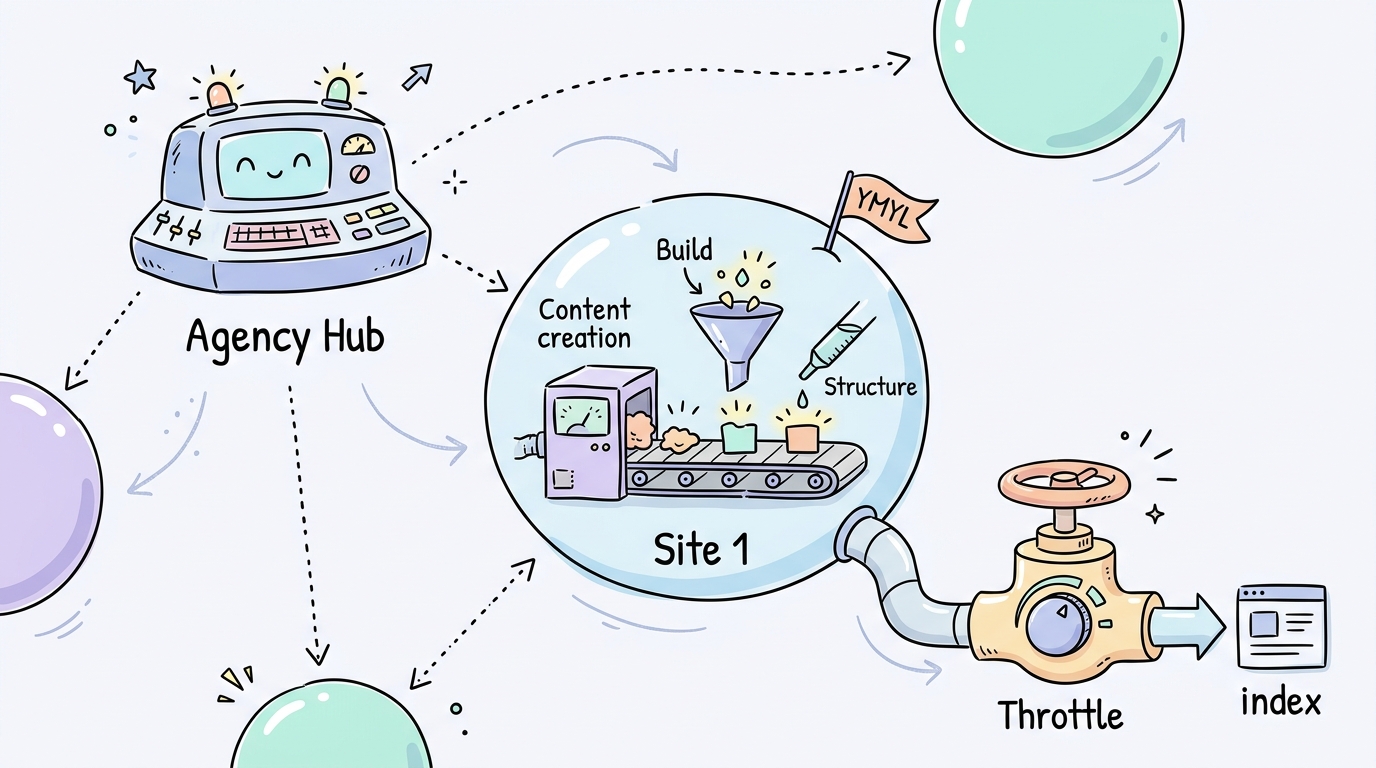
Managing 50+ client sites from a single interface requires complete technical isolation between each tenant to protect domain authority and prevent cross-contamination.
If one client site triggers an index freeze, the rest of your agency portfolio must remain completely insulated.
Using a unified dashboard like Kitful AI allows you to orchestrate multi-site publishing across various destinations via direct webhooks, keeping credentials and brand voices entirely separate.
Operational Safe Rules
If managing 50+ client sites, then you must implement isolated tenant environments to prevent cross-contamination of brand voices and localized data assets.
If working within YMYL (Your Money or Your Life) niches, then the automated generation pipeline must inject structured author credentials and enforce a 70/30 AI-to-human editing threshold to satisfy E-E-A-T.
If facing soft penalties or crawl budget delays, then throttle sitemap updates to 100-page daily batches and temporarily noindex thin-template category shells.
To avoid triggering Site Reputation Abuse penalties, you must ensure that your automated content is never hosted on unrelated, high-authority domains without strict editorial oversight. Maintain a slow, natural publishing pace and utilize a human-in-the-loop review process for all sensitive client niches.
How Do You Audit and Verify Automated Sites at Scale?
Scaled auditing is the only way to protect fifty distinct client sites from creeping indexation errors, template bugs, or content drift.
Without systematic weekly checks, a single template logic error can ruin the search visibility of an entire domain.
You should run automated validation routines across a random ten percent sample of all newly generated pages.
Audit Checklist
Execute a programmatic similarity check across a 10% sample of pages to confirm a uniqueness ratio of >=60%.
Run a crawler analysis to verify that the topical cluster internal link density ratio is above 2.0.
Verify schema accuracy using Google's Rich Results Test for FAQPage and Organization structures.
Perform weekly AI Visibility Score audits on major platforms (ChatGPT, Gemini, Perplexity) to monitor brand citation frequency.
These automated parameters can be summarized as follows:
Verification Test
Target Metric
Recommended Frequency
Content Similarity
>=60% Uniqueness
Pre-Publishing Batch
Link Density
>2.0 Cluster Ratio
Weekly Crawl
Schema Validity
0 Errors
Monthly Audit
AI Visibility
Brand Citation Growth
Weekly Scan
Frequently Asked Questions About Multi-Site AI Content Automation
No, Google's ranking systems do not penalize content solely because it was created by AI. Google's primary focus is on the originality, depth, and helpfulness of the material, meaning that high-quality automated content ranks just fine.
What is Google's Site Reputation Abuse policy?
Google's Site Reputation Abuse policy addresses situations where a third party publishes low-value content on a highly trusted, reputable host website. This is done to piggyback on the host's existing domain authority and is highly penalized.
How can agencies scale to 1,000+ programmatic pages safely?
Avoid simple keyword-swapping templates. The modern playbook requires using AI agents to inject unique, distinct data points and localized metrics into every single page.
Why is schema markup critical for AI Overviews?
JSON-LD serves as a machine-readable semantic translator that clearly defines entities, relationships, author credentials, and Q&A blocks. AI crawlers can digest this structured information much faster than raw prose, making citations more likely.
The Sovereign AI Content Stack of Tomorrow
Simple keyword-stuffed templates are dead.
The era of launching empty keyword-stuffed templates and watching rankings climb is officially over. The version of programmatic SEO that works in 2026 looks almost nothing like the template-and-spin approach that dominated the previous cycle.
Today's enterprise engines demand database precision, semantic schema alignment, and rigorous multi-tenant separation. While AI can drastically accelerate your publishing capabilities, it should never replace judgment, original information, or human editing.
Take the next step by mapping out your proprietary client data assets, auditing your internal linking structures, and shifting your focus toward generative search citation optimization.
 Kitful