 Kitful
Finding 'Zero-Volume' Low Competition Keywords that Drive Massive Conversions in 2026
Traditional SEO tools are lying to you about search volume. This playbook reveals the 2026 strategy for finding 'zero-volume' gems that drive higher conversions than head terms.
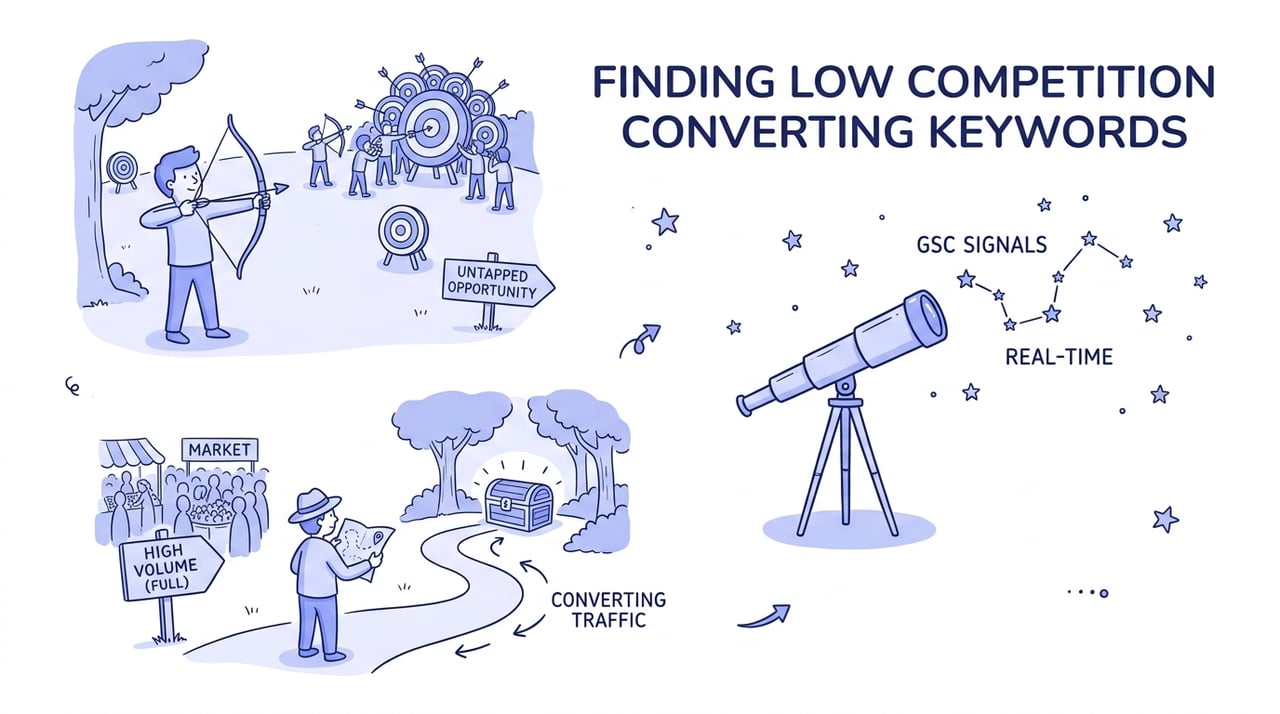
Your favorite SEO tool is effectively lying to you about what your customers actually want. Most platforms rely on historical averages, which means they are perpetually stuck looking in the rearview mirror.
Here is the reality: 15 to 20 percent of Google searches every single day have never been seen before. If you only target keywords with high reported volume, you are fighting for scraps in a crowded room while ignoring an empty banquet hall next door.
Following the volume is a race to the bottom that results in high-cost PPC and impossible organic competition. When you shift your focus to zero-volume queries, you are capturing demand the moment it exists, not months after the tools finally notice it.
This strategy is not about settling for less traffic. It is about owning the most profitable corners of your niche before your competitors even know they exist.
The Bottom Line Up Front
Targeting queries that legacy tools ignore is the fastest way to build a conversion-driven content engine. Here is what you need to know:
- Zero-volume keywords convert at a 36% average rate, nearly triple the 11.45% seen with head terms.
- Long-tail and low-reported queries drive roughly 70% of all search traffic on the web.
- Dominating these specific niches allows you to build topical authority without needing a massive backlink profile.
- Search engines prioritize specific, high-intent answers over generic guides in 2026.
Focusing on these terms is a shortcut to ranking on page one while larger brands are still debating their high-volume strategy.
What Are Zero-Volume Keywords Really?
Zero-volume keywords are search terms that SEO tools like Ahrefs or Semrush report as having 0 to 10 monthly searches. This usually happens because the query falls below reporting thresholds or simply lacks enough historical data for the tool to make a guess.
In 2026, the rise of voice search has changed the landscape entirely. The average length of a voice search query is now 29 words, which almost always results in a zero-volume report because humans do not speak in keywords.

These tools are estimates, not a direct feed of Google's server reality. Just because a tool says zero does not mean people aren't searching; it means the tool cannot verify the trend yet.
Step 1: Mine Your Google Search Console Goldmine
Your Google Search Console is the only source of truth that matters for your specific site. It reveals exactly what phrases are triggering your impressions, even if those phrases are not yet driving clicks.
Look for queries with high impressions but zero reported volume in your external tools. These are latent demand signals that indicate you are already being considered for terms that have no competition.
Here's a walkthrough that covers the key steps:
- Identify core seed topics based on your product or service functionality.
- Filter your GSC data for long-tail phrases containing at least five words.
- Look for question-based queries starting with "how to," "why does," or "best way to."
- Isolate terms with impressions but a zero percent click-through rate.
- Cross-reference these terms against your current content to find gaps.
Tip: Sort your GSC queries by impressions in descending order to find the high-reach, low-click phrases that indicate a missing dedicated page.
Step 2: Capture The 'Voice Of The Customer'
Stop looking at spreadsheets and start listening to the humans who actually buy your product. The phrases your customers use to describe their pain points are often wildly different from the industry jargon you are targeting.
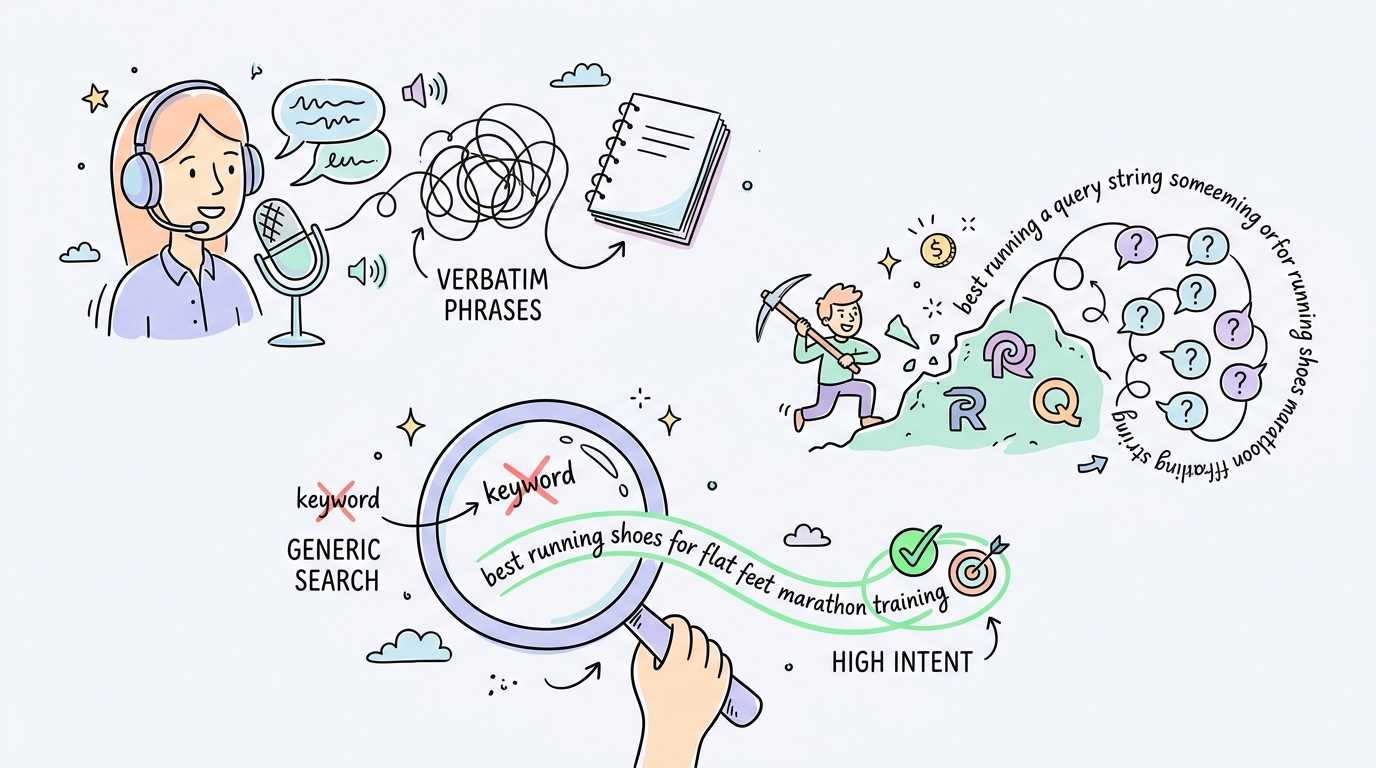
Analyze your customer support tickets and recorded sales calls to find verbatim phrasing. If three different customers ask the same hyper-specific question, that is a high-converting content opportunity regardless of what the tools claim.
Example
Instead of fighting for "running shoes," which is dominated by massive retailers, look at the specific problems your customers face. A query like "best running shoes for flat feet marathon training" might show zero volume, but the person typing it is ready to buy a specific solution immediately.
- Mine Reddit and Quora threads for specific question strings in your niche.
- Use the exact phrasing found in the "Top" or "Most Helpful" comments.
- Check specialized forums where enthusiasts discuss technical frustrations.
- Note the emotional language users apply to their problems.
- Map these phrases back to your product features for direct solution-selling.
Step 3: Validate Real-Time Demand Without Tools
Once you have a list of potential phrases, you need to confirm they actually exist in the real world. You can do this by using Google Trends or simply checking Google Autocomplete for real-time validation.
If Google starts suggesting your phrase as you type, it means people are looking for it right now. You can also use Answer Socrates to find related questions that search engines are actively trying to map to user intent.
- If the phrase appears in Google Autocomplete, it is a high-priority target.
- If 'People Also Ask' boxes show related technical questions, create a dedicated guide.
- If the top 5 results are low-authority sites or forum posts, you can easily rank.
- If the SERP is filled with generic head-term pages, a specific answer will win.
- If the keyword describes a brand-new industry trend, target it immediately to be first.
Monitoring GSC for impressions on new pages within 30 days is the ultimate validation of your strategy.
The Zero-Volume Tool Stack For 2026
To win at this game, you need tools that prioritize real-time data and SERP weaknesses over historical volume logs. You should rely on first-party data whenever possible, but a few specialized tools can speed up the discovery process.
- LowFruits Keyword Tool: Best for finding "weak spots" in search results where low-authority sites are ranking.
- Keywords Everywhere: Useful for seeing real-time data overlays while you browse Google Autocomplete.
- Answer Socrates: An essential free resource for mapping out every possible question a user might ask about a topic.
- Google Search Console: Your primary tool for identifying what is already working under the radar.
Each of these tools has its own tradeoff. While LowFruits is excellent for spotting easy wins, it requires a paid subscription to unlock the full potential of its SERP analysis, and GSC only shows data for terms you already rank for.
Strategy Comparison: Head Terms Vs. Zero-Volume
The difference between high-volume and zero-volume strategies is the difference between vanity and profit.
| Feature | Head Terms (High Volume) | Zero-Volume Keywords |
|---|---|---|
| Conversion Rate******* | 11.45% | 36.00% |
| Competition******* | Extremely High | Very Low |
| Time to Rank******* | 6-12 Months | 1-4 Weeks |
| Intent Accuracy******* | Vague / Informational | High / Transactional |
| Cost per Click******* | Expensive | Often $0.00 |
Zero-volume keywords provide the fastest path to revenue for new or mid-sized websites.
Execution: Creating Content That Dominates
To dominate these queries, you must write content that directly solves the hyper-specific problem the user is facing. Do not create a generic 2,000-word guide; instead, provide the exact answer in the first 100 words to win the Featured Snippet.
Group these zero-volume keywords into topic clusters. For example, if you are using Kitful AI to automate your blog, you can generate 10 specific articles around niche pain points and link them all to one pillar page about your core service.
Rule: Never sacrifice search intent for word count; a 500-word page that perfectly answers a technical query will outrank a 3,000-word fluff piece every time.
AI Overviews (SGE) are triggered more frequently for keywords with fewer than 1,000 monthly searches. By targeting zero-volume terms, you increase your chances of appearing in the SGE response block, which often sits above all traditional organic results.
Stop Waiting For The Tools To Catch Up
Stop waiting for SEO tools to tell you what to write about. By the time a keyword shows 1,000 monthly searches in a dashboard, the opportunity to rank easily has already passed.
Remember that 92% of all keywords have fewer than 10 searches per month. This is the real market where your most qualified customers are hiding, and dominating these niches is the only way to build a true competitive moat.
Start mining your Search Console data today and publish your first high-intent, zero-volume page. The data is already there; you just have to stop ignoring it.