BlogFrom Product to Post: Building a Shopify AI Blog Automation Workflow Using n8n and Airtable
From Product to Post: Building a Shopify AI Blog Automation Workflow Using n8n and Airtable
Learn how to build a highly defensible, automated SEO publishing machine for Shopify. We map out the exact n8n blueprint and Airtable database structure to scale traffic without triggering Google quality updates.
•9 min read
The standard programmatic playbook is dead. In fact, more than half of all search queries in 2026 end without a single organic click.
A massive 58.5% of searches require on-page content structured specifically to win AI citations rather than traditional blue link visits.
Meanwhile, Google's 2026 core updates are aggressively penalizing raw programmatic content scale. If you run a hands-off, autopilot blog publishing hundreds of generic AI drafts a day, your traffic will eventually hit zero. The algorithm targets these exact velocity spikes.
Ranking today is not about publishing endless pages stuffed with keywords. It is about building trust, demonstrating usefulness, and establishing verifiable proof of quality. Out-of-the-box Shopify AI plugins that write and post with a single click cannot survive this environment.
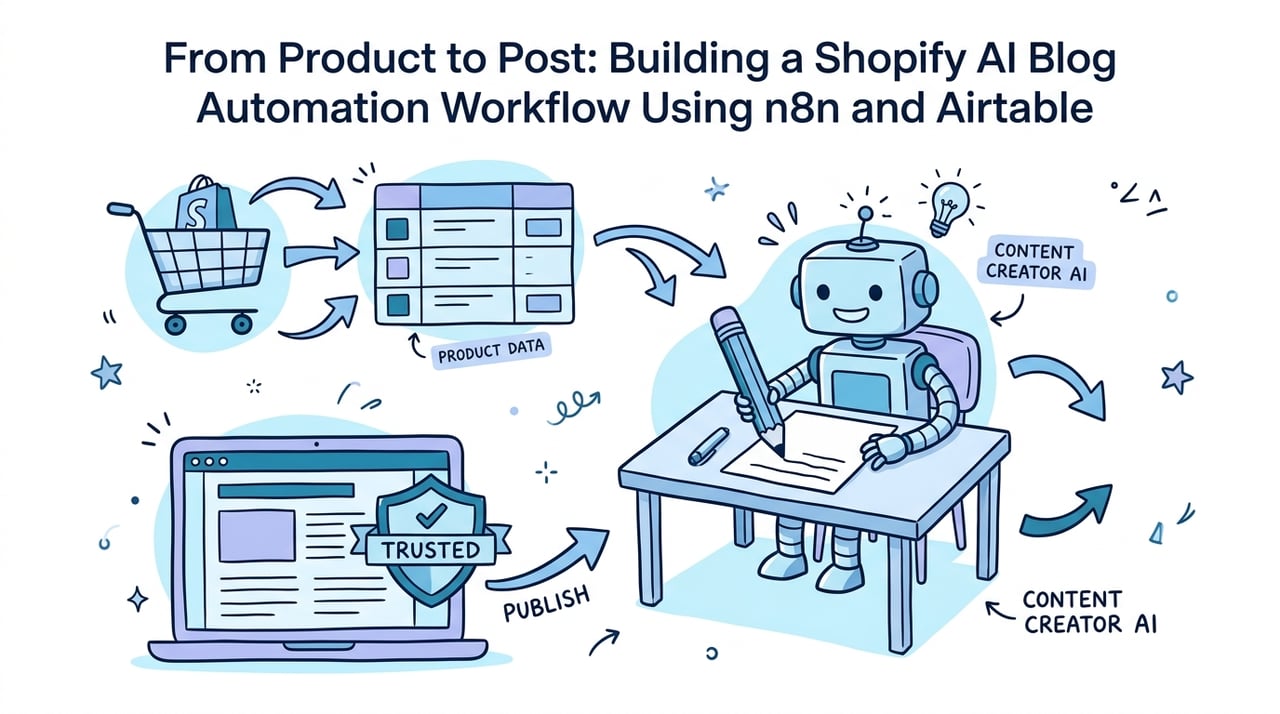
To scale your ecommerce SEO safely, you need a resilient, multi-agent automated system that respects quality thresholds. I found that connecting Shopify directly to an external database like Airtable using n8n is the absolute best way to build this. This system allows you to generate content at scale while keeping an uncompromised human-in-the-loop editorial queue.
The Blueprint at a Glance
Here is the core logic. You can build a highly scalable, safe SEO machine by separating your content database from your actual Shopify store.
Relational Database Control: Use Airtable to manage product details, metadata, expert credentials, and target keyword lists.
Workflow Orchestration: Use n8n to connect your APIs, handle multi-agent reasoning prompts, and automate formatting.
Editorial Gatekeeping: Use a strict manual review status in Airtable to block raw AI text from publishing until a human reviews it.
This approach acts as your absolute defense against automated content penalties. It ensures your store benefits from programmatic scale without sacrificing human quality control.
Here is a walkthrough that covers the key steps:
Let us dive into the technical requirements for setting this up.
Essential Requirements for the Automated Pipeline
Before configuring any automation, we must assemble our toolkit. Ensuring you have the correct administrative access early prevents runtime failures in your API calls.
Here is what you need to get started:
An active Shopify store with custom app development enabled, specifically requiring the write_content scope permission to post blogs.
API accounts with OpenRouter, OpenAI, or Google Gemini to power your multi-agent prompts.
Keyword research APIs such as Haloscan to verify real-time search volume and check search intent.
Rule: Never use administrative API tokens with broader scopes than necessary; limit your Shopify token strictly to content writing permissions.
Once you have gathered these keys, we can move directly to constructing our n8n database and flow rules.
Step-by-Step Blueprint: Building the n8n Core Engine
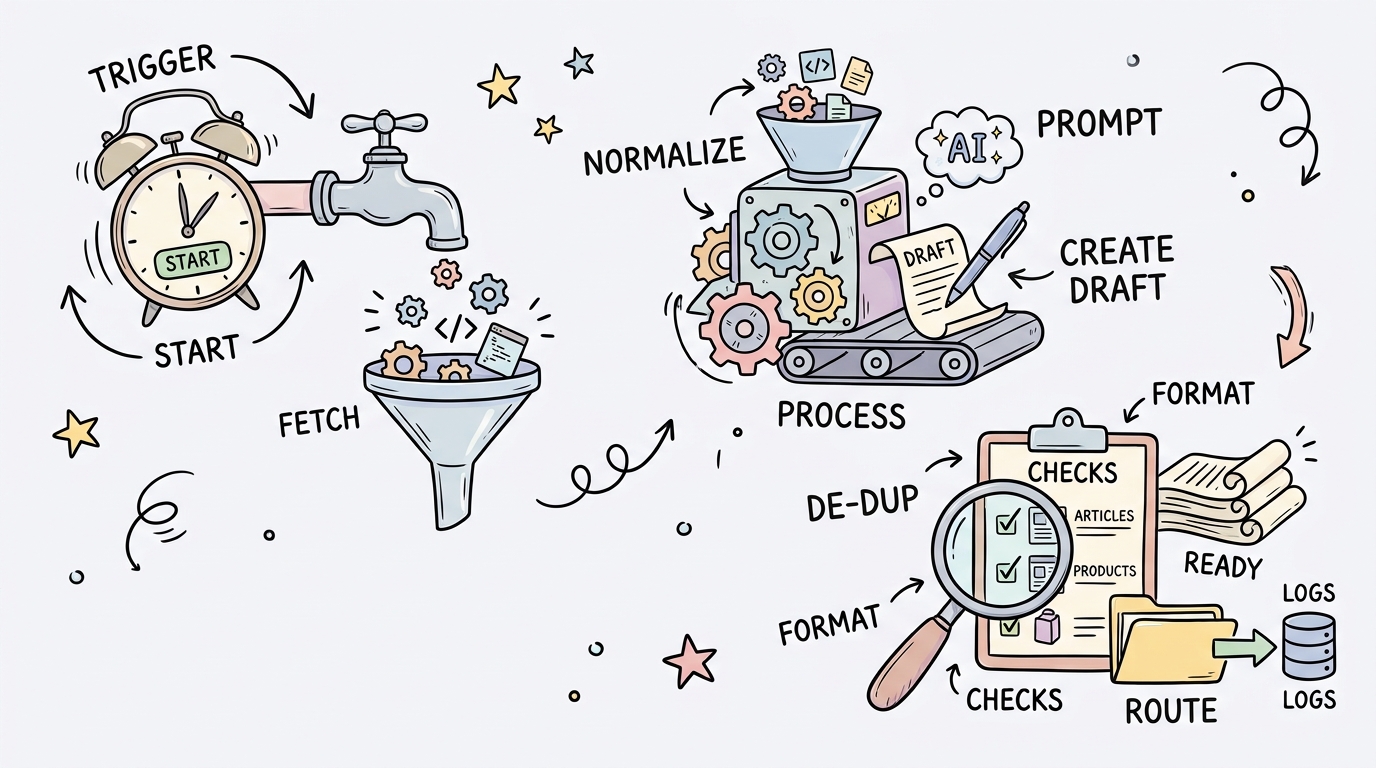
Setting up your automation engine requires a logical data flow. I build these pipelines using a sequence of nodes that ingest product information, clean the formatting, run structured prompts, and stage the draft.
First, establish a trigger. You can use an Airtable webhook triggered by a status change, or a scheduled cron node inside n8n to fetch fresh listings.
Next, fetch the products. The workflow connects to Shopify to pull details like descriptions, prices, tags, and variants. We then clean this raw data. Because Shopify returns a complex nested payload, we must normalize these variables into structured JSON arrays.
To avoid posting duplicate articles, insert a filter node. This node cross-references the retrieved Shopify product handle against your database logs. If a match is found, the execution halts.
For the actual content generation, we use reasoning-based prompts. We instruct our models to analyze the product and write a comprehensive, long-form guide. The response must include optimized semantic headings alongside structural JSON-LD schemas.
Finally, we must sanitize the output. AI models often include markdown markers or unescaped characters that break Shopify's HTML blog renderer. I use a simple JavaScript node inside n8n to clean the HTML tags before sending the data to our editorial board.
Tip: Use strict token limit controls on your LLM nodes so that long drafts do not crash your workflow loops.
Hardening the Workflow: Schema Injection and Real E-E-A-T
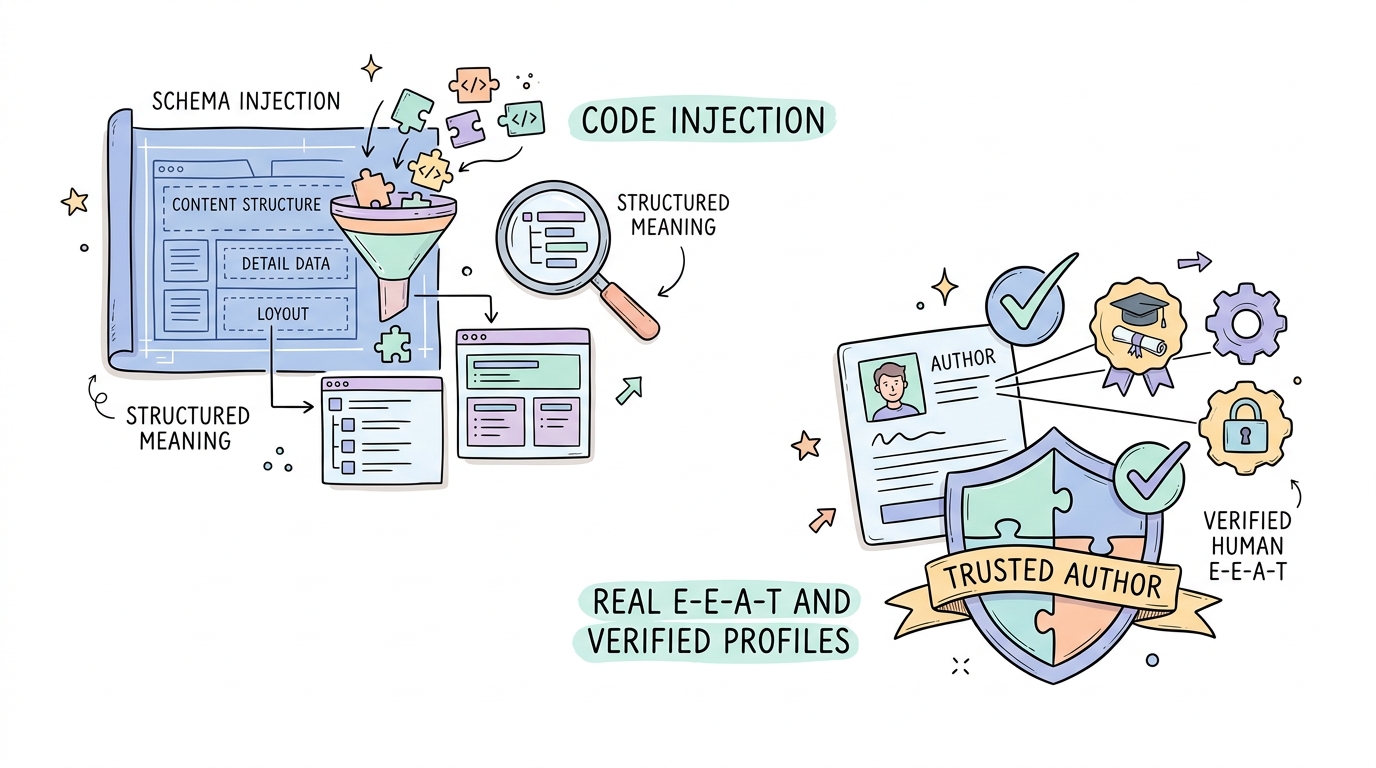
Security in modern search ranking requires a shield built of clear quality signals. In late 2025, websites lacking clear human authority signals experienced up to an 18% rankings drop. AI search engines simply do not trust anonymous automated content.
To survive, we must programmaticially build real-world E-E-A-T signals directly into our pages. We do this by pulling true author credentials from an Airtable directory and merging them directly into our blog posts.
Furthermore, schema markup is the software language that tells AI and search engines exactly what your content means. In early 2026, AI Overviews appeared in over 48% of commercial search queries. These rich summaries rely heavily on structured data schemas. By injecting schema programmatically, you increase your chances of being featured in generative answer engines.
When managing automated websites, we must strictly follow the Google Search Central Spam Policies to avoid manipulative patterns. Injecting genuine expert schemas and structured data is the legitimate way to prove trust.
Schema Integration Example
This block demonstrates how to structure a JSON-LD payload containing both product reviews and expert author credentials. Our n8n workflow dynamically replaces the variables:
A critical step in content scaling is ensuring your newly published pages are woven into your overall site structure. However, poorly executed programmatic linking is a fast track to an algorithmic penalty.
If you use automated systems that repeatedly use exact-match anchor text on thousands of pages, search crawlers will flag your site for manipulation. Instead, your links must be natural, contextual, and semantically relevant.
I use specialized database queries to analyze existing blog sitemaps. By comparing page text, we can identify semantic clusters. Using tools like LinkStorm AI Internal Linking Automation, you can systematically find these patterns without running heavy queries on your live Shopify database.
The system then suggests 3 to 5 highly relevant URLs with natural, varied anchor texts. Here are the core routing rules to build into your automated architecture:
If a recommended link uses exact-match product anchor text, then programmatically modify the anchor to use a natural, sentence-based phrase instead.
If the target article has no semantic similarity score above 75%, then route the link suggestion to a manual review field in Airtable instead of posting it automatically.
If your site is in a niche with complex internal categorization, then prioritize linking to high-level collections over individual product variants to keep link juice flowing correctly.
Choosing Your Orchestration Engine: n8n vs. Zapier & Make
When choosing an automation platform, your decision directly affects your bottom line. Programmatic workflows require heavy loops, multi-step APIs, and iterative agent calls.
If you use a service like Zapier or Make, you are billed on a per-step basis. Running detailed content outlines, vector queries, and editing loops across 1,000 product pages can easily generate hundreds of thousands of operations, causing your monthly subscription costs to explode.
By contrast, a self-hosted instance of n8n allows you to run unlimited execution steps without any per-step fees, keeping your operational margins healthy.
Orchestration Engine
Price
Best For
Pros
n8n
Free (Self-hosted) or Paid Cloud plans
High-volume programmatic projects and multi-agent AI loops
Zero per-step fees when self-hosted Deep javascript integrations
Zapier
Tiered subscription based on usage
Simple integrations with external consumer applications
Massive native app ecosystem Extremely friendly user interface
Make
Tiered subscription based on operations
Visual linear automations with moderate complexity
Clean interface to drag and drop nodes Good error handling options
Fatal Automation Mistakes to Avoid in 2026
The allure of complete hands-off publishing leads many store owners down a dangerous path. The absolute biggest mistake is deploying raw AI-generated blog posts straight to your store without any human editing.
Google's quality systems are highly sensitive to low-value scaled content patterns. Attempting to manipulate AI Overviews by stuffing recommendation engines, hijacking list-building elements, or engaging in recommendation poisoning will get your store penalized under modern anti-spam guidelines.
If you want to protect your business, you must treat your programmatic setup as a drafting tool, not a publishing tool. Every generated article should land in your Airtable dashboard with a status of "Pending Review." An editor must review the factual accuracy, fix any robotic syntax, and refine the product links.
Failing to run this editorial check leads to indexing issues and sudden drops in search visibility. If you are looking to master these workflows without breaking search rules, resources like Jonathan Boshoff's Free AI SEO Academy provide excellent strategies for maintaining high editor standards at scale.
Remember that programmatic scale is only useful if the pages actually stay indexed. Keep your system clean, verify every run, and never automate 100% of the editorial decisions.
Frequently Answered Questions
Will Google penalize my Shopify store for using AI content?
Google does not penalize content simply because it was written by an AI. However, they aggressively target scaled content abuse, which refers to publishing low-quality articles at a high velocity without providing unique value. As long as your posts are informative, edited by humans, and useful, your store is safe.
What is Generative Engine Optimization (GEO)?
GEO is the practice of optimizing your content so that AI search engines can easily parse and cite it. By using clear schemas, direct answers, and clean markdown lists, you make your pages easy for engines like ChatGPT, Gemini, and Perplexity to extract. This helps secure valuable citations inside AI summaries.
Why is an editorial queue necessary for programmatic SEO?
An editorial queue is your safety net against AI hallucinations, format breaks, and low-quality outputs. Programmatic runs can sometimes produce repetitive phrases or incorrect product specifications. Having a human editor quickly review and approve the text in Airtable ensures every post meets your brand's standards before going live.
Build Systems That Scale and Defend
Building a customized automation pipeline using n8n and Airtable gives you total control over your ecommerce content strategy. By combining database scale with a strict editorial review checkpoint, you create a powerful SEO machine that is both defensible and highly optimized for modern search.
If building custom multi-agent nodes and hosting your own server sounds too complex, you can look into dedicated platforms. For instance, Kitful AI offers an all-in-one content automation workspace that researches keywords, drafts research-backed articles, humanizes text, and automates publishing directly to Shopify.
The absolute goal is simple: transform content generation from a massive operational time-sink into a structured, highly valuable digital asset. Pick your stack, configure your pipeline, and start driving programmatic organic traffic to your store today.
 Kitful