BlogHeadless CMS Automation Guide: Programmatic AI Article Publishing for Strapi, Sanity, and Contentful
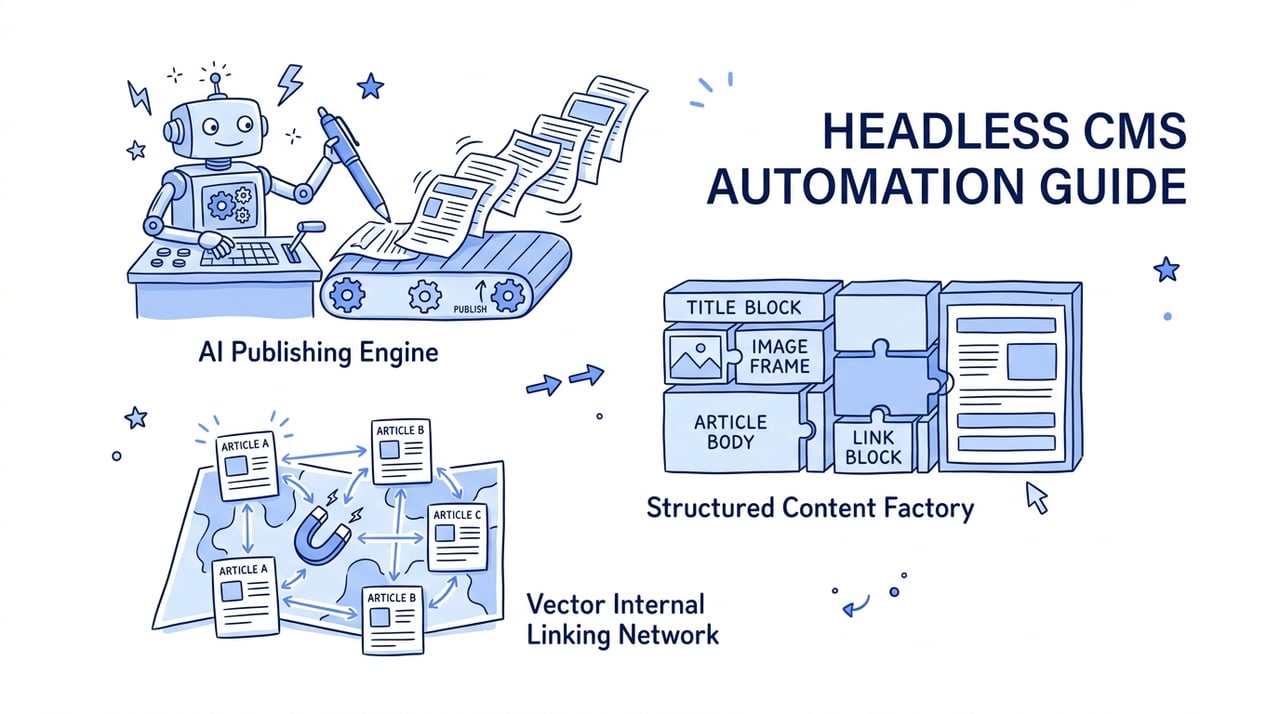
Headless CMS Automation Guide: Programmatic AI Article Publishing for Strapi, Sanity, and Contentful
Discover how modern SEO architects automate high-quality, structured AI article publishing. This playbook breaks down programmatic pipelines for Strapi, Sanity, and Contentful.
•7 min read
The programmatic SEO playbook that relied on spinning endless, thin landing pages is dead. Following Google's massive update, site owners who scaled poor templates saw immediate traffic collapses. The real issue is not the use of artificial intelligence itself. Google does not penalize content solely for being AI generated, but it aggressively filters out duplicate keyword templates that offer zero unique value. If you want to survive the modern search landscape, you must adapt to a programmatic model that prioritizes data authenticity, strict structural modeling, and deep contextual authority. True programmatic scale now belongs to those who build highly customized, structured data pipelines.
At a Glance: The Modern Playbook for Automated Publishing
Modern automated publishing requires moving away from flat text files and embracing deeply modeled, API-driven workflows. Here is a quick summary of the shift:
Move from massive, unstructured HTML text blocks to highly segmented, schema-compliant headless database fields.
Implement robust validation layers and automated quality assurance queues to prevent low-quality publishing runs.
Shift from outdated keyword-matching internal link strategies to dynamic, vector-based semantic similarity clustering.
Treat content as a network of connected data points designed to feed both traditional search engines and AI search engines.
Structured Content vs. Unstructured Blobs: The AI Engine's True Language
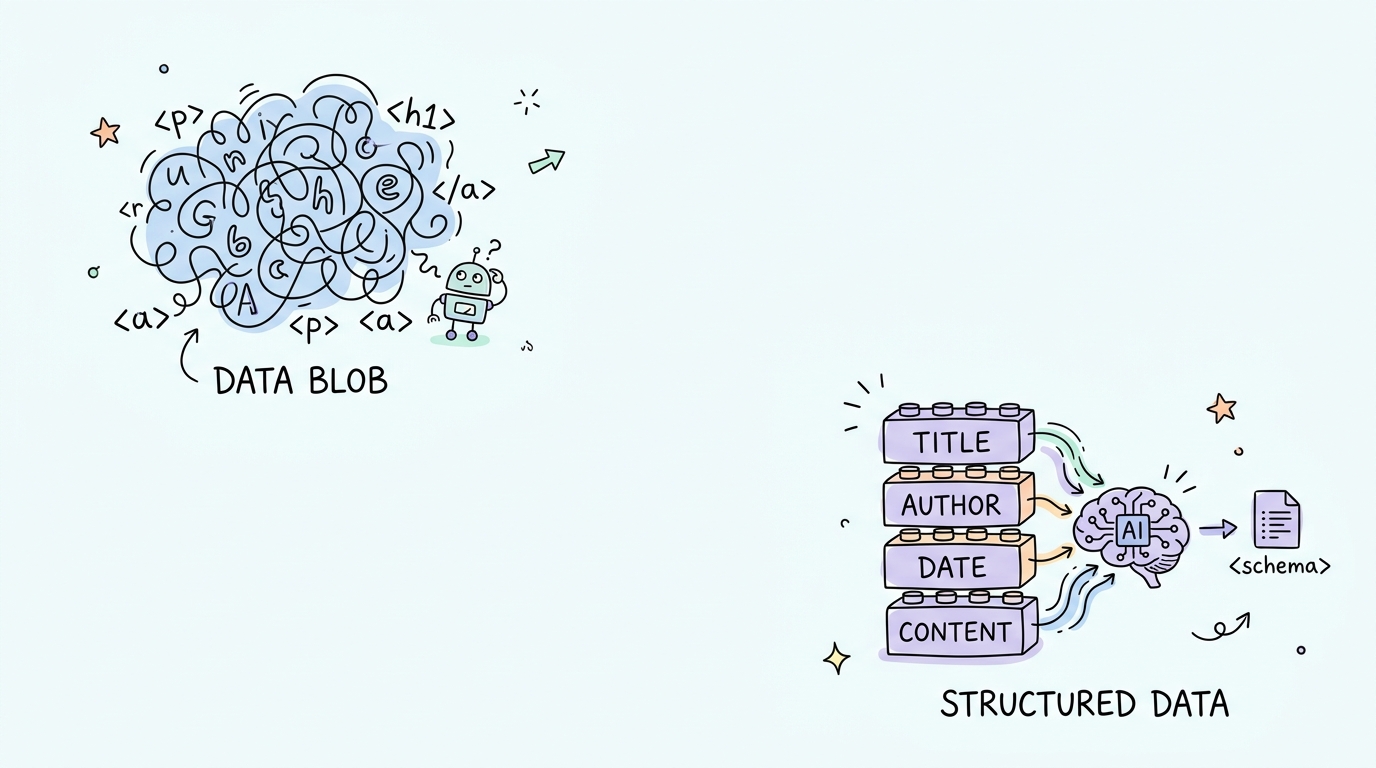
To understand why old automation pipelines fail, look at how modern search engines digest information. Legacy content management systems output a single, massive block of rich text or unstructured HTML. This setup blinds artificial intelligence models. When data is trapped in a generic text blob, an AI model cannot easily distinguish between a core product feature, a localized delivery schedule, or a simple marketing tagline.
Headless systems solve this problem by decoupling the editorial interface from the delivery layer. By storing every piece of context as a separate, structured database field, you build a machine-readable resource. Your automation pipeline can dynamically inject structured schemas and precise semantic connections at scale. A system where AI is wired directly into the database model produces publishable, high-quality resources, whereas a simple chatbot bolted onto a legacy sidebar merely generates draft text.
Here is a practical workflow video showing how to coordinate these systems at scale:
Rule: Never dump raw AI articles into a single rich text block; always separate metadata, key entities, and body copy into isolated API fields.
Comparing the Big Three: Strapi vs. Sanity vs. Contentful for AI Workflows
Your choice of headless CMS dictates how you build your automation pipeline. Different platforms handle API interactions, scheduling, and structured data with varying levels of flexibility.
Headless CMS
Core Architecture
AI Automation Mechanism
Best For
Strapi
Document Service API with custom cron-tasks
Programmatic middleware hooks and custom API controllers
Complete developer control over self-hosted setups
Sanity
Real-time Content Lake using Portable Text formats
Agent Actions that execute natively on structured blocks
Contextual AI pipelines needing rich structured data
Contentful
Global space environments with modular App SDKs
App SDK integrations and external workflow orchestration
Enterprise teams managing massive multi-brand scaling
Each platform has distinct structural advantages. For instance, developers using Strapi can leverage custom cron configurations and server-side JS middleware to process raw text payloads before they write to the database. This is ideal if you require total control over server environments. On the other hand, the Sanity platform processes content-aware functions natively on its real-time Content Lake. Its Portable Text model translates text into a rich JSON structure instead of flat HTML, allowing AI engines to parse details flawlessly. Contentful excels at global enterprise localization, though it relies heavily on external middleware to manage vector embedding calculations.
Step-by-Step: Constructing a Production-Ready AI Publishing Pipeline
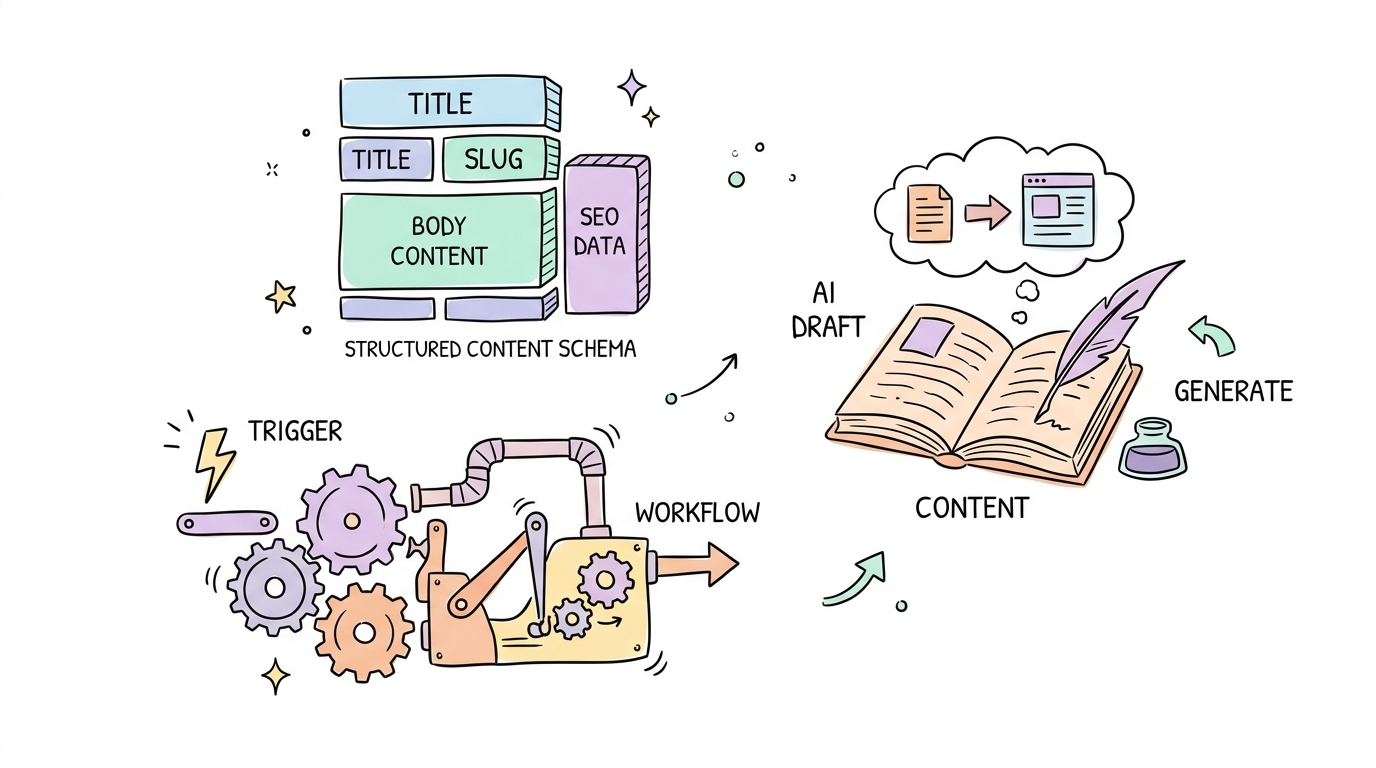
Building a resilient, production-ready AI publishing pipeline requires connecting structured content definitions with robust queue management. If you try to run massive, unthrottled API runs, you will hit rate limits and experience immediate timeout failures.
First, design your content types inside your CMS, ensuring you have separate fields for your Title, Slug, Rich Text Body, and custom SEO metadata. Next, configure your automation framework using platforms like n8n. You can kick off the process using a scheduled database trigger or a webhook connected to your data source.
When generating content, configure your LLM nodes to accept a strict markdown outline, exact keyword parameters, and a highly specific brand voice brief. Instead of publishing live, your workflow should route the finished JSON payload into a staging release or set the default publication status to Draft.
Here is a sample node configuration payload for pushing structured data into Strapi's Document Service API:
/* POST /api/articles */
{
  "data": {
    "title": "Optimizing Programmatic Pipelines",
    "slug": "optimizing-programmatic-pipelines",
    "body": "## The Core Shift
Automating your pipeline...",
    "seo_metadata": {
      "meta_title": "Optimizing Programmatic Pipelines | Tech",
      "meta_description": "Learn how to build resilient headless publishing pipelines.",
      "prevent_indexing": false
    },
    "publishedAt": null
  }
}
Consider using the n8n and Strapi Workflow Template to kickstart your pipeline setup without writing custom HTTP requests from scratch.
If you want a fully managed SaaS platform that handles keyword discovery, automated multi-language generation, and direct publishing to platforms like WordPress, Ghost, or custom webhooks, Kitful AI provides an all-in-one solution. For $49/mo (standard price $99/mo), it automates these complex steps natively, removing the need to host and maintain complex external workflow scripts.
Tip: Set your automated publishing status to 'Draft' or queue entries within staging releases to allow manual editor review before going live.
Ditching Keywords: Automating Internal Links via Semantic Embeddings
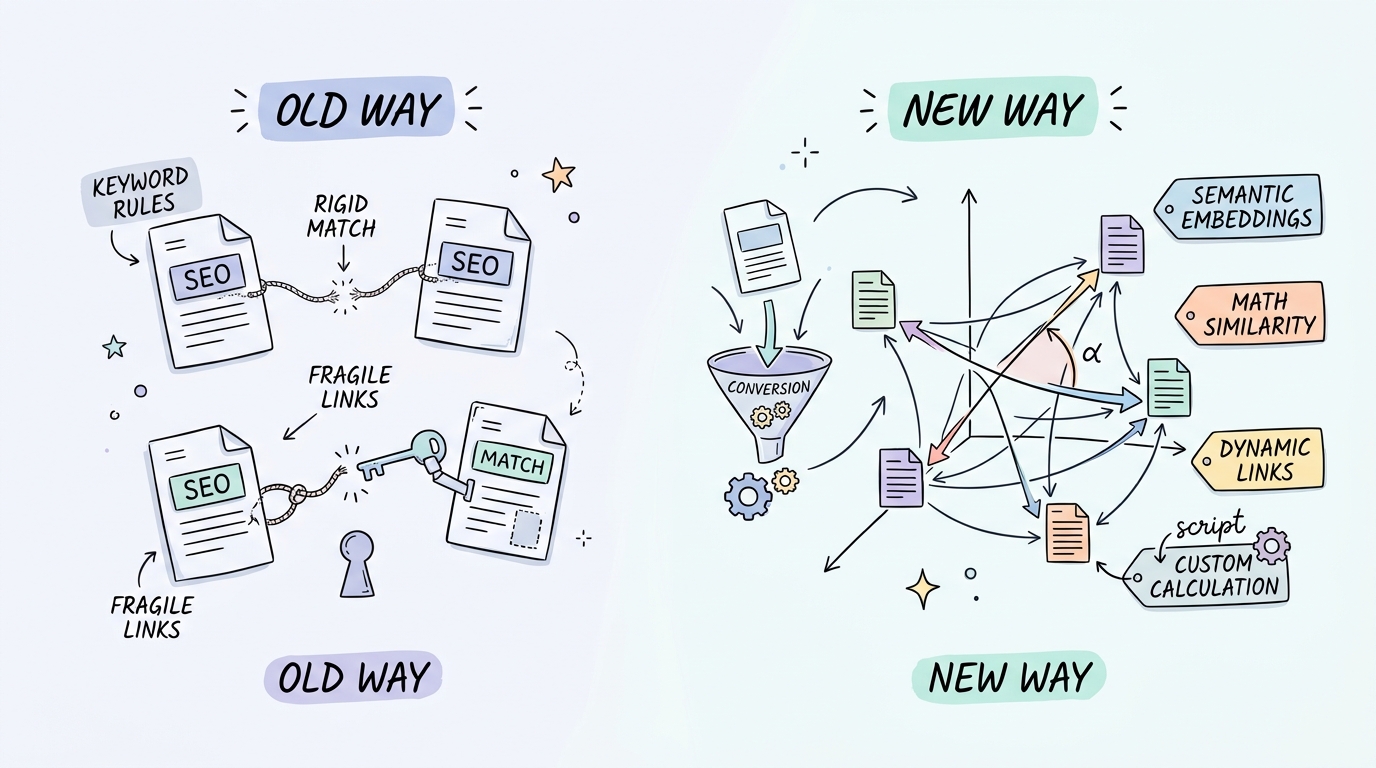
Relying on rigid, keyword-matching rules for internal linking is a recipe for broken sites and orphaned pages. In a modern headless ecosystem, you should automate your internal linking structure using semantic similarity calculations instead of basic regex patterns.
By transforming every page on your site into a vector embedding, you can calculate the mathematical similarity between articles. This lets you insert highly relevant internal links based on actual context rather than exact keyword matches. When your automation pipeline generates a new draft, it calculates the page's vector coordinates and compares them against your existing index, automatically finding the most contextually relevant pages to link to.
Apply these decision rules when designing your semantic linking engine:
If your headless setup lacks a native vector database, then write a custom script using LangChain to calculate cosine similarity externally.
If you are running high-volume batch imports exceeding 200 articles, then route your API updates through a queue manager like QStash to prevent database locks.
If you notice too many links pointing to a single high-authority landing page, then introduce a link-frequency cap inside your programmatic script to distribute page authority evenly.
Surviving the 2026 Web: Site Reputation Abuse and Scaled Content Compliance
Google has steadily increased its focus on quality enforcement, hitting sites with overnight drops when they deploy low-quality scaled content. The March 2026 Core Update proved that automated scraping and publishing without human oversight is a highly volatile strategy.
60-90% of average rankings were lost overnight by sites caught using low-quality programmatic templates to scale content.
This decline highlights why unverified, raw AI output fails. Google's modern quality systems also target Site Reputation Abuse, which penalizes high-authority domains that host irrelevant third-party content solely to exploit their ranking power.
To protect your digital authority, your programmatic systems must include verification filters. For example, a successful localized campaign using tools like Metaflow to collect real-world regional directory data should always run that data through a strict validation script before auto-publishing to Sanity.
Furthermore, Rankability's 2026 AI detection study revealed that 83% of top competitive Google search results read as human-written. This means that while raw AI text is not explicitly penalized, humanization, editing, and factual verification are essential steps if you want your programmatic pages to maintain long-term rankings.
No, Google does not penalize AI content simply because of how it was generated. Ranking algorithms prioritize helpful, original, and reliable information designed to benefit human readers.
How do I automate internal linking in a headless CMS?
You can convert your articles into 1,536-dimension vectors using models like OpenAI's text-embedding-3-small. Then, calculate the cosine similarity between your draft and existing database entries to link pages contextually.
What is Google's site reputation abuse policy?
This policy targets situations where a high-authority host domain publishes third-party content without close oversight, usually to leverage that host's ranking power for unrelated topics.
Why are unstructured HTML blobs bad for modern SEO?
AI search engines and modern search engines need structured, machine-readable semantic data. Monolithic HTML blobs make it difficult for generative crawlers to isolate key parameters.
The Future Belongs to the Structured
Building a programmatic SEO system that lasts requires a clean break from old habits. Moving away from unstructured HTML blobs and investing in highly structured, decoupled headless schemas is the only way to remain competitive. By automating your internal linking via vector embeddings and putting editorial QA guardrails in place, you protect your site from sudden algorithm updates. Focus on creating organized, machine-readable data structures today. This foundation ensures your content remains readable, indexable, and authoritative for both human searchers and AI retrieval engines.
 Kitful