 Kitful
How to Audit a Blog Post for SEO Without Using 5 Different Tools
Most blog posts are optimized on paper but fail in the SERPs because they ignore search intent and AI answer engines. This guide shows you how to perform a manual, high-impact SEO audit to revive your rankings.
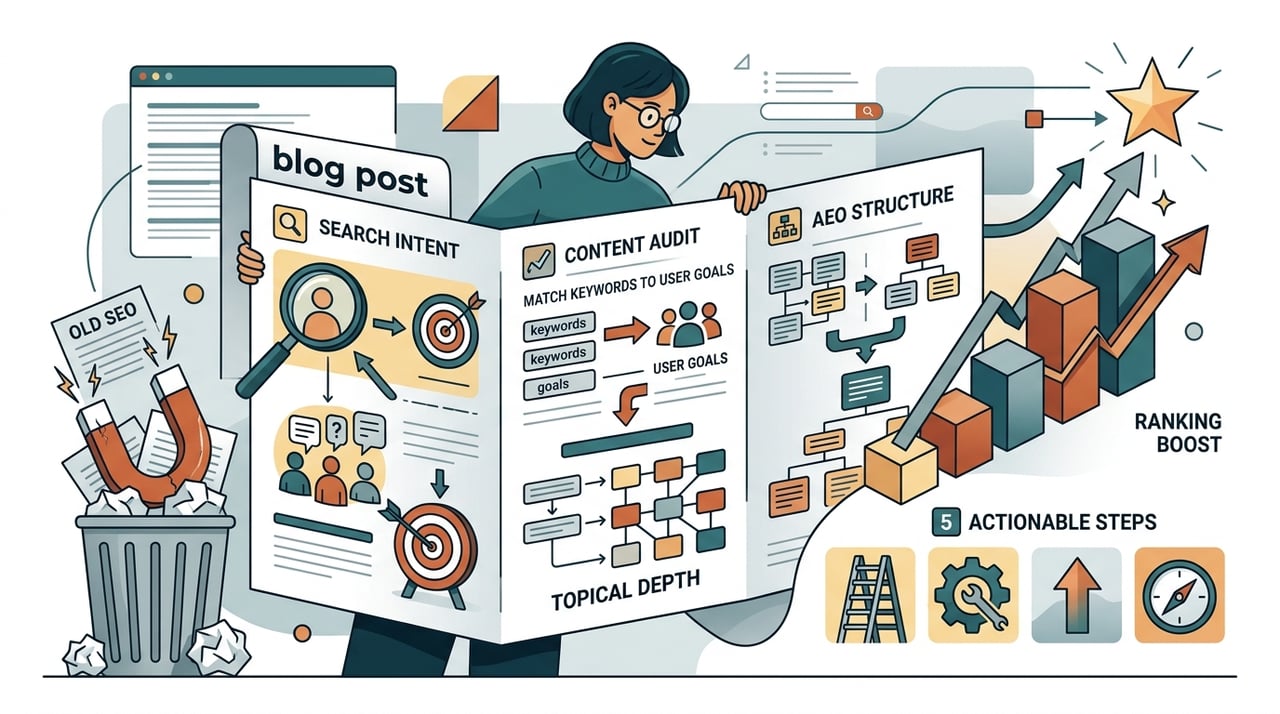
Your blog posts are probably perfectly green in your SEO plugin but still getting zero traffic from actual humans. Keyword density is a relic from a simpler era.
Google no longer rewards you for hitting a magic number of keyword repetitions. Most blogs fail because they are static while the search results around them are alive and constantly shifting.
Generic automated checklists cannot see that your competitors just updated their data or that searchers changed their minds. A manual audit is the only way to reclaim your spot at the top of the pile.
The TL;DR Of High-Performance Auditing
Search intent is the primary ranking driver, not just keyword volume.
AI search engines like ChatGPT prioritize chunked content and clear semantic structures over raw word counts.
- Align your content type with current Google rewards to fix intent mismatch.
- Focus on the click-gap and topical authority to attract and keep readers.
- Format headers for AI extraction to win in Answer Engine Optimization (AEO).
Step 1: Confront Your Search Intent Mismatch
Open your browser and look at the top five results for your target keyword right now. If those results are all listicles and your post is a long-form guide, you have a search intent mismatch.
Google has decided what the user wants, and you are trying to sell them something else. This matters because no amount of keywords will fix a wrong content format.
- If the SERP is full of tutorials, your post must be a step-by-step guide.
- If the top results are listicles, restructure your content into a list to match.
- If you see news or recent dates, your content needs a freshness injection.
Tip: Don't fight the algorithm. If Google wants a list, give it a list.
Step 2: Engineer High-Click Titles And Metadata
Your title is the only thing standing between a searcher and your content. Ensure your primary keyword is near the start of the headline to anchor the topic.
Creating a clear click-gap is essential for attracting visitors. You need to give the reader a specific reason to click your link instead of the one above it.
Google often rewrites meta titles and descriptions when it thinks it can do better for the user. However, you cannot neglect them or you might lose your main selling point in the shuffle.
Review the Google Search Quality Rater Guidelines to understand how quality is judged. This ensures your metadata aligns with what search engines consider high value.
Step 3: Structure For AI Search Engines (AEO)
Modern search is shifting toward Answer Engine Optimization (AEO). Large Language Models like ChatGPT and Gemini are the new gatekeepers of information.
These engines don't just list links, they summarize your content for the user. To win here, you need to format your post for easy extraction by machines.
- Add a TL;DR summary at the very top of your post.
- Use question-based headers for common search queries.
- Provide a direct one to two sentence answer immediately below those headers.
- Use the Kitful Blog SEO Checker to verify your AEO score.
Rule: Use a logical H1 to H3 hierarchy to act as descriptive signposts for both AI and humans.
Step 4: Close The Topical Authority Gaps
Topical authority is earned by covering every angle of a subject. Look at your competitors and identify what they cover that you missed.
If they have a section on pricing or a specific use case, you likely need one too. Identifying these gaps is the difference between a shallow post and a ranking post.
Example
A post about coffee makers that ignores maintenance misses a huge intent signal.
Updating your content isn't just about adding words. You must refresh outdated statistics and fix every broken link you find.
Here's a walkthrough that covers the key steps:
Always update the last updated timestamp to signal freshness to the crawl bots.
Step 5: Master Scannability And Internal Linking
No one wants to read a wall of text on a mobile screen. Break your long paragraphs down so they never exceed two or three sentences.
Scannability is the difference between a bounce and a conversion. Use bold text for your most impactful phrases to help skimmers find the value.
15% of daily searches on Google are for completely new terms.
Internal linking keeps users on your site longer. Check Google Search Console to see which pages should link back to your new post.
- Ensure your post links to one to three related articles on your own site.
- Aim for links from high-authority pages within your own domain.
- Use descriptive anchor text rather than generic click here buttons.
The Evolution Of Your Audit Workflow
SEO is not a one-and-done task. The SERP is a living organism that changes every day.
Monitor your Click-Through Rate in Search Console after you make your updates. If you see your average time on page increasing, your readability improvements are working.
Stop chasing green lights in a plugin and start building for the user. Go back to your top five most important posts and start Step 1 today.