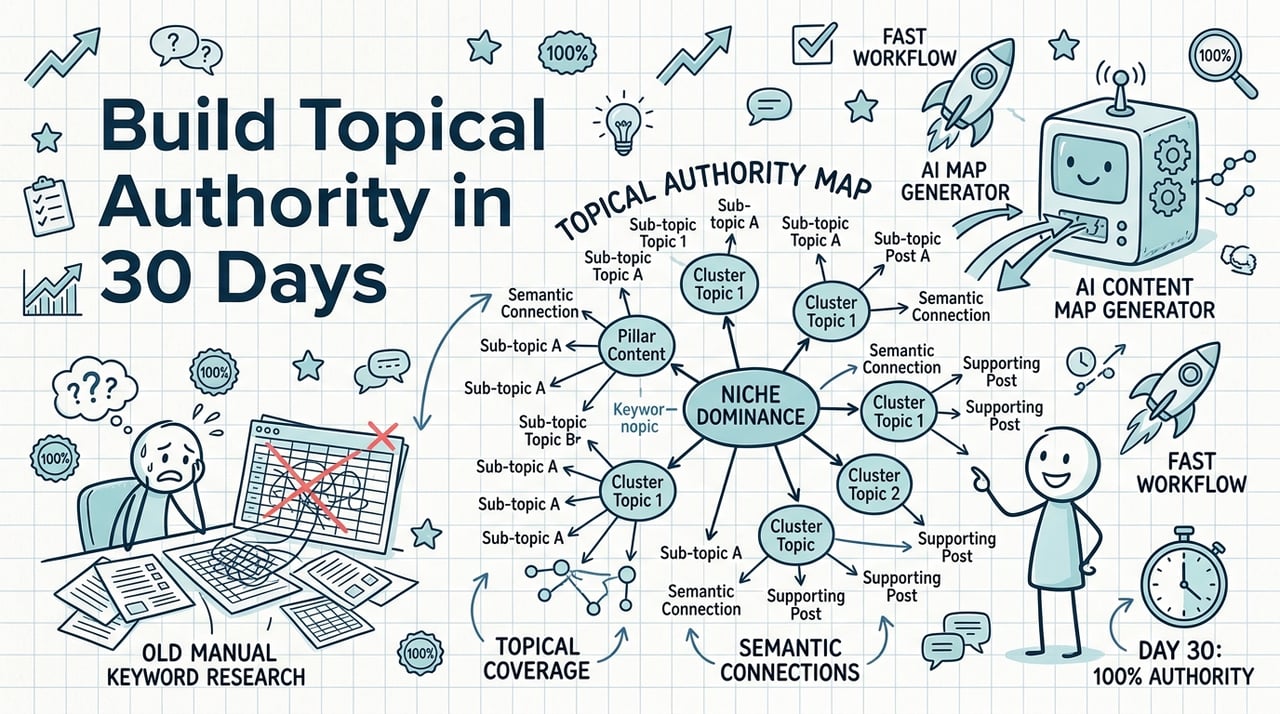
Spending ten hours staring at a keyword spreadsheet is a slow death for your SEO strategy. Most site owners waste weeks manually clustering terms only to find their rankings stalled due to thin topical coverage.
You are likely fighting a battle that AI has already won for the competition. Manual research is no longer a viable way to compete in a world where search engines prioritize entities over keywords.
Traditional SEO feels like guessing in the dark. You pick a keyword, write a post, and hope for the best. But when you miss the semantic connections that search engines expect, your site remains an outsider in its own niche.
The game has shifted from individual rankings to total niche dominance. Building a topical map allows you to prove your expertise to AI agents before you even publish your first word.
The 30-Day Authority Blueprint
Building a topical map used to be a grueling manual process involving hundreds of rows in Excel. Now, you can use automated generators to achieve niche dominance with a fraction of the effort.
- 430% speed increase in content production workflows for teams using AI tools.
- 91% faster mapping compared to manual keyword research and clustering methods.
- 1,200 keywords generated and clustered into a logical hierarchy in under 60 seconds.
- Semantic relationships are prioritized over raw search volume to satisfy modern ranking signals.
- Complete coverage ensures your site is seen as a definitive source by both users and AI agents.
What Is a Topical Authority Map?
Topical authority is a measure of how comprehensively your website covers a specific subject area. It is not about winning one keyword: it is about owning the entire conversation around a niche.
Modern search engines use semantic relationships to understand your site. By using Kitful AI Writing Tools, you can structure your content in a hub-and-spoke hierarchy that proves deep expertise.
A well-built topical map signals to search engines that you have left no stone unturned. This structure makes your site more resilient to algorithm updates that target thin content.
When you cover a topic thoroughly, you earn the trust of AI agents. This trust translates into higher visibility in both traditional search results and new generative search interfaces.
The 4-Level Authority Framework
Effective topical mapping follows a rigorous four-level structure. This hierarchy ensures that every piece of content supports a larger strategic goal.

- Level 1: The Pillar. This is your core niche or the most broad topic your site covers.
- Level 2: The Cluster. These are the primary sub-topics that break the pillar into manageable categories.
- Level 3: The Intent. These articles address specific user needs and questions within each cluster.
- Level 4: The Support. Long-tail keywords and FAQs that provide granular detail and boost semantic richness.
This architectural approach prevents content gaps and ensures a logical flow for users. By nesting intent-based pages under broad clusters, you create a clear path for search crawlers to follow.
Each level serves a distinct purpose in the ecosystem. The Pillar captures the broadest traffic, while the Support layers provide the specific data points that prove your site knows the topic inside and out.
30-Day Master Plan: Daily Tasks for Niche Dominance
Building authority requires a consistent daily rhythm. Follow this 30-day sprint to transform your site from a collection of posts into a dominant topical powerhouse.
Consider the case of a new affiliate marketer who spent forty hours on research and still missed the semantic gap that an AI found in sixty seconds. Their site struggled for months while their competitor, using an automated map, dominated the front page in weeks. Efficiency is the difference between an authority site and a digital ghost town.
- Day 1: Define your core niche and identify your primary seed keyword.
- Day 2: Run your seed keyword through an AI generator like Kitful.ai.
- Day 3: Review the 1,200 clustered keywords and remove irrelevant entries.
- Day 4: Audit your current content to see which map nodes are already filled.
- Day 5: Map out your Level 1 Pillar page content requirements.
- Day 6: Identify your first three Level 2 Clusters to target.
- Day 7: Categorize cluster keywords by informational and transactional intent.
- Day 8: Use tools like Topical Map AI to find Level 4 long-tail gaps.
- Day 9: Find 'Weak SERP' opportunities where competitors lack depth.
- Day 10: Design your internal linking structure to connect spokes to hubs.
- Day 11: Write and publish the foundational Level 1 Pillar article.
- Day 12: Apply basic schema markup to your Pillar page to define entities.
- Day 13: Draft the first three articles for your primary Level 2 Cluster.
- Day 14: Use an AI writer to scale production for supporting nodes.
- Day 15: Publish your first batch of cluster-specific support content.
- Day 16: Link all Level 3 and 4 support articles back to their Pillar.
- Day 17: Review AI drafts for expert-level insights and E-E-A-T signals.
- Day 18: Optimize all published images with descriptive alt text for semantic context.
- Day 19: Check Google Search Console to ensure your new pages are indexing.
- Day 20: Start the drafting process for your second Level 2 Cluster.
- Day 21: Publish 10 support articles focusing on intent-based questions.
- Day 22: Automate your internal linking with plugins to save manual time.
- Day 23: Add FAQ sections to your highest-traffic posts to capture PAA boxes.
- Day 24: Update older content to point toward your new topical hubs.
- Day 25: Monitor your initial rankings for specific cluster keywords.
- Day 26: Analyze your Topical Authority Ratio to identify remaining gaps.
- Day 27: Resolve any keyword cannibalization between overlapping articles.
- Day 28: Promote your new pillar content on social channels to drive signals.
- Day 29: Perform a final audit of your 4-level hierarchy for completeness.
- Day 30: Set the schedule for your next niche expansion and repeat.
How to Use a Topical Authority Map Generator
Using an AI generator is the fastest way to move from a blank page to a full site architecture. The process starts with a single seed keyword that represents your entire business.
Expert Julian Goldie notes that automated tools can perform in seconds what used to take ten hours of manual labor. By automating the research phase, you can focus your energy on refining the voice and accuracy of your content. The real win is the time you buy back to focus on high-level strategy.
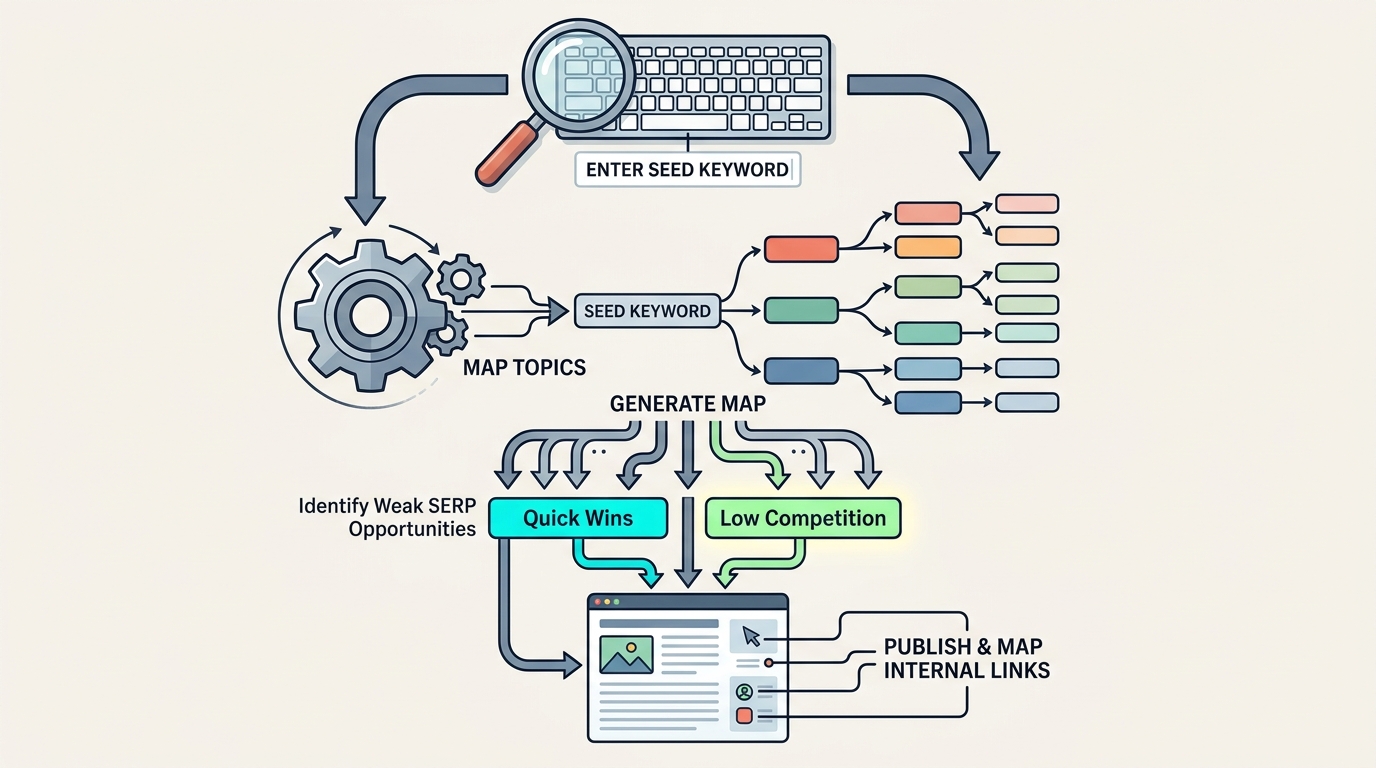
- Define your core topic: Enter your niche into a generator to decompose it into distinct facets.
- Generate the map: Let the AI expand the niche into a 4-level hierarchy of clusters and support topics.
- Filter for quick wins: Sort the results to find keywords where competitors have low content depth.
- Scale production: Use an AI writer or autoblogging feature to create drafts for each node.
- Automate linking: Connect all supporting articles to their respective pillar pages to distribute equity.
Tip: Always review the intent of the clusters before publishing. AI can sometimes group keywords that look similar but serve different user needs.
Once the map is generated, your primary job is execution. You are no longer wondering what to write next: you are simply working through a pre-validated checklist of topics. A clear map removes the friction of decision fatigue in your daily workflow.
Top AI Generators to Accelerate Your Mapping
Selecting the right tool depends on your scale and technical needs. These platforms represent the best options for accelerating your topical authority mapping.
Kitful AI
This is the premier choice for site owners who want a full-cycle automation experience. It handles everything from mapping to multi-CMS publishing on WordPress or Ghost. Kitful is best for those managing multiple sites who need to scale without a large team. One tradeoff is that it provides so much automation that beginners might feel overwhelmed by the feature set. You can explore their capabilities at Kitful.ai.
Topical Map AI
If you need a dedicated generator that produces results in under a minute, this is your tool. It generates between 800 and 1,200 clustered keywords with search volume data instantly. Topical Map AI is perfect for SEOs who need quick, visual maps to present to clients. The tradeoff is that it focuses purely on mapping rather than the writing and publishing side. Check it out at Topical Map AI.
Floyi
Floyi offers a unique visual experience with color-coded maps that represent the four levels of authority. This makes it easy to spot where your site is strong and where it is lacking support. It is an excellent choice for visual thinkers who want to see their niche hierarchy at a glance. A potential downside is that the interface is more focused on strategy than raw data export. Visit their site at Floyi.
Keyword Insights AI
This tool prioritizes user intent above all else. It clusters keywords based on how search engines group them in the real world, ensuring you don't create separate pages for overlapping terms. Keyword Insights is the best option for sites that need to avoid keyword cannibalization at all costs. The tradeoff is that the credit-based pricing can become expensive for very large keyword sets. Learn more at Keyword Insights.
5 Deadly Mapping Mistakes to Avoid
The biggest mistake in topical mapping is ignoring the internal linking that binds your topics together. Without those links, your support articles are just isolated islands that pass no value to your pillar pages.
Focusing only on high-volume keywords is a trap that leads to massive competition and slow results. You need the Level 4 long-tail support topics to build the semantic foundation that makes the Pillar rank.
Pitfall: Creating thin, low-quality content just to fill map nodes will hurt your site's E-E-A-T signals. Every page must provide value to the reader.
Avoid semantic cannibalization by checking if two keywords lead to the same search results. If the results are identical, cover both terms in a single article rather than two separate ones. Clustering by intent is the only way to keep your site architecture clean and efficient.
Topical Mapping FAQ
Can I build topical authority in 30 days?
Yes. While total dominance takes time to mature, you can build the entire content infrastructure in 30 days using automated generators and AI production. The key is publishing a complete cluster rather than random individual posts.
How is topical authority measured?
You can track your progress using the Topical Authority Ratio. This is the percentage of keywords within a specific cluster that have reached the top 10 rankings on search engines.
What is the 'real win' for SEO in 2026?
The real win is being cited as a primary source in AI answers and generative search interfaces. This is known as Generative Engine Optimization (GEO) and relies heavily on structured topical maps.
Do I still need backlinks if I have topical authority?
Topical authority reduces your reliance on backlinks, but they still help. A site with a perfect topical map will often outrank a site with more links but messy, disjointed content coverage.
Command Your Niche in Record Time
Topical authority is no longer optional for those who want to survive the next generation of search. The era of targeting individual keywords is over.
By building a structured map, you give search engines a reason to trust your site as a niche leader. Automation is the only way to maintain this level of coverage without burning out.
Start your first map today. Use the tools available to claim your niche before the competition fills the gaps.
 Kitful