The standard backlink playbook is a graveyard of ignored outreach emails and $500 guest post invoices that buy you nothing but a temporary sugar high. If you are still chasing high-volume trophy keywords with generic blog posts, you are essentially lighting your marketing budget on fire while your competitors quietly build real authority.
Most content today is a recycled version of something else that already exists on the first page of Google. When everyone is saying the same thing, no one has a reason to link to you. Link building has devolved into a volume game that most small to mid-sized brands are destined to lose.
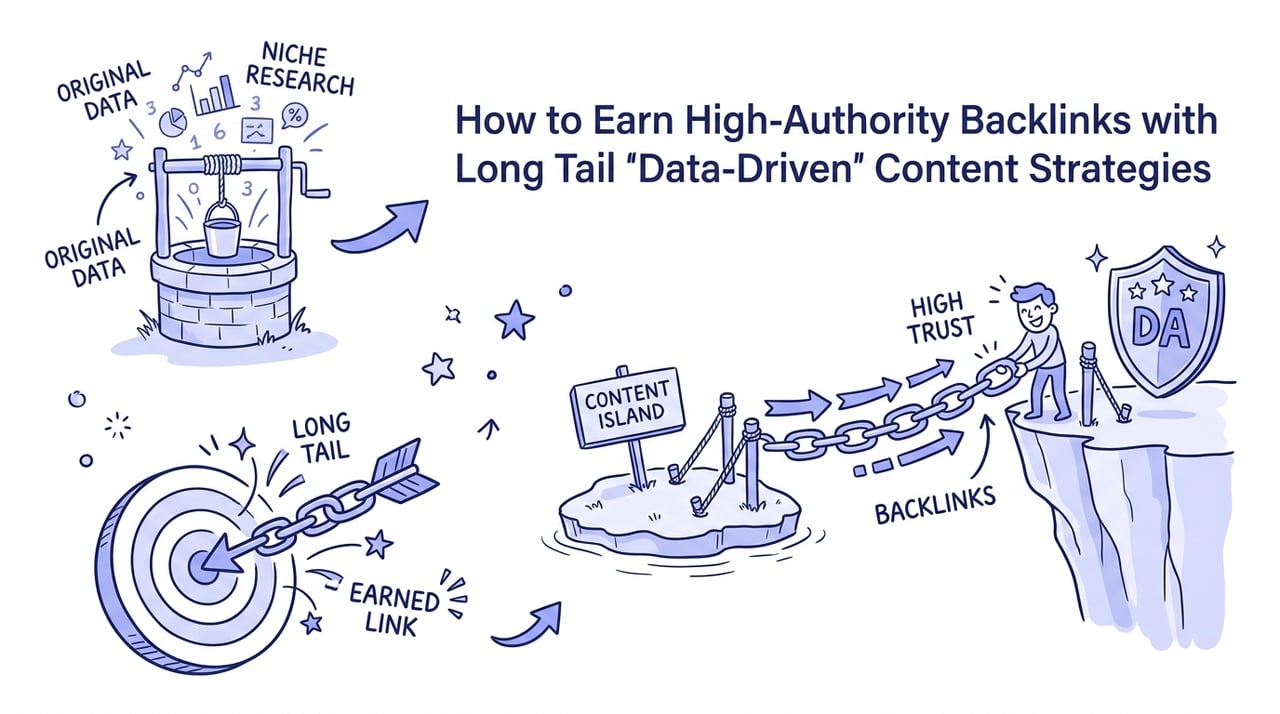
The alternative is not to outspend the giants, but to out-think them by becoming a primary source of information. By focusing on highly specific, multi-word queries backed by original data, you stop begging for links and start earning them naturally. This is the shift from manual labor to an automated authority engine.
I have seen this strategy work in niches ranging from social media software to industrial packaging. The goal is to create assets that act as citation magnets for journalists and AI engines alike. You are no longer asking for a favor; you are providing the missing piece of a reporter's story.
Bottom Line Up Front: The New Rules of Link Earning
Transitioning from manual link building to data-driven authority earning is the only way to survive the saturation of AI-generated content. Here is the reality of the current search landscape:
- Articles containing original statistics earn nearly triple the links of those without, specifically a 283% increase in acquisition.
- Long-tail keywords with fewer than 100 searches per month make up 91.8% of all Google searches.
- Keywords between 10 and 15 words in length get over double the clicks compared to short 1-2 word phrases.
- Content that functions as a primary research source earns 3.8x more links than standard editorial posts.
Proprietary data provides a unique value that competitors cannot replicate with a simple AI prompt. By owning the numbers, you own the conversation in your niche.
Why Long-Tail Data is the 'New SEO Goldmine'
The way search engines interpret authority is undergoing a fundamental shift. We are moving into an era where the context surrounding a mention matters more than the technical strength of a hyperlink. In 2026, context beats the href tag every single time.
Search engines and AI models now prioritize where your brand is mentioned and what specific topics it is associated with. If your data on niche consumer behavior is cited by a major publication, that co-citation builds more topical authority than a dozen low-quality directory links. Long-tail content is naturally less competitive and requires fewer links to reach top positions.
"In 2026, context beats the href tag."
Data-driven assets act as permanent citation magnets for both human writers and the Large Language Models (LLMs) that power AI Overviews. When an LLM looks for a specific statistic to answer a user query, it seeks the primary source. If you are that source, your brand becomes the definitive answer for that long-tail segment.
283% more backlinks
This matters because traditional link building is fragile and prone to algorithm penalties. Data-backed long-tail content, however, solves a specific problem or answers a specific question that people are actually asking on platforms like AnswerThePublic.
Consider a small logistics firm that analyzes internal shipping delays during peak season. By publishing those findings, they provide a benchmark that journalists can use to validate their own industry reports. This creates a passive link acquisition loop that grows over time without additional outreach effort.
The real SEO goldmine is not found in the high-volume head terms dominated by massive corporations. It is found in the specific, data-hungry queries where you can establish yourself as the lone expert. Owning a narrow niche with deep data is more profitable than being a small fish in a broad sea.
Step 1: Mine High-Intent Long-Tail Gaps
Finding the right long-tail gaps requires moving beyond basic keyword research tools. You need to look where your competitors are too lazy to dig: your own internal data and direct customer feedback. Mining intent from customer support tickets reveals what your audience is actually struggling to find.
Start by exporting your Google Search Console (GSC) data to find queries with high impressions but low click-through rates. These are often long-tail questions where the current search results are failing the user. You can also use the Semrush Keyword Magic Tool to filter for question-based keywords with a word count of 4 or more.
- Identify high-intent long-tail gaps using Google Search Console and support logs.
- Use AnswerThePublic to discover the specific 'why' and 'how' questions being asked.
- Cross-reference these questions with competitor content to find 'thin' answers you can improve with data.
- Look for recurring themes in sales calls or community forums like Reddit and Quora.
The Intent Discovery Checklist
- Export queries from GSC with more than 1,000 impressions and a CTR below 2%.
- Search for these queries in Semrush to determine the difficulty and existing content types.
- Categorize gaps by intent: informational (seeking data) vs. transactional (seeking a tool).
- Verify that the gap cannot be fully answered by a generic AI summary.
Tip: Focus on 'how much' or 'average rate' queries, as these almost always require the specific data points that journalists love to cite.
Once you have a list of gaps, prioritize them based on how easily you can collect data to answer them. The most valuable gaps are those that require proprietary knowledge or internal platform statistics to solve. If the top 10 results are just generic listicles, you have found your target.
Step 2: Generate Proprietary Research & Original Statistics
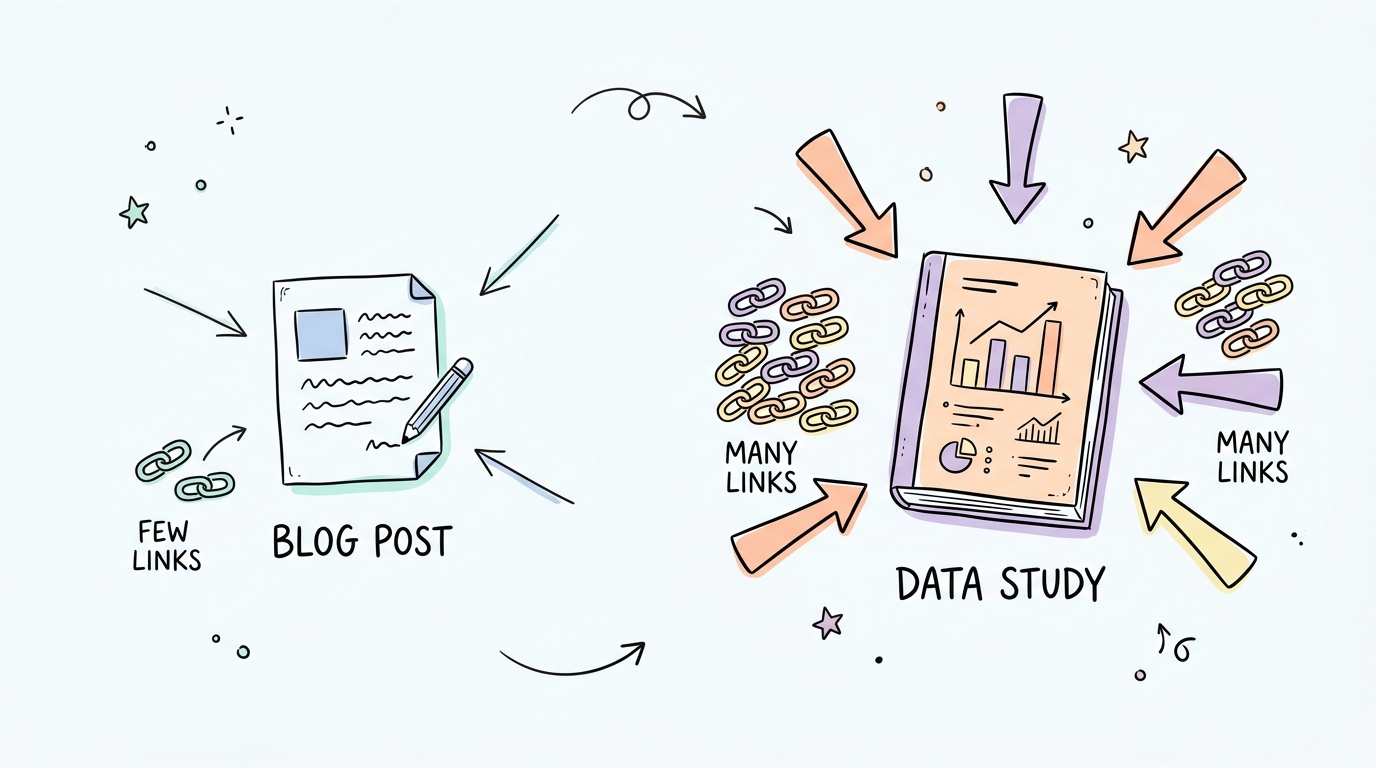
The secret to a 283% increase in backlinks is creating something that does not exist elsewhere. You must conduct original research, whether through user surveys or analyzing public data sets, to create proprietary statistics. Data-driven studies earn nearly four times more links than standard editorial content.
I recommend starting with a simple survey if you have an existing email list or social following. Ask questions that challenge industry assumptions or provide benchmarks for standard practices. If you lack a following, use public data sources like government databases or industry associations to find hidden patterns others have missed.
Example
Buffer famously used this approach with their 'State of Social' report. By surveying 1,800 marketers, they created a single asset that generated over 1,280 referring domains. They did not just write about social media; they provided the data that every other writer needed to support their own social media articles.
- Define one central question your niche is currently debating.
- Create a survey using simple tools or pull a large dataset from a public API.
- Clean the data to find at least five 'surprising' or 'contrarian' statistics.
- Design high-quality charts or infographics to make the data digestible.
- Write a detailed analysis explaining what the numbers mean for the industry.
Rule: Never publish raw data without context; your value lies in the interpretation and the narrative you build around the numbers.
Shorr Packaging followed a similar path by analyzing trends in e-commerce packaging. They earned 170 high-authority links from outlets like Forbes and CNBC because they provided hard numbers in a space filled with vague advice. A single well-executed study can replace an entire year of low-quality guest blogging.
When the data is original, you become the primary source. Anyone who wants to mention your statistic is professionally obligated to link back to your original study. This is how you build a link profile that AI algorithm updates will never touch.
Step 3: Package the Asset for AI & Human Citations
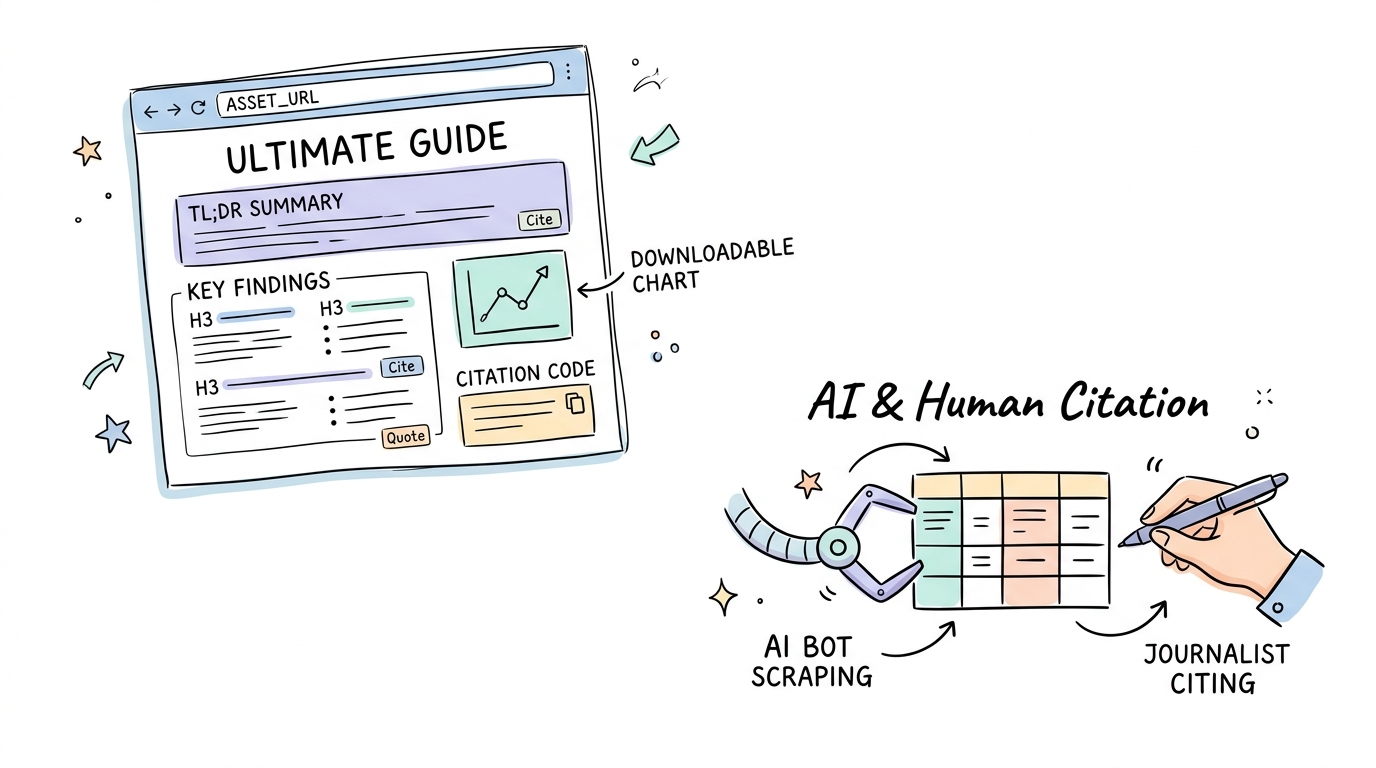
Even the best data will fail if it is buried at the bottom of a generic 500-word blog post. You must package your findings as a standalone 'Ultimate Guide' or a visual report with its own dedicated URL. Burying link-worthy assets deep within generic content is a recipe for invisibility.
Structure the page for both human readability and AI 'scrapability'. Use clear H3 headers for each major data point and include a TL;DR summary at the top with your most impactful statistics. This makes it easy for a busy journalist to find exactly what they need for their deadline.
- Create a dedicated, clean URL for the data report (e.g.,
/industry-report-2025).
- Include downloadable versions of all charts and graphics.
- Provide clear 'Copy Citation' snippets to encourage proper attribution.
- Add FAQ schema to ensure your data points appear in rich snippets and AI Overviews.
Content Packaging Decision Rules
- If the data is highly visual, then prioritize a gallery of shareable infographics.
- If the data is complex and technical, then offer a downloadable PDF whitepaper for lead generation.
- If the goal is maximum backlink volume, then keep the full report gated-free and easily accessible.
- If the data answers a specific 'calculator' style question, then build a simple interactive tool to accompany the report.
Distribute these visuals on LinkedIn and niche-specific forums to trigger a wave of passive link acquisition. When a user shares your chart on social media, it often catches the eye of a content creator looking for their next source. Your asset should be designed to be stolen—with a link back as the price of admission.
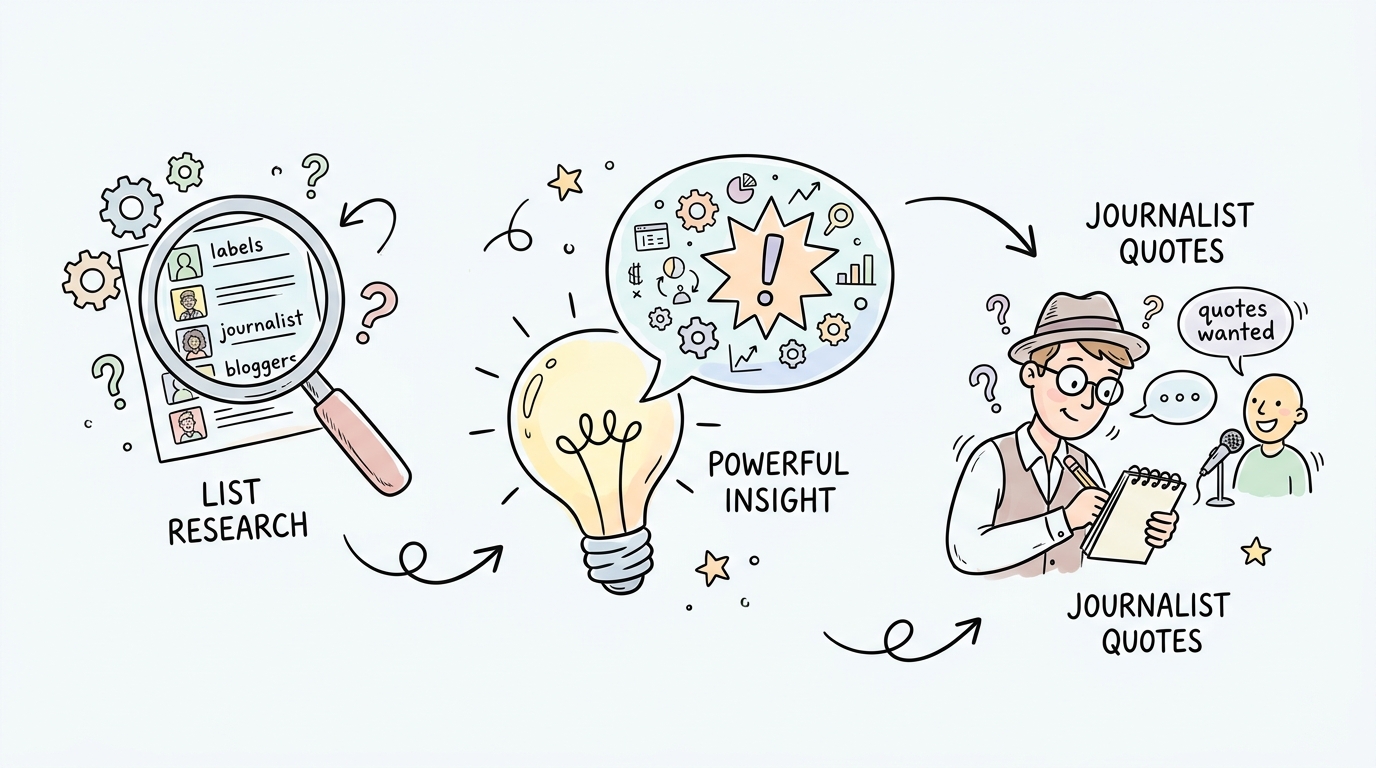
Once your asset is live, you need to tell the right people about it. Precision outreach is not about sending 1,000 templated emails; it is about finding the 20 journalists who have already written about your specific sub-topic. Perform personalized outreach by leading with your most surprising or controversial data insight.
Use Featured.com (Expert Outreach) to find journalists actively looking for expert commentary on your niche. Filter for opportunities that align with your new data points. When you reach out, don't ask for a link; offer your data as a resource that will make their next article more authoritative.
# Simple script logic for organizing outreach targets
# 1. Search for keywords related to your data study
# 2. Extract author names and publication dates
# 3. Filter for articles published in the last 6 months

mkdir -p outreach_list
touch outreach_list/targets.csv
echo "Publication,Author,Latest_Article,Contacted" > outreach_list/targets.csv
Targeting niche publications often yields higher conversion rates than chasing massive trophy outlets. A link from a high-authority industry blog is frequently more valuable for rankings than a generic mention on a news site. Success comes from being the big fish in a highly specific, data-backed pond.
Pitfall: Avoid pitching 'me-too' stories that offer no unique perspective. If your data confirms what everyone already knows, no one will care.
Focus on the delta—what has changed? If your data shows that long-tail keywords now drive 77.91% of organic conversions, lead with that specific number. Specific numbers in subject lines increase open rates because they promise immediate, tangible value.
Data-Driven Content vs. Traditional Formats
Choosing the right strategy depends on your goals for authority and longevity. While traditional methods like guest posting can provide a quick boost, they lack the long-term ROI of data-driven long-tail assets. Data-driven content acts as a permanent citation magnet that requires fewer total links to dominate search results.
In the current landscape, search engines are increasingly rewarding brand mentions and co-citations. Even if a site mentions your study without a clickable link, the association between your brand and the data carries weight. Non-clickable mentions in 2026 are nearly as valuable as standard backlinks for building topical authority.
Future-Proofing Your Backlink Profile
The transition from building links to earning authority is not just a trend; it is a survival requirement. As AI search engines increasingly curate answers directly from the web, being the primary source of truth is the only way to remain visible. Data-driven content provides the proprietary value that AI and competitors cannot replicate.
Survival in the modern SERP requires a commitment to E-E-A-T (Experience, Expertise, Authoritativeness, and Trustworthiness). Original research is the ultimate shortcut to establishing these pillars. You are no longer just another voice in the crowd; you are the source that the crowd quotes.
To ensure your strategy is working, monitor your progress closely using tools like the Ahrefs Backlink Checker. Track the growth of referring domains to your specific data assets rather than just your homepage. You should also regularly check AI Overview citations for your target long-tail queries to see if your data is being used to generate answers.
Stop chasing the same broad keywords as everyone else. Start mining your own gaps, creating your own numbers, and packaging them for a world that craves original insight. This is the path to building a backlink profile that is not only high-authority but entirely future-proof.
 Kitful