BlogManaging Content Decay: An AI Content Refresh Strategy for Mature Affiliate Niche Sites
Managing Content Decay: An AI Content Refresh Strategy for Mature Affiliate Niche Sites
Struggling with declining affiliate traffic? This complete 2026 playbook shows you how to audit, refresh, and optimize your mature niche sites to reclaim keyword rankings and capture high-value AI search citations.
•8 min read
Your affiliate site is quietly bleeding.
Once a downward trend begins, organic search traffic decays at an average weekly compound rate of -1.21%.
This is not just standard competitor drift. It is a systematic displacement of classic search engine visibility.
While your traditional keyword rankings might look flat, searchers are rapidly moving to conversational engines. This shift is quiet because traditional analytics do not track it.
In fact, portfolio managers have observed a 527% increase in untracked AI-referral traffic across their portfolios.
Classical content refresh playbooks that rely solely on updating metadata and adding keywords are dead.
If you want to survive, you must optimize to win LLM citations first instead of merely chasing blue links.
Updating your content must now satisfy both search crawlers and AI summarizers.
The New Reality of Search: Traditional Drift vs. AI Content Decay
Semantic decay is the new threat.
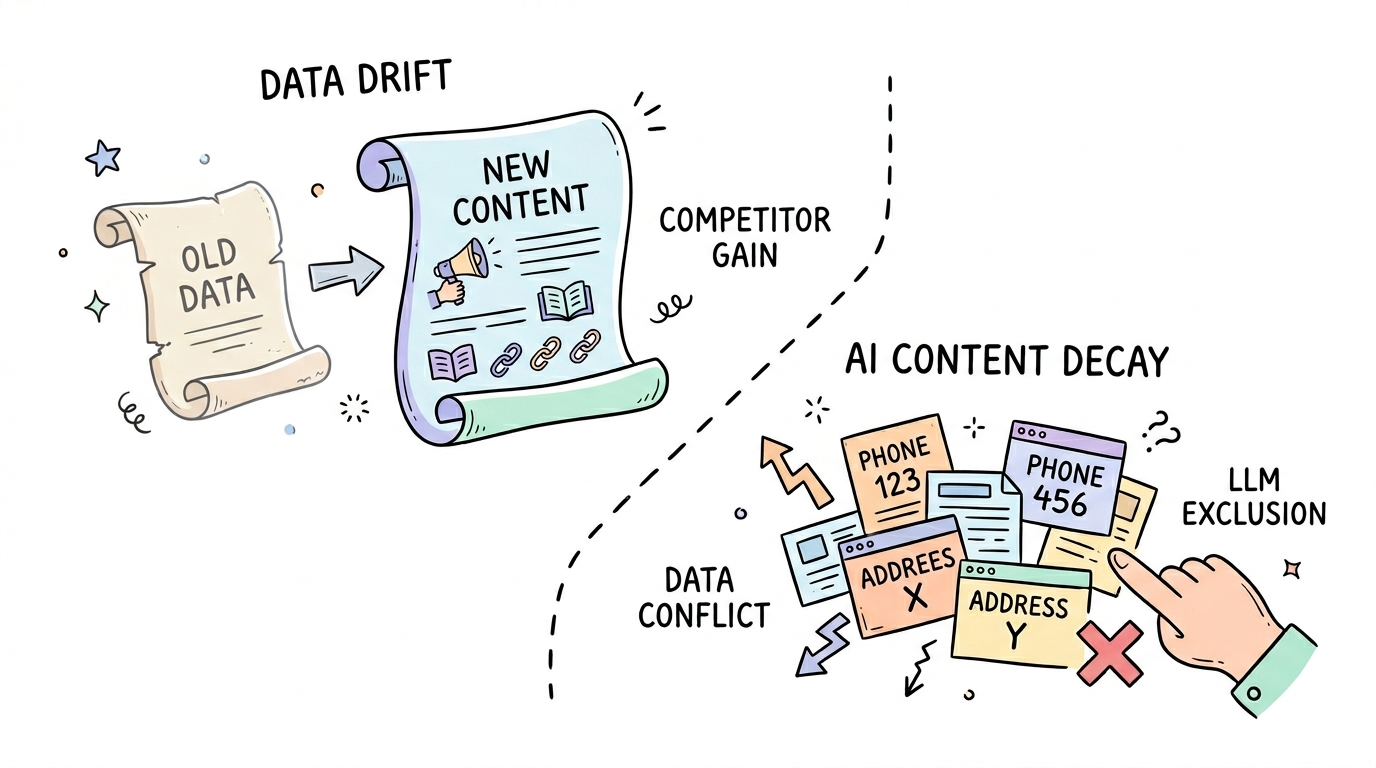
Traditional decay happens when a competitor publishes a longer article with more backlinks. AI content decay is different, characterized by a rise in semantic ambiguity rather than chronological age.
Large Language Models prioritize consistent, safely verifiable data sources over novelty or unverified claims. If your site presents conflicting definitions, AI search engines will simply drop you.
When an LLM detects conflicting signals, it filters your pages out of AI Overviews entirely to avoid brand risk.
Consider a local plumbing service that updates its pricing and offerings on its main page but leaves old blog posts untouched. Because the brand failed to clear contradicting definitions across older directories and blog posts, AI summaries will continue to cite the outdated services or stop citing the business altogether.
This mismatch triggers algorithmic exclusion. If your historical content contradicts your current data, you lose the citation.
Here is a detailed breakdown of how automated text impacts organic search longevity:
To stay visible, you must curate an unambiguous, machine-readable digital footprint.
Establishing a Dual-Health Monitoring System for Your Portfolio
Track citations alongside standard search rankings.
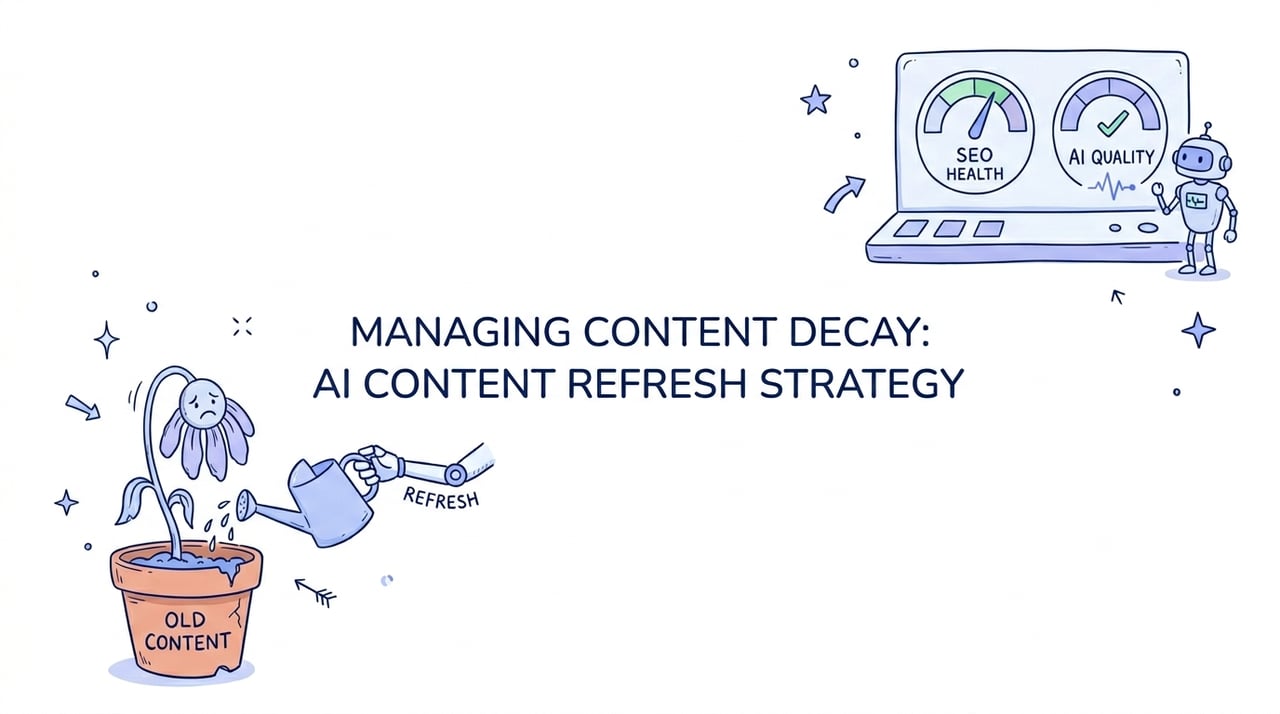
A modern audit requires dual-health tracking. You must measure traditional search engine optimization visibility alongside search engine answer citation rates.
Websites lacking explicit human expertise and E-E-A-T indicators face an average 18% organic ranking decline within a three-month period. To prevent this, you can use specialized brand trackers like Ahrefs Brand Radar to track mentions across ChatGPT and Gemini, and SEOtmer for E-E-A-T validation.
Portfolio Content Classification
Content Tier
Monetization Impact
Refresh Cycle
Metric to Track
Tier 1 Pages
High (Core Affiliate Revenue)
Every 90 days
AI Overviews citations & conversions
Tier 2 Pages
Medium (Informational / Traffic)
Every 6 months
GSC Impressions & Referral traffic
Managing a large portfolio requires strict resource allocation based on performance data.
If a page is a Tier 1 revenue generator, then refresh it deeply every 90 days due to LLM recency preferences.
If a page is Tier 2 evergreen informational content, then extend the refresh cycle to 6 months.
If AI search citation rates drop on high-volume keywords, then prioritize an immediate semantic structural update.
Step-by-Step Playbook to Optimize Existing Content for Search and Citations
Restructure your content for machine extraction.
Winning traffic in 2026 requires updating your pages to be both human-friendly and easily digestible for LLM web scrapers.
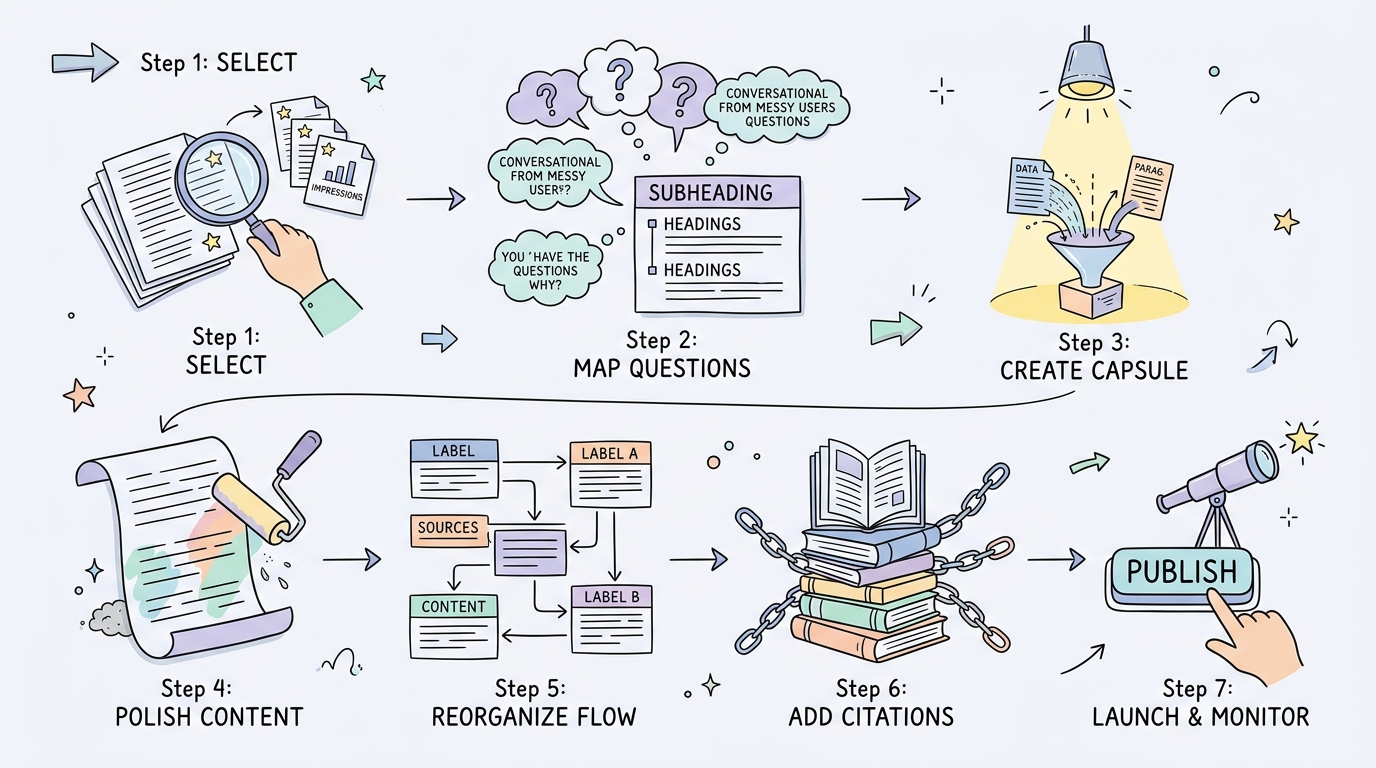
Here is the 7-step execution protocol to reclaim your organic search and citation presence:
Pick Citation-Ready Pages. Identify existing pages in Google Search Console that have strong starting authority, close rankings, or high impressions but declining traffic.
Re-Map Search Intent to Questions. Transform dry headings and sections into clear, conversational Q&A formats that match how users actually speak to AI engines.
Add an Answer Capsule. Insert a direct 2-to-5 line summary accompanied by clear bullet points at the very top of high-impact sections to facilitate rapid LLM extraction.
Upgrade Proof and Credibility. Replace generic stock images with original screenshots, add expert commentary, and insert verified statistics to establish strict E-E-A-T.
Execute Entity and Schema Pass. Inject structured data using JSON-LD with graph structures to define your content relationships explicitly. Refer to Schema.org definitions to ensure compliance.
Build Topical Authority Silos. Connect your refreshed cluster posts to your main pillar articles through a tight internal linking structure, eliminating orphaned pages.
Ship and Track Metrics. Republish the page with a fresh publication date, add a transparent changelog detailing the updates, and begin monitoring your citation rates.
Consider the case of a specialized automotive tools affiliate site that witnessed a rapid 18% drop in organic rankings over three months. The owner replaced generic manufacturer stock photos with unique, custom screenshots showing actual hands-on tool usage and inserted certified quotes from master mechanics. This simple injection of real-world evidence successfully reversed their ranking slide and secured new citations in Gemini.
Tip: Make sure your Answer Capsules are placed above the fold. LLM summarizers scan the top portion of web documents first, meaning delayed answers often get completely ignored by web crawlers.
Use this checklist to verify your updates before republishing:
Conversational H2 and H3 questions matching real search patterns
Structured Answer Capsule at the top of crucial informational headers
Real-world screenshots with explanatory alt text replacing stock images
Clean internal links pointing from supporting child pages to the main parent hub
Scaling Programmatic SEO Safely Without Triggering Scaled Content Abuse Penalties
Scale programmatically without risking manual penalties.
Websites actively utilizing AI content grow 5% faster than non-AI counterparts. However, they also face a higher manual penalty rate of 3.8% compared to just 2.7% for traditional sites.
The risk lies in publishing thin, unedited commodity drafts that lack information gain. John Mueller warns that programmatic SEO is often treated as a fancy banner for spam unless it is backed by highly unique proprietary datasets.
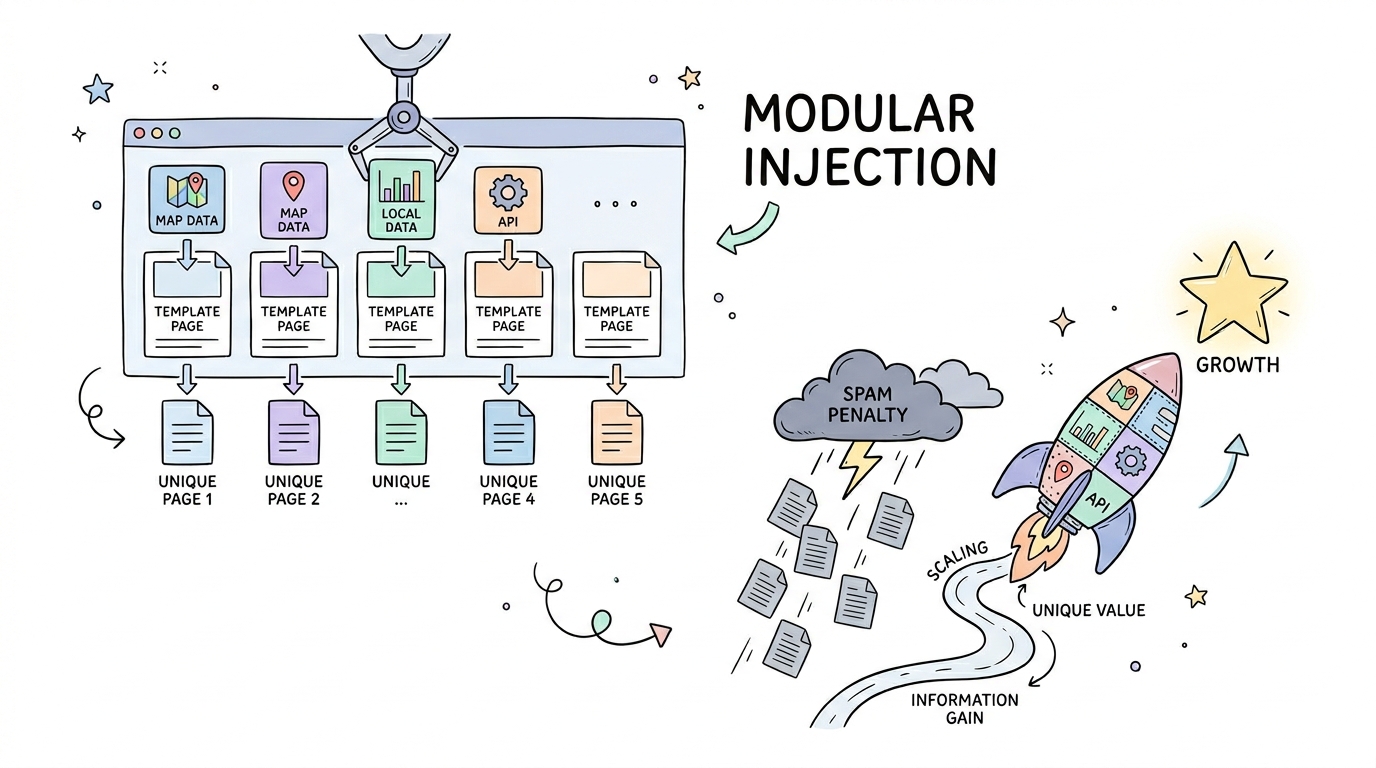
To build thousands of pages safely, you must move beyond simple synonym swapping. You must inject unique database columns, custom calculations, and real-world metrics into every template page to guarantee distinct value.
Example
A programmatic real estate directory scales cleanly to over 1,000 pages without search penalties by avoiding thin template variations. Instead of merely swapping city names in the text, the directory programmatically injects localized transit distances, API-driven local market pricing, and custom interactive charts into every single page template.
You can use automation tools to help manage this scale cleanly. For example, Kitful AI offers an Autoblog tool and direct publishing webhooks to streamline publishing workflows, but your templates must still be grounded in solid, structured datasets to win.
If programmatic page variations are thin and differ only by a single modifier word, enrich the core dataset columns with unique geographic or metric data instead of updating template text.
Defense First: Navigating Google's Site Reputation Abuse Policy
Hard deletion is the only cure.
Google has aggressively cracked down on site reputation abuse, where third-party commercial content is hosted on trusted domains to manipulate search signals.
Glenn Gabe warns that manual penalties for site reputation abuse require drastic, complete removal of violating directories rather than soft workarounds. If your site has been hit or is hosting questionable white-label folders, you cannot rely on quick technical fixes.
Using robots.txt disallow rules or canonical tags to block leased third-party content are invalid approaches that Google's spam team completely rejects. The algorithm will bypass these soft commands and penalize the parent domain.
Pitfall: Do not try to redirect or canonicalize offending folders to save affiliate link juice. If mitigating a Site Reputation Abuse penalty, completely remove or 'noindex' the offending folder, as standard redirects and canonicals are ignored by Google's spam-checking algorithms.
To understand the detailed steps for protecting your directory structures, review the Glenn Gabe SRA Mitigation Guide to secure your domain's indexing status properly.
How to Verify and Audit Your Post-Refresh Footprint
Verify your technical footprint immediately.
After shipping your refreshed pages, you must confirm that search engines have successfully crawled and interpreted the updated structures.
Begin by checking the URL Inspection tool in Google Search Console to ensure the refreshed page has been successfully indexed. Next, copy your structured code and test its compliance using the Google Rich Results Test to guarantee your JSON-LD schema contains no warnings.
Post-Refresh FAQ
Does structured data schema guarantee an AI Overview citation?
No. Web pages featuring comprehensive structured data schema see a 42% increase in the likelihood of appearing in AI-generated answers, but it is not a direct citation guarantee without underlying content authority and recency.
Can I use redirects to bypass Site Reputation Abuse penalties?
No. Standard redirects and canonicals are completely ignored by Google's spam-checking algorithms during Site Reputation Abuse evaluations. You must completely remove or 'noindex' the offending directories to salvage trust.
How do I know if my content is suffering from AI content decay?
AI content decay presents as a rise in semantic ambiguity and a sudden loss of citations in LLM engines like ChatGPT or Gemini. If your organic referral traffic drops while classic keyword ranks remain stable, semantic decay is likely occurring.
Turn AI Content Decay Into Your Moat
Adapt your strategy or fade away.
Traditional blue-link SEO is no longer the sole source of affiliate success.
Dual-health tracking and structured entity schemas represent the clear separation between dying affiliate sites and modern, highly defensible digital media brands.
By aggressively auditing your portfolio, correcting semantic contradictions, and enriching your programmatic datasets, you build a moat that LLMs and search engines will consistently reward.
Begin your dual-health audit today to protect your rankings and secure your place in the conversational search ecosystem.
 Kitful