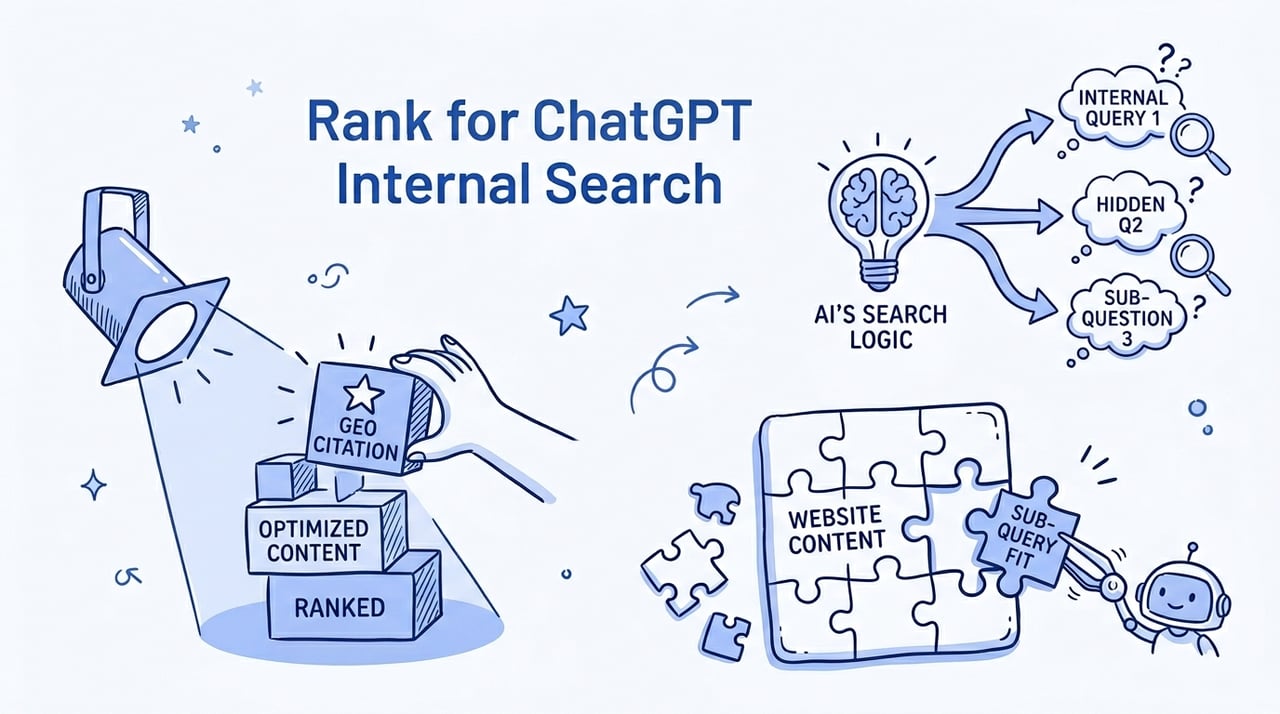
Ranking #1 on Google is no longer the finish line. You can hold the top spot for a primary keyword and still be completely invisible to AI search engines.
The search query your customers type into ChatGPT is rarely the query the machine actually uses. ChatGPT deconstructs user prompts into hidden sub-queries to build its answer.
Passage relevance has officially overtaken page authority. If you aren't ranking for these invisible fan-outs, your content will never be cited.
Generative Engine Optimization (GEO) requires a shift in focus. You must optimize for the machine that optimizes the user prompt.
Key Takeaways: Fan-Out Mastery in 2026
- Fan-out queries are internal sub-queries LLMs use to fetch diverse data points before synthesizing a final answer.
- Content must rank for both the main query and its fan-outs to see a 161% boost in AI citations.
- AI engines favor passage-level extraction over whole-page authority for synthesis.
- Optimizing for 'sliding windows' and 'capsule content' is mandatory for 2026 machine readability.
- High citation rates are driven by direct answers and data-rich passages.
What is Fan-Out Query Optimization?
Query Fan-out is the internal process where an LLM deconstructs a user prompt into multiple concurrent sub-queries. Instead of looking for one answer, the machine searches for 5 to 10 distinct data points to build a comprehensive response.
47% of ChatGPT prompts trigger a web-search fan-out.
This matters because modern AI engines use Reciprocal Rank Fusion (RRF). If your content appears in the search results for multiple internal fan-out queries, it scores significantly higher for citation during the final synthesis.
I have seen countless 'perfectly optimized' pages fail because they only answer the user's explicit question. To succeed, you must extract the hidden intent strings the AI generates internally before you even start writing.
You start by identifying your high-intent core prompts. Use a tool like Keywords Everywhere ChatGPT Extension to reveal the 8 to 12 fan-out queries being triggered behind the scenes.
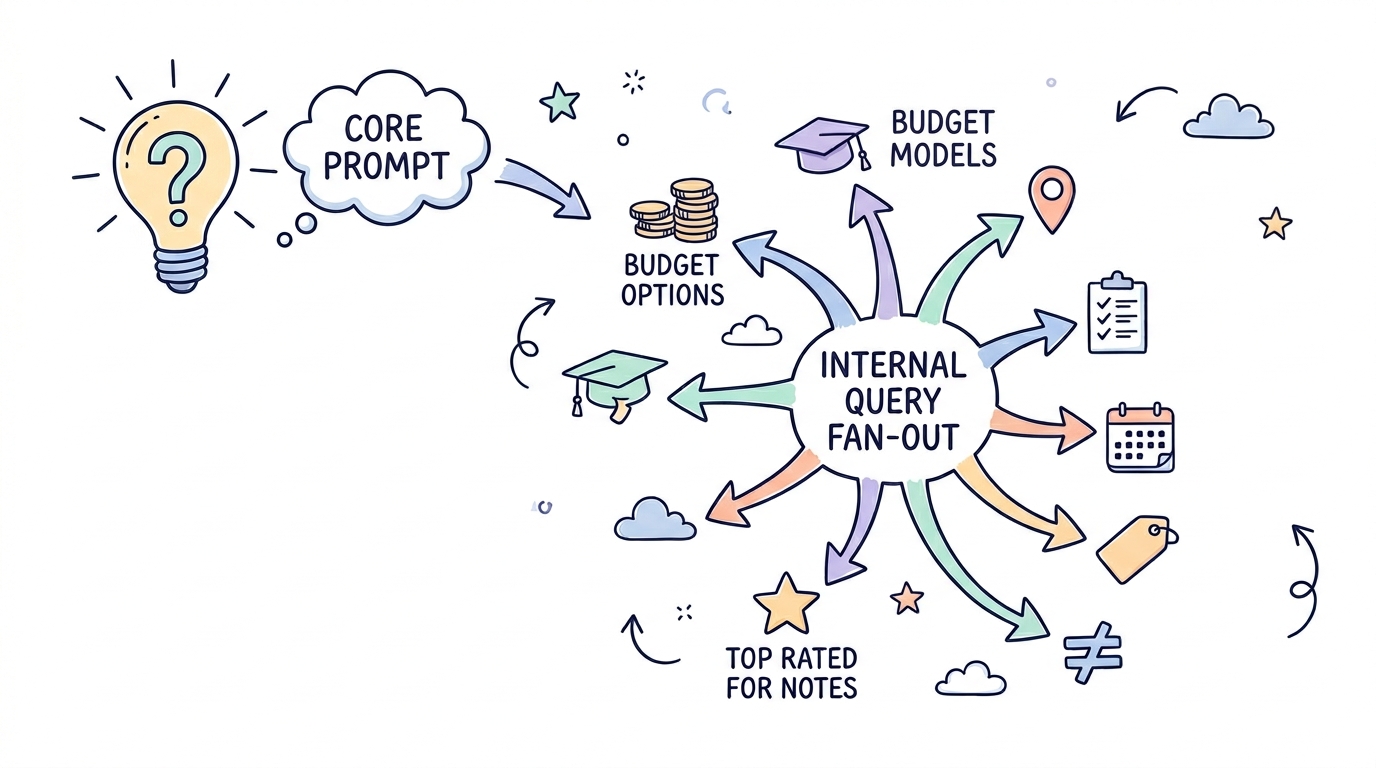
These internal searches act as a roadmap for your content structure. Select sub-queries that map directly to your buyer's journey to ensure you are appearing in the most valuable search paths.
- Identify core prompts using your existing high-conversion keywords.
- Run those prompts through a fan-out generator or the DataForSEO AI Optimization API.
- Triage the results to find 8 to 12 sub-queries with the highest commercial intent.
- Map these sub-queries to specific sections of your pillar pages.
Consider a tech blogger named Alex who ranked #1 for cheap laptops. Despite his ranking, SearchGPT never cited him in AI Overviews until he realized the AI was internally searching for student laptop discounts 2026 and best budget macbooks.
Alex added these specific headers to his guide and provided data-driven answers. Within days, his brand appeared in the citation bubble for both terms. Ranking for the fan-out is the only way to stay relevant as search moves from keywords to synthesis.
The triage process is the most critical step. You don't need to rank for every sub-query, but you must rank for the ones that define the final answer's sentiment.
ChatGPT reads your content using a sliding window approach. This means the model only processes small chunks of text at a time to find the best fit for its internal sub-queries.
Your job is to provide capsule content that is immediately extractable. Immediate clarity at the start of every section is the new gold standard for SEO in the generative era.
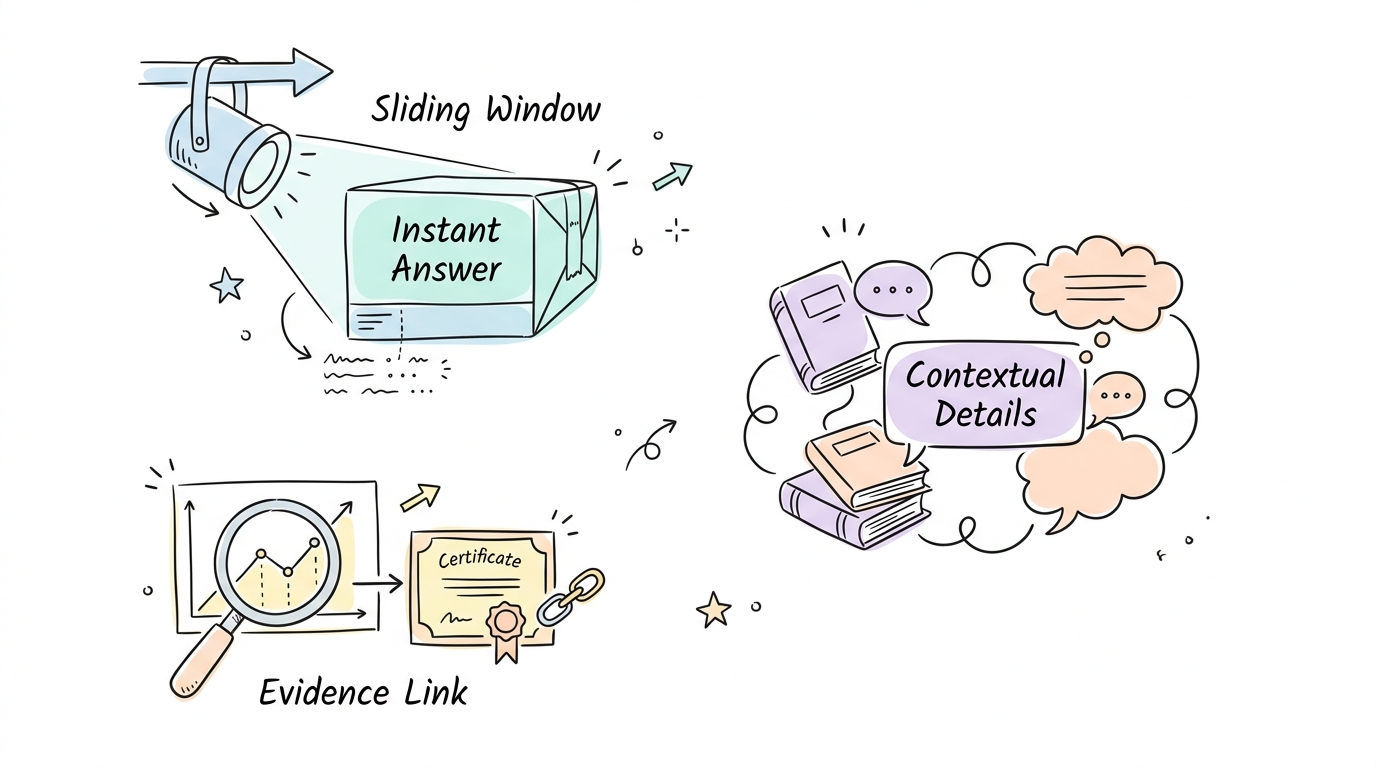
The structure must follow a strict 'Answer Engine' hierarchy. Start with a direct answer of 40 to 60 words, followed by supporting context, and then a statistics-backed expert quote.
- Lead with a direct
What is or How to sentence.
- Use H2 or H3 labels that match the fan-out query text exactly.
- Provide a self-contained answer in the first two sentences of each block.
- Avoid flowery language or poetic introductions that hide the data.
Rule: If your H2 heading does not look like a potential search query, rewrite it immediately.
Example
Prompt: What are the best budget laptops for students?
Fan-out: Student laptop discounts 2026
H2: Where to find student laptop discounts in 2026
Capsule: Students can find the best laptop discounts in 2026 through manufacturer portals like Apple Education Store and Dell University. These programs typically offer 10% to 15% off retail prices for verified college students.
Elena at a fintech startup saw her citation rate flatline because her headers were too creative. Once she swapped Financial Freedom Pathways for How to start a 401k, her Share of Model metrics doubled within a week.
By centering the answer at the very top of the passage, Elena made it easy for the AI's sliding window to grab the relevant info. Machines are lazy; if they have to dig for the answer, they will simply cite your competitor instead.
Step 3: Technical Schema and Machine-Readability
Technical SEO in 2026 has moved from page-level indexing to passage-level extraction. To help AI agents navigate your content, you must use structured data that highlights citation-worthy blocks.
Apply JSON-LD Speakable and FAQ Schema to your most important capsule content. Use Schema.org Article Type Documentation to ensure your author credentials and organization data are properly grounded.
/* example-faq-schema.json */
{
  "@context": "https://schema.org",
  "@type": "FAQPage",
  "mainEntity": [{
    "@type": "Question",
    "name": "How do fan-out queries impact SEO?",
    "acceptedAnswer": {
      "@type": "Answer",
      "text": "Fan-out queries deconstruct a user prompt into sub-queries. Ranking for these internal queries increases citation likelihood by 161%."
    }
  }]
}
This markup serves as a signal to machine crawlers. Structured data provides the machine-readability necessary for LLMs to trust your data points during synthesis.
Evading the 2026 Site Reputation Abuse Hammer
Google's 2026 site reputation abuse policy is a direct response to mass-produced AI pages. If you are building high-volume content, you must focus on Content-Answer Fit rather than just word count.
Avoid keyword stuffing fan-out phrases into low-quality pages. Embedding unique experiential data and statistics can boost your citation rates by up to 40% while protecting you from manual penalties.
Pitfall: Never use programmatic templates that lack verified author bios and trust badges. These are the primary triggers for site reputation abuse flags.
Scaling requires a balance of automation and human insight. Using a platform like Kitful AI can help maintain this balance by humanizing AI text and automating the research-heavy parts of the SEO workflow without sacrificing quality.
The GEO Final Audit Checklist
Follow these steps to ensure your content is ready for the generative search era.
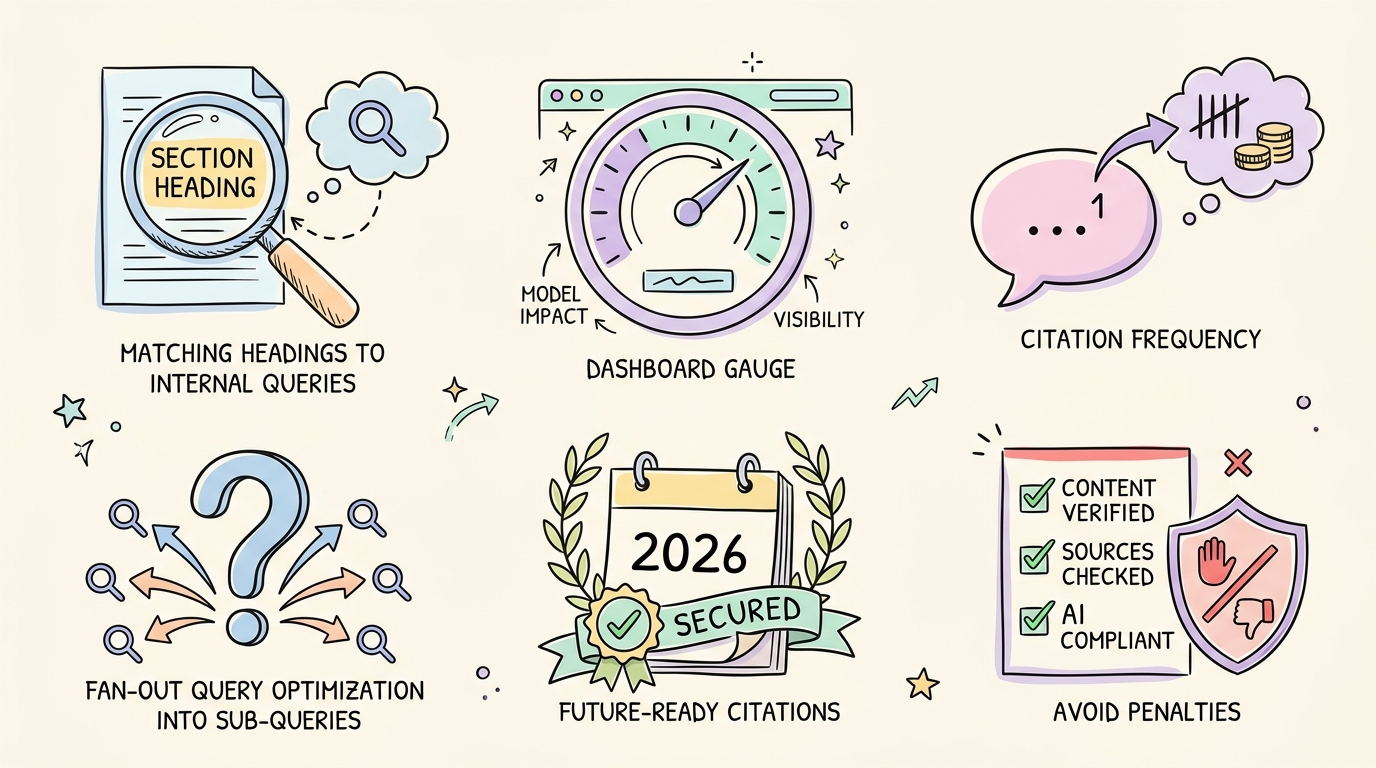
- Check if H2 and H3 headings match identified internal sub-queries.
- Monitor Share of Model (SoM) metrics in Search Console or GEO trackers.
- Verify that brand links appear in the citation footnote bubble.
- Ensure 40-60 word capsule answers are at the top of every section.
- Address English-language fan-outs for all non-English content.
- Audit passages for expert quotes and unique statistical data points.
Frequently Asked Questions
What is a fan-out query?
A fan-out query is an internal sub-query generated by an LLM to gather specific data points. The model uses these to build a synthesized answer to a single user prompt.
Why are fan-out queries often in English?
LLMs conduct 43% of internal fan-out queries in English even when the user prompt is in another language. This is because the English-language training set is the most comprehensive data source available.
How do I track my ranking for fan-outs?
You can monitor citation frequency and Share of Model metrics in modern SEO dashboards. If your content is cited in the footnote bubble, you have successfully ranked for a fan-out.
Does page authority still matter for AI search?
Passage relevance has largely overtaken page authority in generative synthesis. However, having verified author schema and expert credentials still helps the AI trust and select your content.
Winning the Invisible Search War
If your content isn't machine-extractable, you basically don't exist to OpenAI. The traditional model of ranking for a single keyword is dead.
Success in 2026 requires optimizing for the machine that optimizes the user's request. By mastering fan-out queries and engineering capsule content, you secure your place in the future of search.
Start auditing your pillar pages for passage-level clarity today.
 Kitful