BlogScaling Fitness & Health Niches: AI SEO Strategy for Rapid Content Production and Ranking
Scaling Fitness & Health Niches: AI SEO Strategy for Rapid Content Production and Ranking
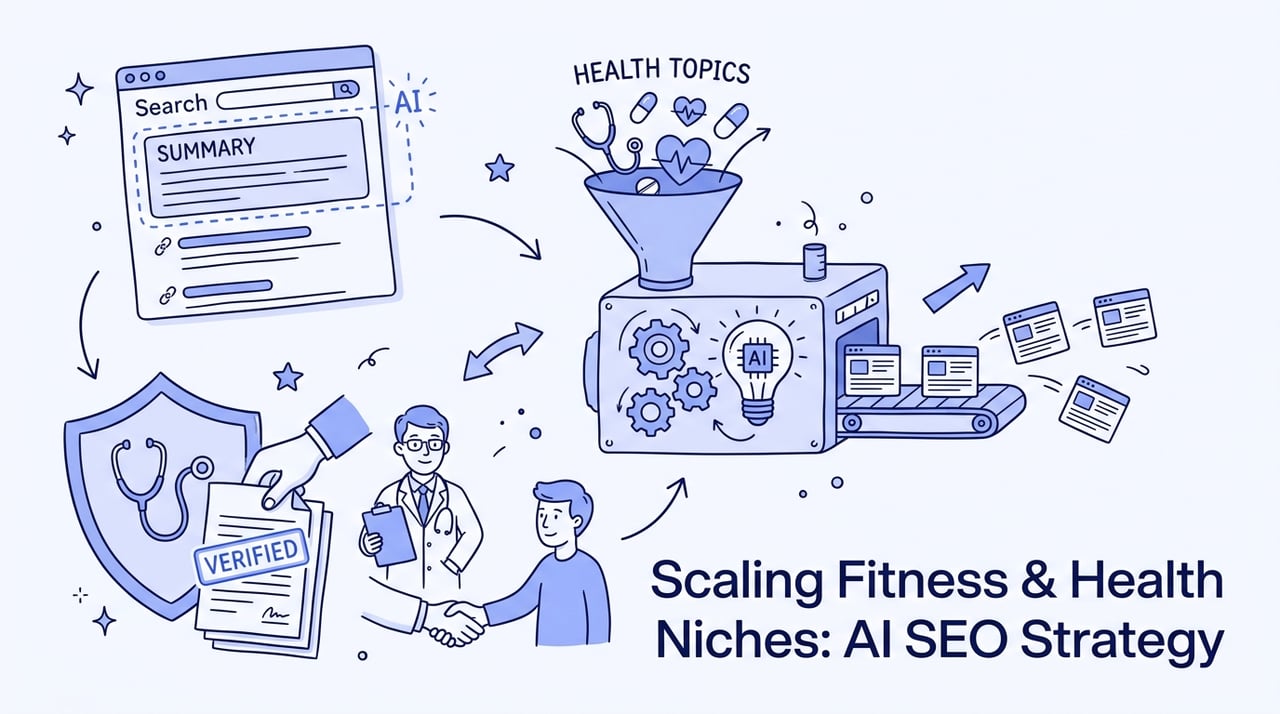
Scaling health and fitness affiliate websites in 2026 demands a complete shift from traditional keyword targeting to advanced Generative Engine Optimization (GEO). This blueprint outlines the tactical steps to build a defensible, programmatic, and expert-validated publishing machine.
•7 min read
The era of launching automated blogs and hoping for easy traffic is over.
Google's May 2026 Site Reputation Abuse manual actions prove that the search engine is systematically deindexing massive sites hosting automated third-party affiliate content. For Your Money or Your Life (YMYL) niches like health and fitness, the risk is even higher because Google demands absolute factual accuracy and credentialed authority.
Traditional AI generation without human verification fails Google's strict quality guidelines immediately. If you want to scale a health affiliate site in this climate, you must implement a sophisticated, programmatic, and medically-validated framework to protect your domain.
SEO vs. GEO: Adapting to the 2026 Search Paradigm
Search is changing fast. The transition from traditional SEO to Generative Engine Optimization (GEO) requires shifting your focus from keyword rankings to direct AI citations.
In 2026, roughly 13.1% of Google searches trigger AI Overviews. This shift means your pages must be designed for AI retrievers to parse cleanly, rather than just ranking as a standard list of blue links. Consider OpenAI's ChatGPT Health integration, which queries real-time Apple Health and MyFitnessPal wearable metrics. The AI looks for medically-vetted source material to contextualize user metrics, completely ignoring sites that lack verified expertise.
To win in this landscape, your strategy must pivot from keyword density to earning direct citations in AI responses. Use the comparison below to align your goals with modern engine optimization requirements.
Feature
Traditional SEO
Generative Engine Optimization (GEO)
Goal
Earn high-ranking links on search results pages to maximize CTR
Get cited, referenced, and quoted directly inside AI responses
Ranking Metrics
Focuses heavily on keyword density, backlink volume, and domain authority
Focuses on verifiably structured facts, E-E-A-T credentials, and information gain
Author Role
Authorship is a secondary quality guideline
Medically qualified expert credentials and real-world experience are mandatory
Architecting a Programmatic SEO Pipeline with Medical Guardrails
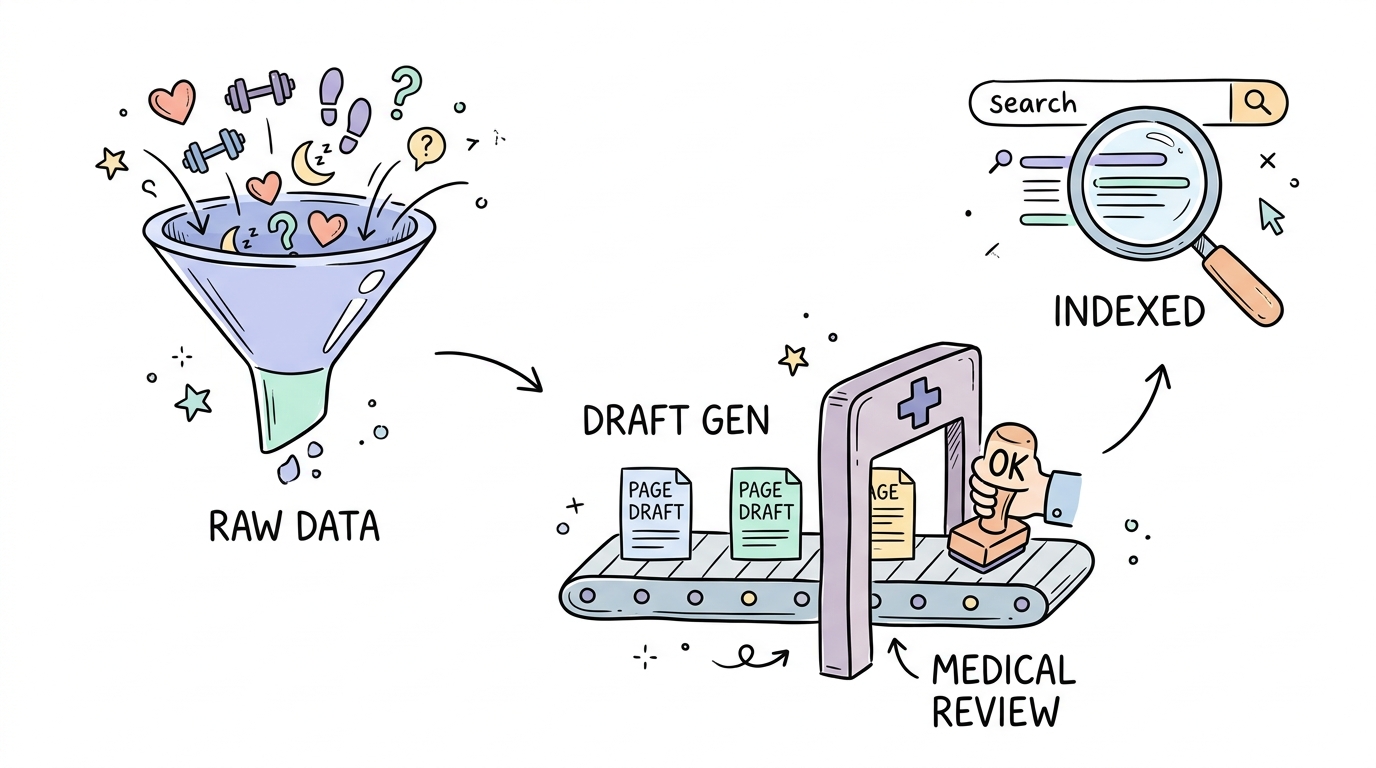
Scale demands structure. You can build a compliant programmatic SEO pipeline by marrying structured fitness databases with an LLM generator and a medical verification gate.
Here is an insightful guide on programmatic SEO strategies for scaling content effectively:
First, secure a clean database of exercises, clinical metrics, or wearable variables. Using a static site generator like Next.js or Astro configured with dynamic routing paths allows you to build highly optimized pages at scale. You can draft the initial descriptions in Google AI Studio using prompts that inject your custom variables, ensuring the content is highly specific.
To maintain pace, tools like BrightEdge Autopilot can optimize your metadata automatically. In practice, publishers using this type of metadata automation have seen up to a 40% reduction in manual content adjustment times while meeting strict YMYL criteria.
Finally, routing every generated piece through a credentialed medical reviewer ensures compliance.
Before pushing your pages live, run through this baseline launch checklist:
Secure credentialed medical reviewer verification for every single draft.
Map your core database variables to specific dynamic template locations.
Run initial drafts through an API to inject unique clinical data.
Use automated metadata tools to construct search-friendly title tags and descriptions.
Structured Schema: Creating the Roadmap for AI Overview Citations
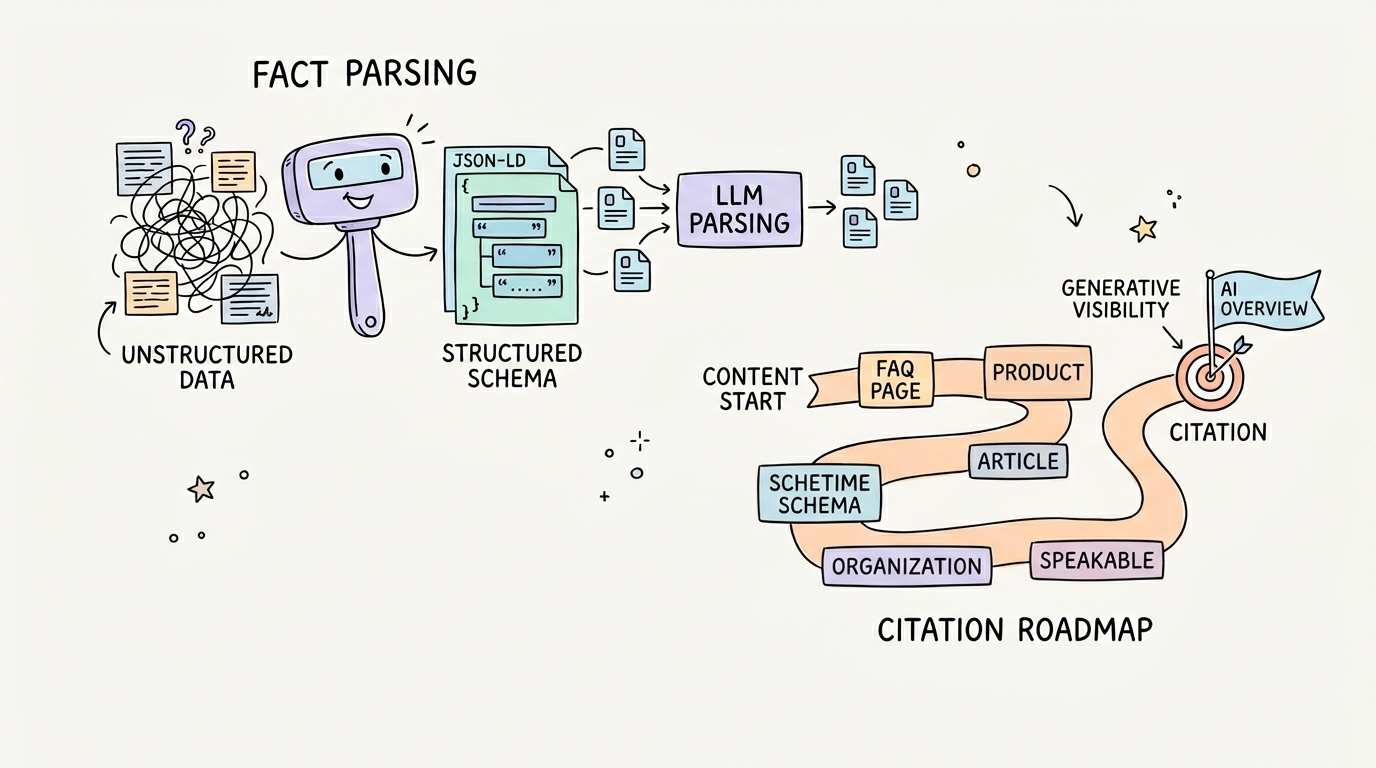
Schema is your API. Structured schema blocks serve as the machine-readable map that allows AI models to find, extract, and reference your website content.
Websites implementing structured schema properly experience a 3.2x increase in AI response citation rates. Furthermore, structured data paired with custom FAQ blocks yields a 44% increase in search citations. Your code templates should dynamically generate FAQPage, Product, Article, Organization, and Speakable schemas. Always pull vocabulary rules directly from the Schema.org Official Vocabulary to avoid parsing errors.
Here is an example of an FAQPage schema block designed for an exercise modification page:
{
  "@context": "https://schema.org",
  "@type": "FAQPage",
  "mainEntity": [{
    "@type": "Question",
    "name": "How do you modify a squat for knee pain?",
    "acceptedAnswer": {
      "@type": "Answer",
      "text": "Perform a box squat to limit the range of motion and reduce patellofemoral shear stress."
    }
  }]
}
Integrate schema validation checks directly into your deployment pipeline. You can automate these checks using the Google Rich Results Test API before going live.
Rule: Never publish programmatic pages with mismatched or empty schema fields, as Google will reject the structured data entirely.
Bypassing Recursive Semantic Analysis and AI Detection Filters
Repetitive writing gets flagged. Bypassing recursive semantic analysis filters requires using high-tier humanization systems to reintroduce syntactic variation and natural sentence entropy into AI drafts.
To keep your programmatic domain indexation rate above the healthy 85% benchmark in Google Search Console, your text must look human. Tools like Walter Writes AI are built specifically to convert repetitive AI phrasing into natural, detector-resistant drafts. Alternatively, you can use Kitful AI's built-in AI Text Humanizer, which is designed to rewrite robotic text into a natural tone while preserving critical facts. Kitful AI offers a standard price of $99 a month, often discounted to $49 a month, giving you access to 500 monthly credits where generating an article typically costs between 10 to 20 credits.
Pitfall: Publishing raw, unedited AI content at massive volume will trigger quality and spam filters, rapidly degrading your search rankings.
If AI detectors flag your programmatic pages, then run the text through a humanizer to break up repetitive sentence patterns.
If your GSC indexation rate drops below 85%, then audit your data inputs to ensure you are not generating duplicate content.
Establishing Topical Authority Through Semantic Internal Linking Hubs
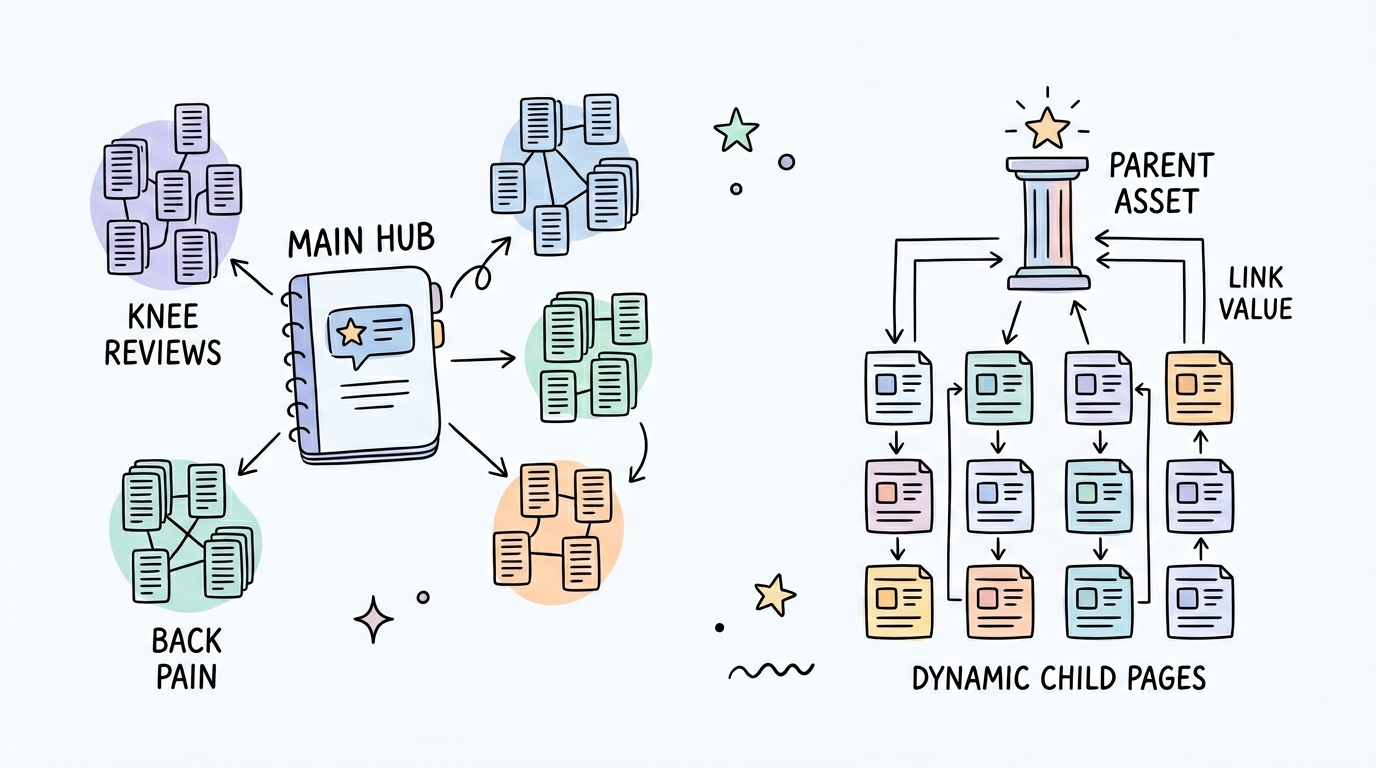
Isolated pages die quickly. Establishing topical authority demands a tight semantic internal linking architecture where programmatic child pages link back to core, doctor-verified pillar assets.
Avoid broad, unfocused cross-linking between completely unrelated categories. Using automated platforms can simplify this process immensely. Dedicated tools like LinkStorm, which scored a 9.6/10 in 2026 tests, alongside LinkWhisper and LinkBoss, make it easy to audit and deploy exact semantic links. While all-in-one tools like Kitful AI have smart internal linking listed as coming soon, leveraging dedicated auditing tools keeps your clusters clean and organized.
The process of mapping out your semantic internal links should follow a clear path:
Link every programmatic variation page back to a core, doctor-verified authority pillar.
Keep anchor text highly descriptive and semantically aligned with the target topic.
Audit your outbound link equity weekly using dedicated linking software.
Keep internal links restricted to closely related subtopics to preserve topical relevance.
Deploying Multi-Key rotators to Safely Index 1,000+ Pages
Submission limits slow growth. Deploying multi-key rotators allows you to bypass standard limits by distributing programmatic indexing across several rotated Google Cloud Service Accounts.
Start by creating a master project inside your Google Cloud Console. You can establish up to 15 distinct service accounts under this project, giving each account access to your Google Search Console property. By scripting an API rotator to cycle through these accounts, you can submit up to 2,400 programmatic pages securely in a single week.
This rapid submission process ensures your content is indexed and ranking while it is still fresh. Continually monitor GSC to ensure your overall indexation rate remains comfortably above the 85% healthy domain benchmark.
Pro tip: Always stagger your indexing submissions across several days to mimic natural site growth patterns and avoid triggering algorithmic alerts.
Frequently Asked Questions: Advanced AI SEO in 2026
Advanced tactics raise questions. Navigating the complexities of 2026 AI SEO requires understanding policy enforcement, citation pathways, and safe scaling limits.
How does Google's 2026 Site Reputation Abuse policy affect health affiliate sites?
This policy targets websites that host low-value, third-party affiliate content under the umbrella of an established domain's authority. If your health affiliate site relies on unvetted, automated promotional content, it risks receiving manual actions and rapid deindexing.
What schema types are critical for getting cited in Google AI Overviews?
To secure citations in AI Overviews, you should prioritize FAQPage, Product, Article, Organization, and Speakable schemas. These structured blocks allow generative engines to easily extract facts and attribute them directly to your domain.
Can I publish 1,000+ programmatic pages in the health niche without getting penalized?
Yes, but only if you avoid thin content by using unique data inputs, securing credentialed medical reviews, and humanizing the final output. Without these quality guardrails, search engines will flag the pages as spam and refuse to index them.
Building a Defensible Moat in the Generative Search Era
Sustainable growth requires a shift in strategy. Building a defensible moat in the generative search era requires structured, expert-verified authority.
Relying on standard, unvetted AI content will only lead to swift deindexing under Google's modern quality guidelines. By combining unique clinical datasets, schema markup, and credentialed medical reviews, you turn your affiliate site into an authoritative knowledge base. Tools like Kitful AI provide the foundation to generate, humanize, and publish this content seamlessly, offering a complete set of features from keyword discovery to automated blog management.
Treat structure as your API for search engines, and let medical expertise defend your rankings.
 Kitful