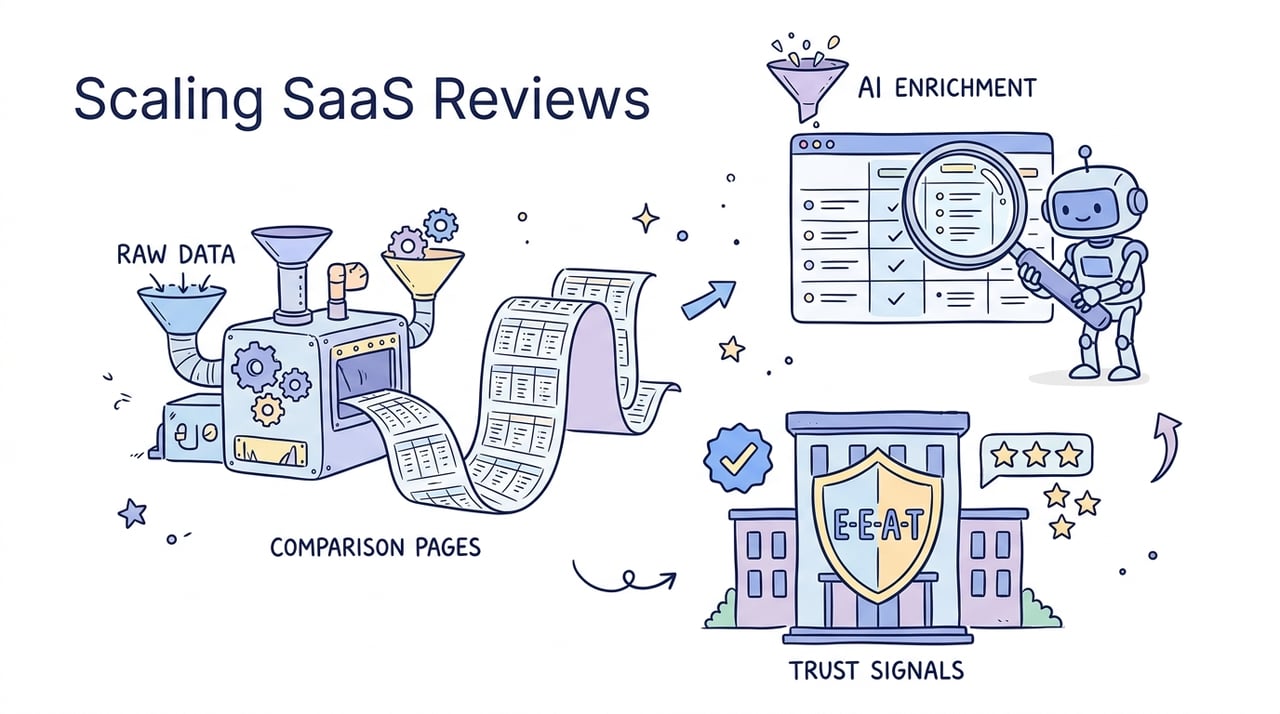
Manual review strategies are a death sentence for SaaS growth in 2026. If you are still hand-writing individual 'alternative to' pages, you are fighting a losing battle against the clock and the algorithms.
Following the March 2026 Scaled Content Abuse update, thin sites saw ranking losses between 60% and 90%. Traditional SEO is like handcrafting furniture in a world where your competitors are building automated furniture factories.
Here is the reality: 40-60% of organic SaaS conversions happen at the bottom of the funnel. You cannot capture that volume by writing one post a week while the market demands hundreds of specific comparisons.
You need a system that scales without triggering the 'low value' flags that now dominate the search landscape. This requires moving from a writer-centric model to a technical architecture built on unique data and semantic depth.
The Programmatic SaaS Framework at a Glance
The 2026 framework shifts the focus from word count to systemized data differentiation. It is a technical problem, not a creative writing exercise.
- Data-First Architecture: Build an Airtable or SQL database with 8-15 unique entity columns to ensure every page provides specific, non-generic value.
- AI Semantic Enrichment: Use advanced humanization techniques to inject structural rhythm and experience signals that bypass automated content penalties.
- Schema Dominance: Prioritize advanced schema markup to serve as the raw material for citations in AI Overviews (AIO).
- Entity Weighting: Focus on entity signals, which now carry 3.4x more weight in ranking algorithms compared to traditional backlink profiles.
Phase 1: Assemble Your 2026 Tech Stack
Building a programmatic engine starts with a stack that handles data, logic, and rendering as separate layers. You cannot rely on a standard blog editor to manage 500+ comparison pages without losing control over quality.
I recommend starting with Ahrefs to map out your initial competitor keywords and link building data. You will need a central database like Airtable to store your product specs and an AI layer for text generation.
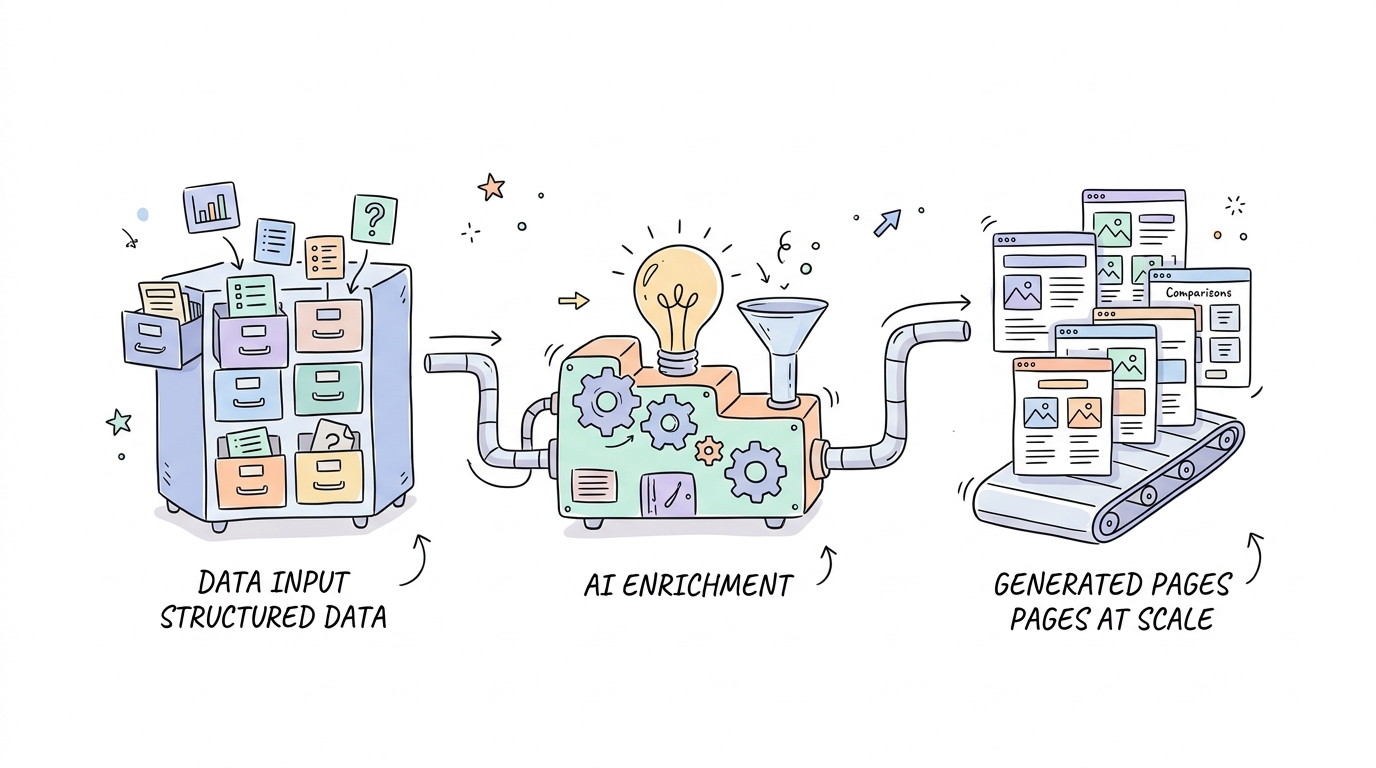
- Database: Airtable or SQL for structured product data.
- CMS: Webflow or a headless WordPress setup for rapid template rendering.
- AI Engine: A platform like Kitful AI to handle keyword discovery and generate research-backed articles.
- Sync Tool: Whalesync or AirOps to bridge the gap between your database and the frontend.
Tech Stack Checklist
- Connect your central database to your CMS via API or syncing tool.
- Set up a keyword research workflow using tools like Kitful AI to find low-difficulty 'vs' targets.
- Create a reusable page template in your CMS that includes dynamic fields for every data column.
- Verify that your CMS supports mass schema injection for custom fields.
Step 1: Build a Structured Database with High Entity Depth
Your content is only as good as the underlying data. If your database only has 'Price' and 'Features' columns, your pages will look like every other generic affiliate site on the web.
Unique data differentiation is your only defense against the Scaled Content Abuse penalty. Aim for 8-15 unique data points per entity to create high semantic depth.
- Live Pricing API: Pull real-time pricing data to satisfy 2026 search requirements for accuracy.
- Sentiment-Driven Pros/Cons: Use AI to extract real user pain points from Reddit, G2, or Trustpilot.
- API Feature Logic: List specific endpoints or integration capabilities to prove technical depth.
- Industry Specificity: Create columns for 'Best for [Industry]' to enable use-case x industry matrix pages.
Rule: Never use pure variable substitution where only the brand name changes. Every page must contain at least 30% unique data points that do not appear on other pages in the same cluster.
Focus on the 'Head Term + Modifier' matrix. This looks like [Competitor] vs [Our Tool] or [Competitor] alternatives for [Specific Industry].
By building this depth, you ensure that when an AI search engine crawls your site, it finds verifiable and structured facts rather than fluff. This makes your site a high-priority source for citations.
Step 2: Use AI to Inject 'Human' Burstiness and Expertise
Search engines in 2026 are looking for 'burstiness'. This is the natural variation in sentence length and paragraph structure that signals a human was in the loop.
Instead of letting an LLM write a flat 800-word block, use a system like the Kitful AI humanizer to disrupt the statistical patterns. This creates the structural rhythm necessary to bypass the latest content quality filters.
The 'Controlled Imperfections' Strategy
Human writing is messy. It uses fragments for emphasis and varies its pace depending on the importance of the point.
- Vary Sentence Length: Follow a long, complex sentence with a very short one.
- Break Predictability: Avoid the 'Topic Sentence + 3 Supporting Sentences' pattern for every paragraph.
- Inject First-Person Signals: Use phrases like 'In our testing' or 'We found that' to signal real-world experience.
Example
Instead of: Tool A is a project management software that offers Gantt charts and time tracking.
Try: We put Tool A through its paces. The Gantt charts are solid, but the time tracking feels like an afterthought. It works, but it is not great.
Experience signals are mandatory for E-E-A-T. Include real screenshots or specific feature sentiment extracted from user forums to ground the AI's output in reality.
Consider this scenario: A content lead at a project management SaaS tried scaling 500 comparison pages using raw AI output. Within weeks, their experience signals failed and traffic plateaued immediately.
By switching to a framework that injected variable sentence lengths and real user sentiment from Reddit, they regained their organic foothold. They proved to the algorithm that the content was derived from human-led research, not just token prediction.
Tip: Use a statistical disruption tool to verify your 'burstiness' score before hitting publish on a major batch.
Step 3: Architect Schema for AI Overviews (AIO)
AI Overviews (AIO) now appear for over 30% of SaaS-related queries. If your site is not structured for machine readability, you are invisible to the users who rely on Gemini or Perplexity.
Schema markup is the raw material used by AI search engines for synthesis. You must implement SoftwareApplication, Review, and FAQ schema to appear in these rich results.
JSON-LD for Comparison Pages
{
  "@context": "https://schema.org",
  "@type": "SoftwareApplication",
  "name": "SaaS Tool Name",
  "operatingSystem": "Web",
  "applicationCategory": "BusinessApplication",
  "aggregateRating": {
    "@type": "AggregateRating",
    "ratingValue": "4.8",
    "reviewCount": "1250"
  },
  "offers": {
    "@type": "Offer",
    "price": "49.00",
    "priceCurrency": "USD"
  }
}
Map your database fields directly to Schema.org: SoftwareApplication attributes. This allows search engines to verify your pricing and feature sets without guessing from prose.
Refer to the Google Structured Data Guide for the latest requirements on review snippets. Validating your schema with the Rich Results Test is the final step before indexing.
Step 4: Launch and Protect Against Content Abuse Penalties
Launch your programmatic pages in stages. A 'big bang' launch of 1,000 pages often triggers a manual review or an algorithmic suppression for content abuse.
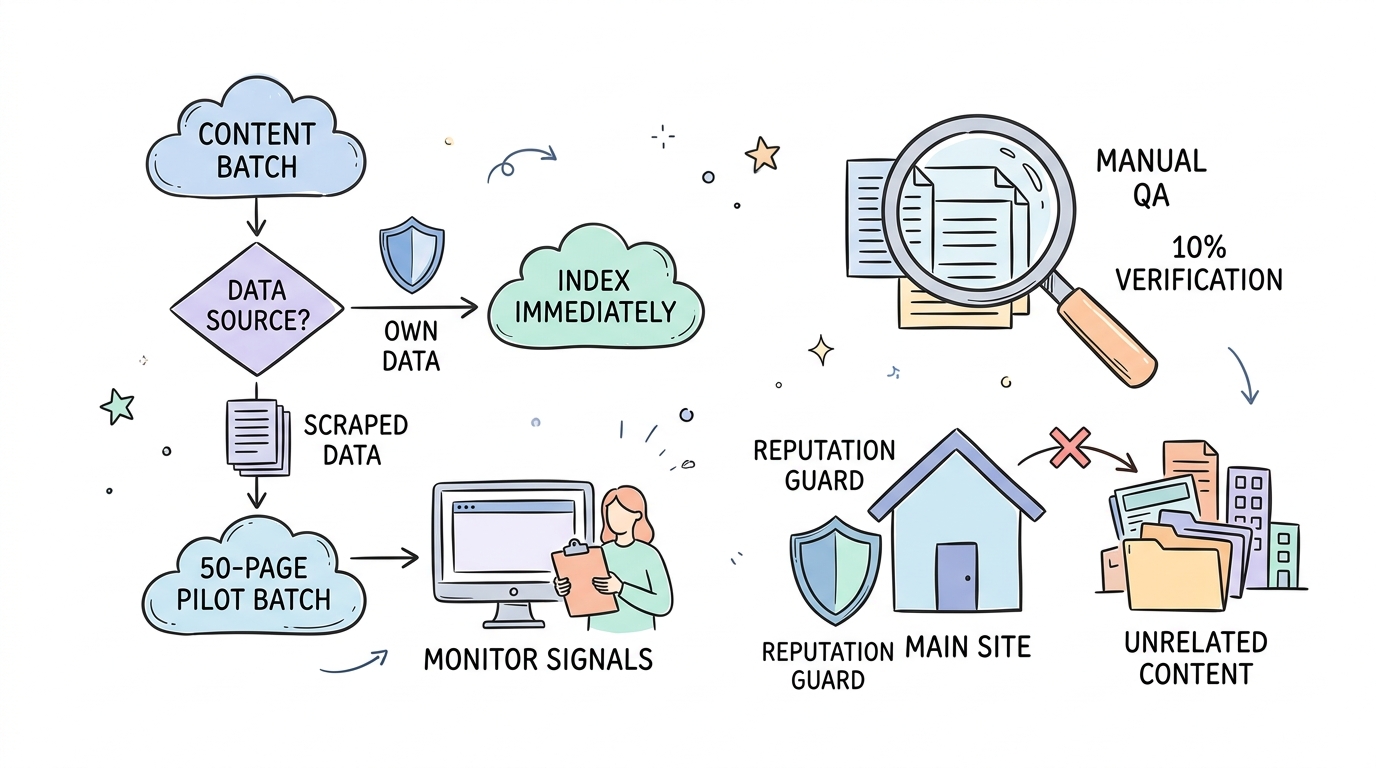
Start with a 50-page pilot batch. Monitor Google Search Console for indexing signals and initial keyword movement before rolling out the rest of your database.
Indexing Decision Rules
- If your dataset is proprietary (e.g., internal user data), index 100% of pages immediately.
- If your data is public or scraped, launch in 50-page increments every two weeks.
- If a page targets a high-security SaaS niche, include a named expert reviewer bio.
Pitfall: Hosting comparison content on an unrelated subfolder can trigger a Site Reputation Abuse penalty. Ensure your programmatic pages live on a relevant path like /alternatives/ or /vs/.
Manual quality assurance is still a requirement. You must review at least 10% of every new batch for rendering errors or logical hallucinations.
Consider the case of a fintech startup that launched 2,000 programmatic pages on a high-authority subfolder overnight. Google flagged it as Scaled Content Abuse, causing a 70% drop in site-wide visibility within forty-eight hours.
They had to de-index 90% of the pages and rebuild the cluster via controlled pilot batches. Only after proving consistent user intent and data accuracy did their rankings begin to recover. Do not skip the pilot phase.
Step 5: Scale Topical Authority via Internal Linking
Once your pages are live, you need to route authority to them. Comparison pages are 'money pages' that rarely earn backlinks naturally.
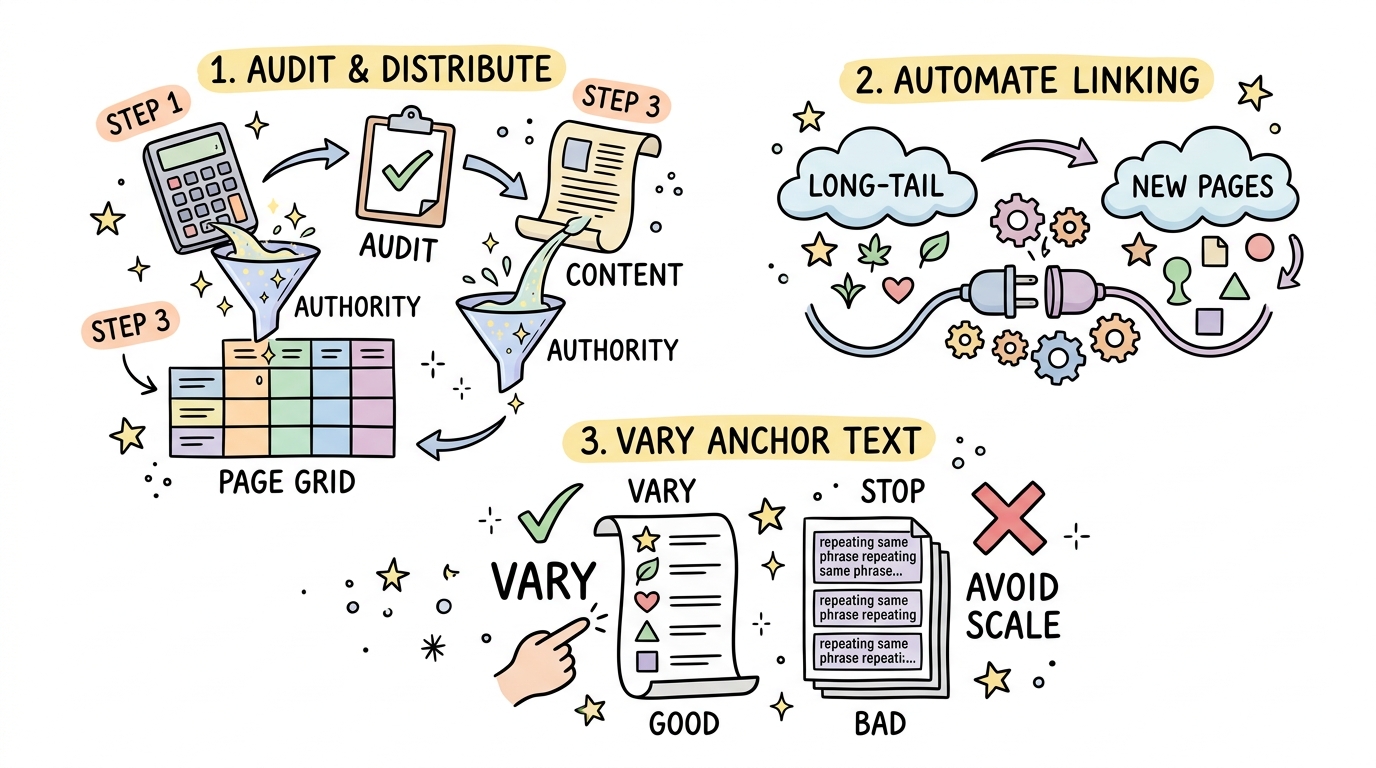
Audit your internal links to move juice from high-authority assets like calculators or research reports. Use a grid of diversified template types to cover all long-tail search intents.
- Integration Pages: Map
[App A] + [App B] workflows using tools like Zapier or n8n.
- Alternative Pages: Target high-intent users looking to switch from a major competitor.
- Comparison Tables: Provide the side-by-side matrices that users crave for decision-making.
- ROI Tools: Build interactive calculators that earn the links your comparison pages cannot.
Avoid over-optimizing your anchor text when doing this at scale. Use a mix of branded, descriptive, and generic anchors to keep the link profile looking natural to the algorithm.
Comparing Framework Efficiency: Manual vs. Programmatic
From Handcrafted Posts to an AI SEO Factory
Winning in 2026 is about providing the most friction-free path from a search query to a product demo. The era of the handcrafted, 2,000-word fluff piece is ending for bottom-of-funnel keywords.
Your goal is to build a factory that produces high-value, data-rich comparison pages at scale. Focus on the technical foundation: structured data, AI-driven burstiness, and robust schema.
Experience and unique insight are the only signals that cannot be faked. If you build a system that respects those signals, you will dominate the AI search results. Start with your 50-page pilot batch this week.
Programmatic SaaS SEO: Frequently Asked Questions
How do I avoid the March 2026 content abuse penalty?
Avoid mass-publishing low-quality templates with only brand name changes. Ensure each page has at least 8-15 unique data columns and uses AI humanization to create structural variety.
Can I use scraped data for programmatic reviews?
You can, but it is risky for long-term rankings. If you use public data, you must enrich it with unique sentiment analysis or live pricing APIs to provide value beyond what is already indexed.
How many data columns do I need for a good comparison page?
Aim for 8 to 15 unique data columns per entity. This includes pricing, specific feature sets, user sentiment, and technical specifications like API availability.
What is the most important schema for SaaS reviews?
SoftwareApplication is the core requirement. You should also layer on Review schema for star ratings and FAQ schema to capture more real estate in search results and AI Overviews.
 Kitful