BlogSurviving the 2026 Site Reputation Abuse Policy: A Compliance Guide for Scaled Publishers
Surviving the 2026 Site Reputation Abuse Policy: A Compliance Guide for Scaled Publishers
Google's 2026 update to site reputation abuse makes automated enforcement real-time. This compliance playbook provides scaled publishers and affiliate networks with actionable blueprints to bulletproof their technical SEO infrastructure and survive algorithmic sweeps.
•11 min read
The digital landscape shifted overnight when several major publishers watched their search rankings vanish. During the penalty sweeps of late 2025 and early 2026, the consequences of hosting non-endemic reviews became painfully clear. For instance, Cointelegraph saw its organic clicks collapse from 4 million monthly visits to roughly 75,000. The culprit was a subdirectory filled with third-party casino and iGaming reviews. Many scaled publishers believed they could bypass these penalties through white-label agreements or licensed partnerships. They were wrong. Google has made its stance unequivocal (the editorial oversight loophole is officially dead). If you publish third-party content solely to exploit your domain's hard-earned authority, the search algorithms will find you. Traditional parasite SEO can no longer survive behind a thin veil of licensing. To protect your business, you must transition to a system of total structural compliance. This playbook outlines how to rebuild your footprint and bypass automated sweeps without sacrificing programmatic revenue.
Executive Summary: The 2026 Rules of Engagement
Managing a large digital portfolio in 2026 requires an immediate adjustment to your publishing standards. Google's real-time detection systems now flag manipulative setups automatically.
Here is a summary of the compliance baseline you must implement immediately:
No exemptions exist for licensed or white-labeled content if the primary purpose is to hijack your domain authority.
Automated systems like SpamBrain now execute real-time algorithmic enforcement, rendering manual review loops obsolete.
Total compliance requires removing high-risk directories entirely or applying strict noindex, nofollow protocols to partner sections.
Traditional search optimization and generative search engine criteria have merged, making sitewide compliance mandatory.
For a detailed look at how these algorithmic sweeps are wiping out established domains, watch this analysis of the recent updates.
You must understand these changes to protect your organic traffic.
What Is the Google Site Reputation Abuse Policy 2026?
Google defines Site Reputation Abuse as the practice of publishing third-party content on an authoritative host domain to hijack its established ranking signals for unrelated or low-quality content. This tactic, often called parasite SEO, stands in contrast to Scaled Content Abuse, which focuses on mass-producing thin, low-value pages across a domain to manipulate search rankings.
To address these issues, Google deployed real-time automated updates that changed the ecosystem. The search engine updated its systems to target parasitic directories automatically, closing the popular editorial oversight loophole in late 2024. Publishers can no longer argue that they reviewed, edited, or licensed the third-party sections to keep them compliant. If the content is fundamentally disconnected from the host's primary purpose, Google classifies it as spam.
According to Google's Site Reputation Abuse Policy Update, no level of human involvement or white-label ownership alters this core exploitative nature. This structural change was part of a larger cleanup. According to the Google Spam Policies documentation, the search engine has focused heavily on reducing unoriginal content.
45% reduction in unhelpful, unoriginal search results achieved by Google following its March 2024 Core Update rollout.
The automation of these sweeps means penalties occur instantly. Algorithmic systems like SpamBrain identify unrelated directories without waiting for human review teams to intervene.
Pitfall: Believing that a signed contract or a small disclaimer on a partner page will protect your domain from a site reputation abuse manual action.
The EU Commission DMA Investigation: Why Google's Rules Face Antitrust Friction
The conflict between search quality enforcement and publisher revenue has triggered official legal friction. The European Commission is investigating whether Google's site reputation abuse penalties unfairly impact legitimate digital publisher commercial partnerships.
This investigation highlights a deep regulatory friction. On one side, Google must maintain search quality by filtering out low-value content. On the other side, publishers argue that these abrupt algorithmic penalties harm legitimate commercial models. The European Commission launched this probe to review potential violations of Article 6(12) of the Digital Markets Act (DMA). You can read more details in the EU Commission DMA Investigation Announcement.
Because of this regulatory pressure, Google has had to reconsider how it communicates with webmasters. The search giant submitted a formal remedies proposal in mid-2026. This proposal aims to make manual action warnings and algorithmic penalty processes more transparent for EU-based news sites. Publishers may soon gain clearer diagnostic paths before their organic footprints are wiped out.
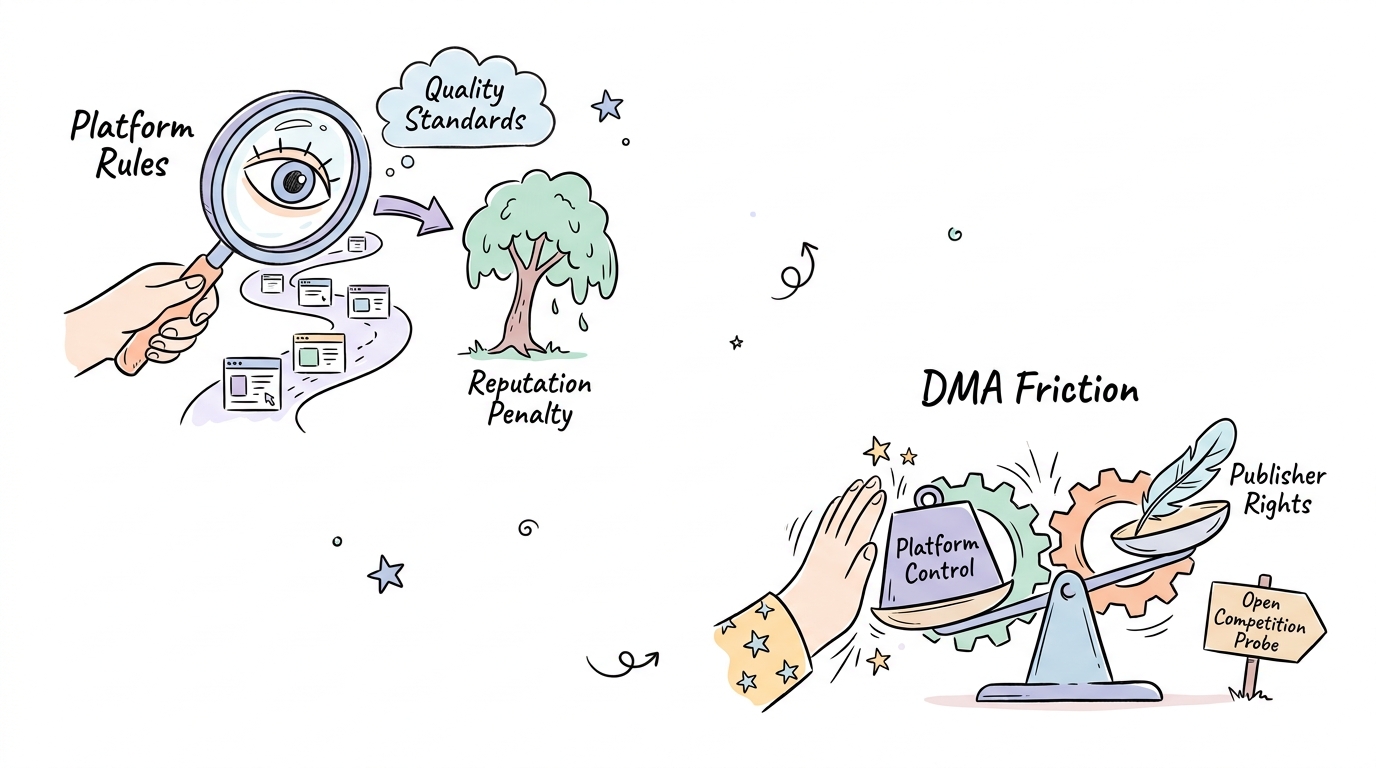
This board illustrates how the push for search quality collides directly with digital monetization rules under the DMA.
Catalog of High-Risk Violations Flagged by SpamBrain
SpamBrain actively targets specific high-risk configurations where third-party content or automated scripts are hosted on highly authoritative domains. These setups are flagged because they leverage host ranking signals rather than providing genuine value to search users.
Let's look at the primary configurations triggering immediate automated sweeps of unrelated directories:
White-Label Partner Directories (e.g. /deals/ or /coupons/)
This setup involves hosting commercial coupon or discount subdirectories without any native editorial cohesion. These pages rarely match the host site's core editorial focus and exist solely to capture transaction-intent organic traffic.
Sponsored Payday Loans or Casino Reviews on Educational/News Sites
This configuration involves placing high-commission, high-risk financial or gaming offers on highly trusted informational domains. This practice represents a major violation because the parent domain's educational authority is used to rank unrelated, high-risk commercial content.
AI-Generated Listicles from Partner CMS Integrations
This setup dynamically feeds automated, unverified content from external partners directly into subdomains or subdirectories. These feeds operate with zero native editorial oversight, generating thousands of low-quality pages that trigger automated spam filters.
This programmatic tactic generates thousands of location-specific service pages using near-identical text. Swapping basic keywords on static templates creates massive duplication, triggering scaled content abuse manual actions.
AI Generation Without Human Oversight or Named Editors
This violation involves publishing mass synthetic content without verifying claims or establishing author trust. These pages lack original research and fail to demonstrate E-E-A-T, which leaves them vulnerable to core algorithm demotions.
To navigate these structural risks safely, use these decision rules to evaluate your domain layout:
If you host sponsored coupons or affiliate reviews, then you must migrate them to a separate domain or apply strict noindex, nofollow robot tags.
If you execute AI programmatic SEO at scale, then you must ensure that every page features a unique data hook (such as original comparison tables or specific local reviews) to avoid scaled content filters.
If your pages are powered by automated partner CMS integrations, then you must enforce a similarity threshold below 40% and source data from at least three distinct primary databases.
Protecting your site requires a proactive shift from risky hosting setups to strict engineering guidelines. If you leave these subdirectories unmonitored, SpamBrain will eventually flag them.
The 4-Step Technical Audit and Compliance Protocol
Securing your website against modern spam policies requires a systematic audit of your technical architecture and editorial workflows. By establishing clear technical boundaries and content standards, you can prevent algorithmic penalties while scaling your publishing efforts.
Let's walk through the exact steps to bring your domain into full compliance:
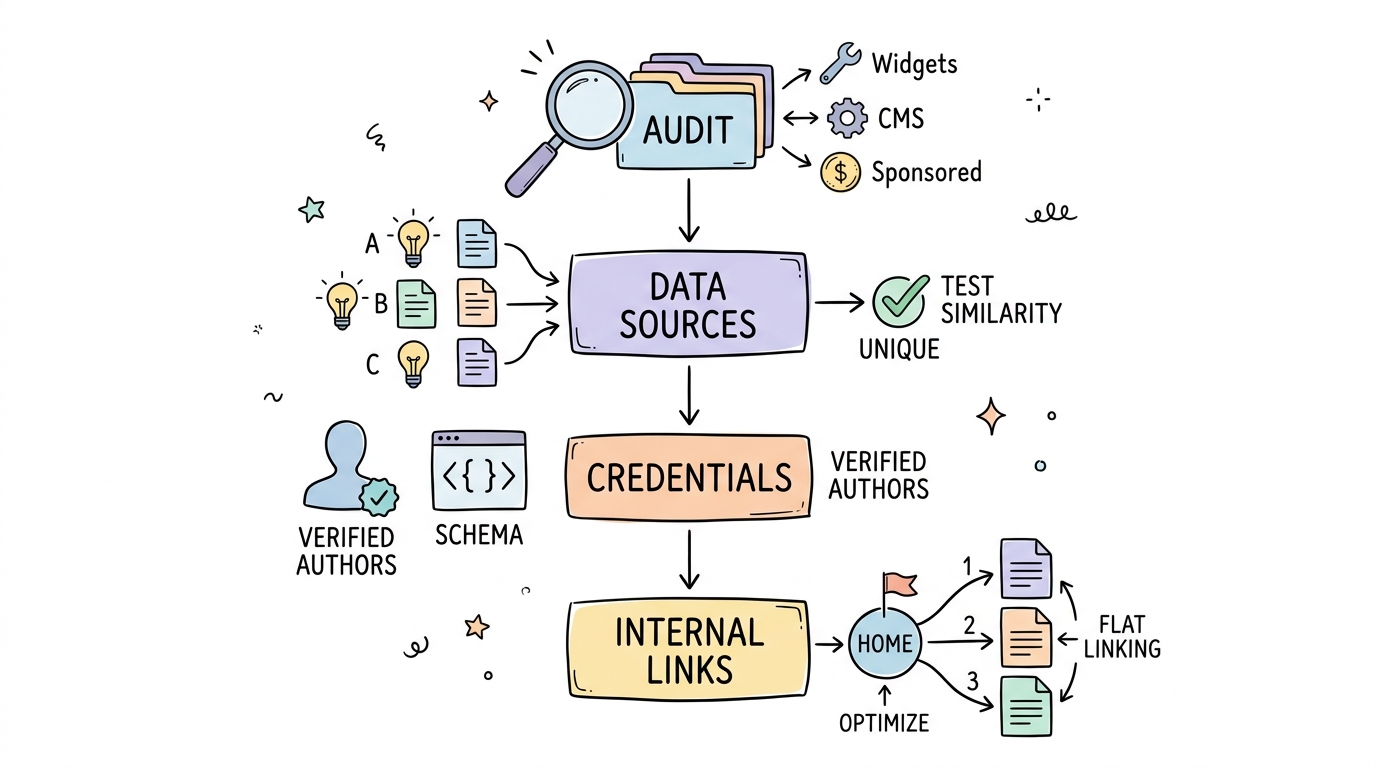
Audit all subdirectories and widgets
Perform a comprehensive content audit of all third-party subdirectories, widgets, and sponsored sections. Map your domain's directory structure to isolate third-party or programmatic segments. You must identify any external CMS integrations feeding automated content onto your subdomains.
Enforce programmatic uniqueness thresholds
If you generate programmatic pages, you must prevent duplication. Generating thousands of programmatic pages using basic keyword swaps triggers immediate scaled content abuse filters. Ensure your page similarity remains under 40% and that each page offers a truly unique local or structural data hook pulling from at least 3 distinct primary data sources.
Inject verified E-E-A-T signals
Implement structured trust credentials across all publishing pipelines. Include detailed author bios, named human editors, and verified links to professional social profiles. All of these credentials must be verified via JSON-LD Schema markup to help search crawlers validate author identity. This structured metadata acts as a primary trust signal for search systems. In 2026, unnamed or synthetic authors without verified profiles are highly vulnerable to manual penalties.
Optimize internal linking architecture
Establish a flat internal linking architecture to distribute page authority evenly. Create a tight topical map using the pillar-cluster model. Keep your click depth within 3 clicks of the homepage to prevent orphaned pages.
Here is a visual map of how these components work together:
To verify your setup is complete, use this compliance checklist:
Confirm that no active site reputation abuse penalties exist in Google Search Console.
Ensure all partner directories return correct noindex, nofollow HTTP headers or meta tags.
Run programmatic sections through similarity checkers to verify they exceed 60% uniqueness.
Check that every informational article has a named human editor and structured schema markup.
For publishers scaling their content safely, using advanced platforms can streamline the compliance process. You can use tools like Kitful AI to generate research-backed, humanized content with built-in compliance checks, while managing your editorial pipeline through direct WordPress or Ghost integrations.
Rule: Every piece of automated content must pass through a strict human review loop before publication.
How to Recover From a Site Reputation Abuse Penalty
Recovering from a site reputation abuse penalty requires completely purging the non-compliant content and filing a transparent, evidence-backed reconsideration request. This process proves to Google that you have permanently removed the offending material and established strict editorial safeguards.
Your first step is to locate the exact penalty details. Access the Manual Actions Report in Google Search Console to confirm if your site has been hit by a manual penalty. If the traffic drop occurred without a manual message, you are likely dealing with an automated algorithmic adjustment.
In either case, you must take immediate action. Purge the offending directories completely from your domain. Alternatively, apply sitewide noindex, nofollow HTTP headers across all partner integrations to block search crawlers.
Once the technical cleanup is complete, you must draft a formal reconsideration request. For details on how to navigate this process, consult the Google Manual Actions Report Guide. Your request must present concrete proof of the cleanup. Provide details of terminated third-party contracts and outline your newly implemented internal editorial guidelines.
Example
Consider a regional news site that hosted a white-label coupon directory in /deals/. After receiving a manual action, the team deleted the entire subdirectory and set up a 410 Gone status code. They submitted a reconsideration request showing the deleted folder structure, the terminated contract with the affiliate provider, and their updated internal review policy. The manual action was successfully revoked within ten days.
A successful recovery depends entirely on showing complete, permanent removal of the exploitative content rather than temporary fixes.
Bridging Compliance and Advanced AI SEO
Compliance with Google's site reputation abuse policies represents a crucial foundation for modern artificial intelligence search optimization. Generative AI engines look for the same structural trust and verified E-E-A-T signals that traditional search algorithms favor to filter out information pollution.
Traditional search and generative search optimization are converging. Large language models require structured, highly verified content to cite your brand as an authority. However, simply injecting technical metadata is not enough.
According to the Ahrefs Schema AI Citation Study, schema markup alone barely moves AI citations unless coupled with deep domain authority and original, verified research. This research highlights that metadata acts as an analytical layer rather than a shortcut. You must prioritize content depth first.
To optimize for these evolving platforms, refer to the Google AI Optimization Guide to align your metadata with modern LLM retrieval standards. Verify your authorship entities, maintain high factual accuracy, and build deep topical clusters. By securing your domain against thin, third-party content, you protect the authority that generative engines rely on.
This matters because search and answer engines increasingly share a unified technical framework. When you clean up risky directories and build clear, human-vetted content structures, you are optimizing for all modern search channels at once.
Frequently Asked Questions
What is Google's Site Reputation Abuse policy?
This enforcement standard targets the practice of hosting third-party content on a trusted domain to exploit its ranking power. Google classifies this as search spam when the hosted content is unrelated to the host site's core purpose.
Does editorial oversight exempt our site?
No, Google's policy updates explicitly closed this loophole. Licensing agreements, white-label ownership, and minor human edits will not prevent your site from being penalized if the underlying content remains exploitative.
How do I clear a manual action?
You must completely remove the non-compliant directories or apply robust noindex rules to prevent search crawling. Once the cleanup is complete, you must file a targeted reconsideration request in Google Search Console presenting clear proof of the changes.
Can I keep sponsored content if it is highly relevant?
Yes, but you must monitor it closely. If the sponsored section operates with zero editorial control and exists solely to capture search traffic for third-party commercial gains, it remains a high-risk target for automated sweeps.
Securing Your Digital Footprint for the AI Era
Securing your digital footprint against site reputation abuse is a strategic necessity for long-term survival in the generative search era. The publishers who dominate future search rankings will be those who guard their topical authority with absolute discipline.
Maintaining clean directories and enforcing strict editorial standards is no longer just about avoiding search penalties. It is about establishing the core domain trust that both traditional search engines and AI engines demand.
Take the steps to clean up your subdirectories today. By eliminating high-risk partner configurations, you protect your organic visibility and secure your site's competitive advantage. The future of search belongs to publishers who prioritize depth and compliance.
 Kitful