BlogThe 30-Day Automated Pipeline: How to Bulk Schedule AI Articles Across Multiple CMS Platforms
The 30-Day Automated Pipeline: How to Bulk Schedule AI Articles Across Multiple CMS Platforms
Scaling content in 2026 requires more than a simple API call. This technical playbook outlines a robust 30-day pipeline to generate, format, and bulk-schedule 1,000+ highly unique AI articles safely.
•15 min read
It happened overnight.
In late March 2026, thousands of high-volume programmatic blogs vanished from Google search results. Entire networks that had enjoyed steady organic traffic for years saw their impressions drop to zero.
The reason was simple. Google launched its March 2026 spam and core updates, rewriting the rules of automated publishing.
Many publishers realized too late that simply exporting raw LLM outputs to a CMS is a recipe for algorithmic deletion. In this new landscape, factual errors are the new thin content.
Penalties for inaccuracy now far exceed the risks associated with shorter, more concise articles.
If you want to scale content in 2026, you cannot rely on old template-swapping methods. Modern automated pipelines must prioritize deep informational differentiation over simple page count. The goal is no longer just publishing volume, but building a robust, highly curated 30-day automated queue that functions with strict editorial safeguards.
To succeed with programmatic SEO today, you must treat your automated queue like a software engineering pipeline. The winners in this landscape will be teams that seamlessly combine automation with editorial judgment, search intent mapping, and channel-specific optimization.
Here is your core execution checklist for the next 30 days:
Establish multi-source database connections to guarantee high-entropy page data.
Implement a multi-stage LLM generation workflow that separates drafting from fact-checking.
Set up a paced publishing queue that limits daily outputs to 100 or 200 pages.
Validate your structured JSON-LD entity schema before pushing content live.
Automate semantic internal linking across your target page silos to distribute authority.
What is Google's Core Position on Mass Content Production?
Google is not banning AI content outright.
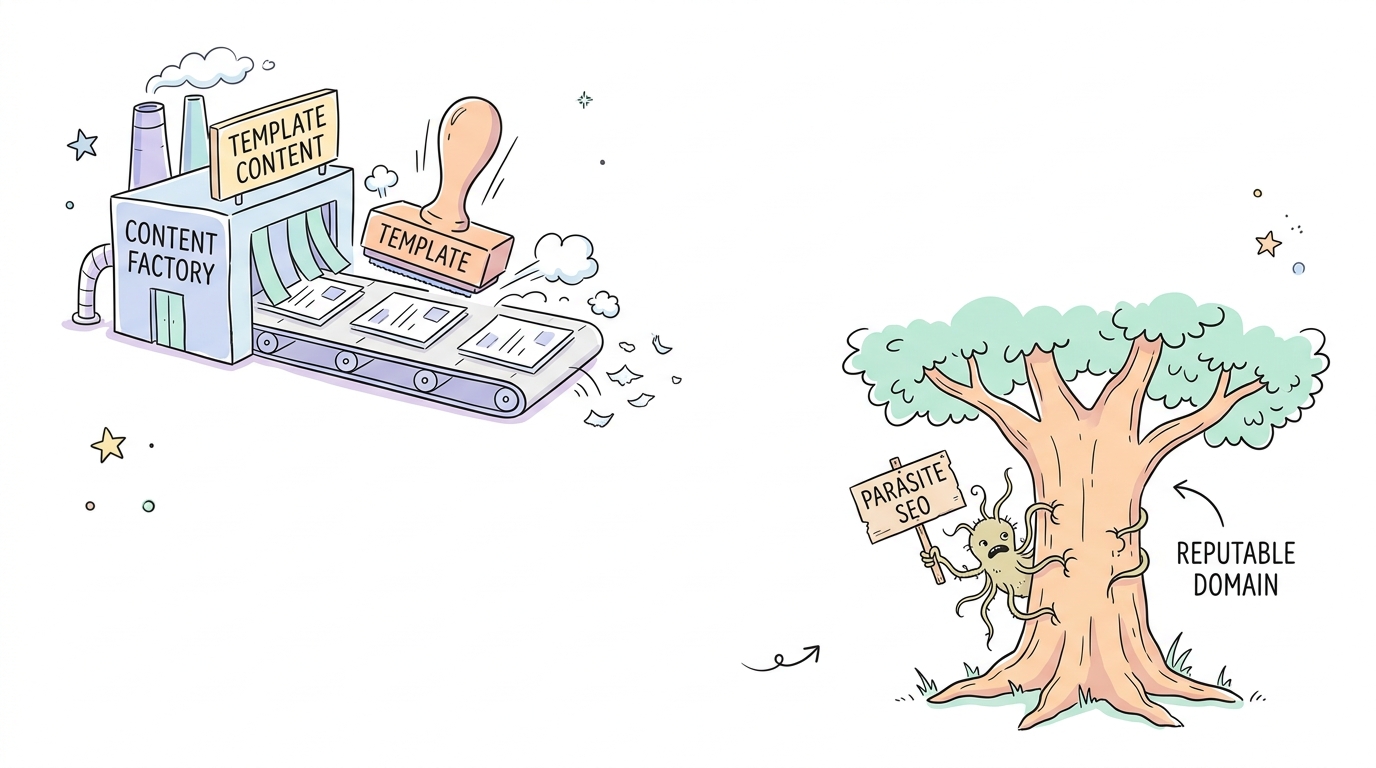
Instead, the search engine is aggressively targeting scaled content abuse, which refers to the mass production of low-quality, template-swapped, or repetitive pages designed primarily to manipulate rankings. In March 2026, Google executed a deliberate, two-phase algorithmic sweep.
Search analyst Roger Montti observed that Google's spam-then-core rollout in late March 2026 was a highly structured process, designed to knock away artificial props before evaluating true content quality.
The initial Spam Update launched on March 24, 2026, completing its rollout in under 20 hours to penalize scaled content abuse and active link schemes. Immediately following, the Core Update launched on March 27, 2026, running for 12 days before finishing on April 8, 2026, to re-evaluate overall semantic quality and authority.
At the same time, Google clamped down on site reputation abuse, which is the practice where third parties publish low-value content on highly reputable host domains (like coupon subfolders on major news publisher sites) to ride on those domains' established search authority.
Here is a video walkthrough explaining the strategic shift required to succeed with programmatic campaigns under these strict guidelines:
To protect your site from getting caught in these automated filters, you must understand the exact differences between these updates and how they evaluate your published assets.
Here is a real scenario: An affiliate manager running a network of finance sites woke up to find their organic traffic down 85% because they relied on a single database API that printed identical product features across 5,000 pages. This is a direct consequence of Google's rapid March 24, 2026 sweep against scaled content.
To avoid this fate, you must run your scaling efforts through strict structural filters. Use these decision rules to evaluate your programmatic campaigns:
If your content relies on simple keyword swaps without distinct secondary database sources, then pause generation to inject at least two new unique API feeds.
If you are hit by a Spam Update penalty, then immediately remove or consolidate low-value assets and request a manual review where applicable.
If your site experiences a Core Update drop, then focus on improving your overall E-E-A-T signals and information gain over a multi-month recovery cycle.
For those seeking to align their strategies with these strict standards, referencing Google's Spam Policies for Web Search is a critical step in understanding the precise boundaries of automated creation. Additionally, staying informed on the Google Site Reputation Abuse Policy Update will help you protect your subdirectories and partner domains.
Step 1: Architecting Your Multi-Stage Generation Pipeline
A secure pipeline requires modular isolation.
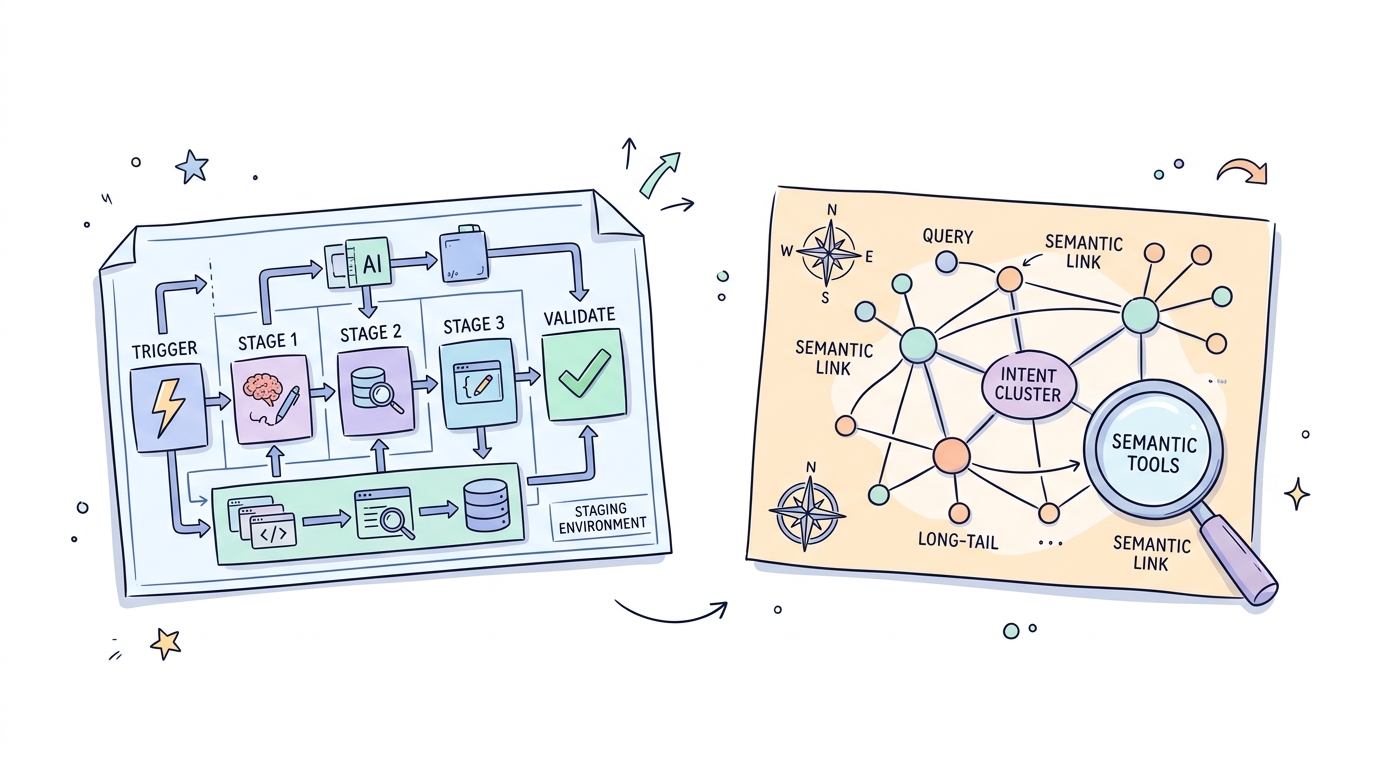
You cannot build a scalable system by sending a list of keywords to a single prompt and expecting high-quality outputs. You must architect a multi-stage production pipeline that decouples drafting, fact-checking, and optimization into distinct, sequential API steps.
Before writing a single prompt, make sure you have the following prerequisites in place:
API keys to leading large language models (such as Claude, OpenAI, or DeepSeek) supporting sequential bulk generation.
A structured database or multi-source spreadsheet containing verified, unique local or industry metrics.
A CMS with headless support or REST API access, such as WordPress, Webflow, or Shopify.
An automated JSON-LD schema generator and access to Google's Rich Results validation suite.
A staging environment to test formatting, script rendering, and link placements before pushing live.
Once these prerequisites are met, construct your multi-stage pipeline. The first stage handles the initial draft, the second stage verifies all data points against your database, the third stage expands E-E-A-T signals by integrating external authoritative citations, and the fourth stage adjusts the tone to disrupt predictable machine rhythms.
Consider this scenario: A SaaS founder attempting to build local landing pages with zero quality assurance publishes 2,000 pages where the placeholder [City Name] fails to render on 400 of them, causing Google's automated systems to instantly classify the entire directory as scaled content abuse.
To avoid this, you can deploy a simple automated script to handle the multi-stage logic and run validation checks before scheduling. Here is a basic Python blueprint for calling your multi-stage API pipeline:
# pipeline_execution.py
import os
import requests

def generate_draft(prompt_data):
    # Stage 1: Call primary LLM to draft content structure
    response = requests.post(
        "https://api.openai.com/v1/chat/completions",
        headers={"Authorization": f"Bearer {os.environ.get('OPENAI_API_KEY')}"},
        json={
            "model": "gpt-4o",
            "messages": [{"role": "user", "content": f"Draft article for: {prompt_data}"}]
        }
    )
    return response.json()['choices'][0]['message']['content']

def validate_content(draft_text, verification_metrics):
    # Stage 2: Cross-reference facts and check uniqueness criteria
    if len(draft_text) < 500 or any(metric not in draft_text for metric in verification_metrics):
        return False
    return True

# Example execution
draft = generate_draft("Best accounting practices for startups in Austin")
is_valid = validate_content(draft, ["Austin", "Texas", "tax rate"])
print(f"Validation Status: {is_valid}")
To keep your system running safely, establish these validation steps in your production routine:
Map out your target long-tail intent clusters using semantic tools, avoiding simple keyword volume matching.
Design structural templates with high variability, utilizing three to five intro variants, dynamic data tables, and custom interactive modules to ensure at least a 60% uniqueness ratio per page.
Deploy an automated quality assurance validation layer checking each page's unique data points and complete field parameters before publishing.
How Do You Programmatically Bypass 2026 AI Content Detectors?
AI detectors search for mathematical uniformity.
To programmatically bypass AI content detectors in 2026, you must disrupt the predictable structural rhythms, low entropy, and uniform sentence lengths inherent to raw LLM outputs. Modern AI detectors do not read your text like a person. They measure structural entropy, perplexity, and sentence length distributions rather than flagging individual words.
Writers and industry researchers emphasize that detectors look for highly predictable transitions and uniform patterns. If your content is failing AI detection filters, you must strip mechanical transitions and intentionally vary sentence lengths to mimic human writing textures. Human writers naturally utilize diverse sentence lengths, break logical patterns, and insert sudden context.
Tip: You can use programmatic regex patterns or system prompts to automatically strip robotic transitions like "Furthermore," "In conclusion," "Moreover," and "As a result" from your final text before it reaches your CMS database.
To see this in action, compare how a machine generates a paragraph versus how a programmatically adjusted humanized output looks.
Example
Predictable Machine Output:
"Furthermore, implementing a cloud-based accounting system is essential for startups. As a result, companies can access financial data in real-time, which significantly improves operational efficiency. Moreover, this transition ensures long-term scalability."
High-Entropy Adjusted Output:
"Startups need cloud accounting. Without real-time financial tracking, you are operating in the dark. Moving your ledger to the cloud is not just about staying organized, it is about keeping your business alive when cash gets tight."
By setting system instructions that forbid list-like transitional words and demand a standard deviation of sentence lengths between 5 and 25 words, you create content that easily bypasses pattern-recognition filters.
Step 2: Structuring Entity-Rich Schema for Generative Search
To optimize your programmatic pages for 2026, you must prioritize Generative Engine Optimization (GEO) by feeding search engines highly structured, machine-readable JSON-LD schema that clarifies identity, relationships, and authority. Writers and SEOs are shifting away from short-term optimization hacks to durable machine-readability investments. This includes validating custom JSON-LD schema to make it easy for AI agents and Overviews to cite your brand.
Rule: Never push a programmatic page live without validating its schema through Google's Rich Results validation suite to prevent crawler entity mapping failures.
You can easily automate the generation of these schema blocks using the SuperSchema AI Generator and map them to your content database. This process ensures that Gemini, Claude, and Perplexity can associate your content with established real-world entities. This strategy directly aligns with Google's Guide to Generative AI Search Optimization, which emphasizes structured machine readability over unstructured keyword optimization.
Here is a template for the exact structured JSON-LD you should programmatically inject into the HTML header of each generated article page:
Step 3: Scheduling Paced Wave Releases and Injecting Interlinking
Paced publishing prevents algorithmic red flags.
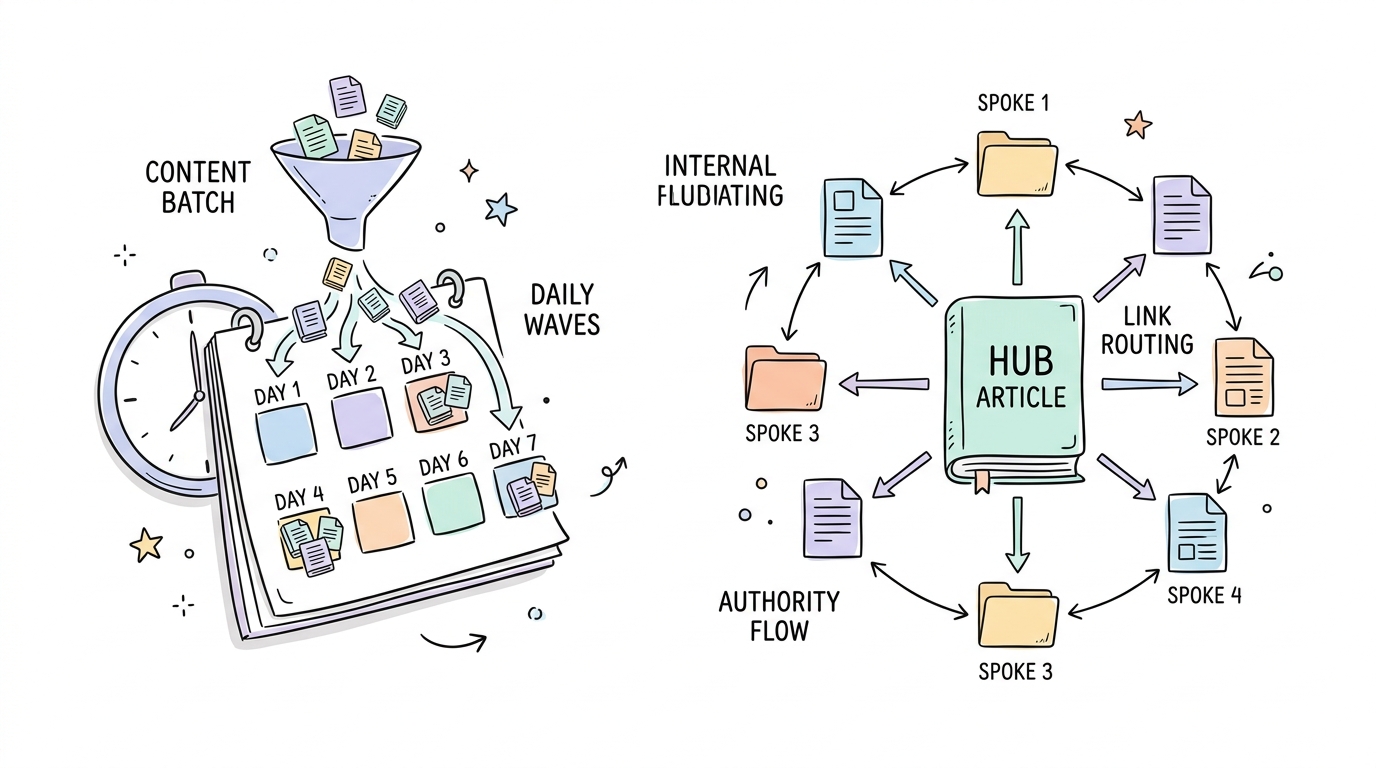
You must never dump thousands of newly generated pages onto your CMS in a single batch, because doing so instantly triggers Google's automated scaled content abuse filters and causes search crawlers to ignore your site. Instead, you need to establish direct API publishing connections to WordPress, Shopify, or your headless CMS, scheduling outputs in paced daily waves of 100 to 200 pages. This paced approach mimics natural growth and gives search engines time to index your pages without overloading your server.
82% of websites miss internal linking opportunities, leaving significant organic search traffic uncaptured.
When you schedule your articles, you must simultaneously inject automated, semantic internal links to pass link equity and build strong topical authority. Statistics show a 40% increase in organic keyword rankings when internal link architecture is semantically aligned with topic clusters. This step is critical because failing to link your programmatic pages leaves them isolated, making it impossible for Google crawlers and LLM indexing models to discover them.
Consider this scenario: An e-commerce brand manager pushes 3,500 new product variations to Shopify in a single afternoon, triggering a hosting rate-limit block and an immediate manual review flag on Google Search Console for sudden spammy publication patterns.
To ensure your scheduled releases pass authority smoothly and avoid server issues, implement this staging list:
Limit your daily publish volume to 100 or 200 pages to avoid triggering search engine alerts.
Integrate a semantic internal linking tool such as Link Insight or BlogHunter to connect new pages to your existing pillar posts.
Monitor your Google Search Console indexation status using an initial test batch of 10 to 20 pages before activating the full bulk pipeline.
Check for broken redirects and clean up orphans weekly to keep your site architecture pristine.
Top AI Tools to Scale Your Bulk Scheduling Safely
When we scale programmatic content, choosing the right stack makes the difference between manual exhaustion and streamlined ranking growth. Here is a quick reference scorecard of the top-performing platforms in the automated space:
Tool Name
Core Category
Best For
Platform Support
Kitful AI
Bulk Generation
All-in-one automated blogging
WordPress, Shopify, Webhooks
Keytomic
Programmatic API
Enterprise headless pipelines
Custom CMS, Headless APIs
KoalaWriter
One-Click Engine
Rapid affiliate article generation
WordPress, Shopify
Link Insight (ESP)
AI Internal Linking
Semantic entity structure
Universal
Below is our comprehensive directory of specialized tools for programmatic generation, advanced AI internal linking, and content validation.
1. KoalaWriter
This one-click SEO engine converts keyword lists into bulk articles. It is ideal for rapid generation runs.
2. Jasper
An enterprise platform built for massive product catalogs. It handles complex brand guidelines and vast SKU variations easily.
3. Frase
A deep mapping tool that helps design structured templates. It ensures your programmatic outputs align with actual search intent.
4. Link Insight (ESP)
A fully automated platform for internal linking. It analyzes semantic relationships to build logical entity networks across your site.
5. LinkWhisper
A semi-automatic internal link builder tailored for WordPress and Shopify. It offers smart in-dashboard suggestions to speed up editing.
6. LinkBoss
A semantic interlinking engine that supports WordPress, Shopify, and custom CMS platforms. It fully automates the anchor text process.
7. BlogHunter
An AI-driven blog automation tool. It analyzes your existing site content relevance to optimize internal structures and schedule updates.
8. Kitful AI
A unified platform for automated bulk generation. It features built-in humanization, multi-CMS scheduling, and support for over 50 languages.
9. Keytomic
An API-first programmatic platform designed for developers. It connects structured databases directly to headless CMS environments.
10. SEOmatic
A no-code programmatic page builder. It is ideal for launching thousands of highly targeted landing pages without touching code.
11. Super Schema
An AEO-optimized schema builder. It generates validated JSON-LD markup to help search agents understand your entity relationships.
12. GPTZero
A validator that flags predictability patterns. Use it to check if your bulk content exhibits raw LLM rhythms.
13. Originality.ai
A robust detection tool that analyzes structural entropy. It helps you identify repetitive sentence lengths before you publish.
14. Paperpal
An academic-grade proofing utility. It highlights factual inconsistencies, which is a critical step for modern quality assurance.
15. Sight AI
A bulk generation tracking tool. It monitors content metrics and logs API output runs across large production batches.
16. eesel Blog Writer Agent
An autonomous queue manager that executes your publishing schedule. It handles background pipeline tasks without manual intervention.
17. Custom Webhook Integrator
A generic routing system. It transfers structured content payload from your generation databases to your live web hosting servers.
18. Low-Code Workflow Automation
Visual workflow managers like n8n or Zapier. They serve as the glue connecting database layers to content generation APIs.
19. Structured Database Mapper
A spreadsheet or database link. It stores programmatic inputs, local metrics, and unique variables for template population.
20. Headless CMS Gateway
High-speed publishing endpoints that deploy static pages. They process hundreds of programmatic draft updates instantly.
21. Rich Results Validator
A testing script utility. It checks structural schemas to ensure search engines parse authors, products, and FAQs correctly.
22. Semantic Clustering Tool
An architecture planner. It groups long-tail keywords into coherent topical clusters, preventing thin content overlap penalties.
23. Dynamic Table Generator
A component builder. It injects unique structured tables into template files, boosting on-page information gain metrics.
24. HTML Purifier
An API-driven markdown translator. It cleans up raw model outputs to ensure clean, semantic HTML code for CMS imports.
25. Anchor Text Planner
An optimization tool. It maps target destination URLs to relevant keywords, distributing link equity evenly across new clusters.
26. Alt-Tag Injector
An automated metadata helper. It writes contextual descriptions for your programmatic images, ensuring complete search indexation.
27. Readability Tester
A sentence variation analyzer. It checks the diversity of your writing, helping you avoid robotic, uniform text.
28. Localization Engine
A translation interface. It scales your programmatic templates across international markets using context-aware translation tools.
29. Paced Scheduler
A publication throttling tool. It spaces out your bulk drafts, publishing articles in steady daily waves of 100 to 200 pages.
30. Indexation API Client
A Google Search Console utility. It submits newly scheduled links in real-time, speeding up discovery and search crawl rates.
As search engines and AI models evolve, operators must continuously adapt their programmatic setups to stay compliant and visible.
How did Google's March 2026 core update affect scaled AI content?
Google's March 2026 core update aggressively targeted scaled content abuse, which is the mass production of low-quality, template-swapped, or repetitive pages designed primarily to manipulate rankings. While AI-assisted writing itself is not banned, sites that published thousands of raw, unedited AI articles lacking original research or first-party information gain saw immediate traffic drops of 60% to 90%. Success today requires combining high-quality API data with human editorial oversight to ensure every page provides genuine value.
What is Google's Site Reputation Abuse policy in 2026?
Site reputation abuse, often called parasite SEO, is the tactic where third parties publish low-value content on highly reputable host domains, like coupon subfolders on major news publisher sites, to ride on those domains' established search authority. Google has updated its policy and automated penalties to enforce against this. In 2026, the European Commission is actively investigating whether Google's enforcement policies comply with the Digital Markets Act (DMA).
Why does schema markup matter for AI search and GEO in 2026?
Structured schema, such as Organization, Person, Article, and Product JSON-LD, provides clear machine-readable context about entities, relationships, and authors. In 2026, generative search engines and AI agents use this data to map site authority, establish E-E-A-T credentials, and categorize data quickly without having to parse unstructured page copy, significantly increasing citation chances in AI Overviews and chat answers.
How do AI detectors identify content, and how do you bypass them?
Modern AI detectors scan for statistical regularity. They track uniform sentence lengths, steady rhythmic structures, and predictable transitions. To bypass them, you must break these patterns by varying sentence lengths dramatically, removing corporate jargon, eliminating mechanical transitions like "Furthermore" and "As a result", and injecting emotional texture or first-person human perspectives.
Mastering the Automated Content Queue
The era of low-effort automation is over.
Building a sustainable programmatic SEO system in 2026 requires moving past simple keyword-swapping templates. The future belongs to operators who treat AI as a robust generation engine and build sophisticated automated workflows around verification, rich entity schema, and semantic authority.
In 2026, the best internal linking strategy is one built on deliberate topical structure, not intuition. By pacing your releases, humanizing your output patterns, and ensuring that every page pulls from diverse, high-quality data feeds, you can scale safely without triggering automated search penalties.
The winners will be teams that combine automation with editorial judgment, search intent mapping, and channel-specific optimization. Your next step is to evaluate your current database sources and set up a multi-stage validation script to secure your content pipeline for the years ahead.
 Kitful